








Robert Coover
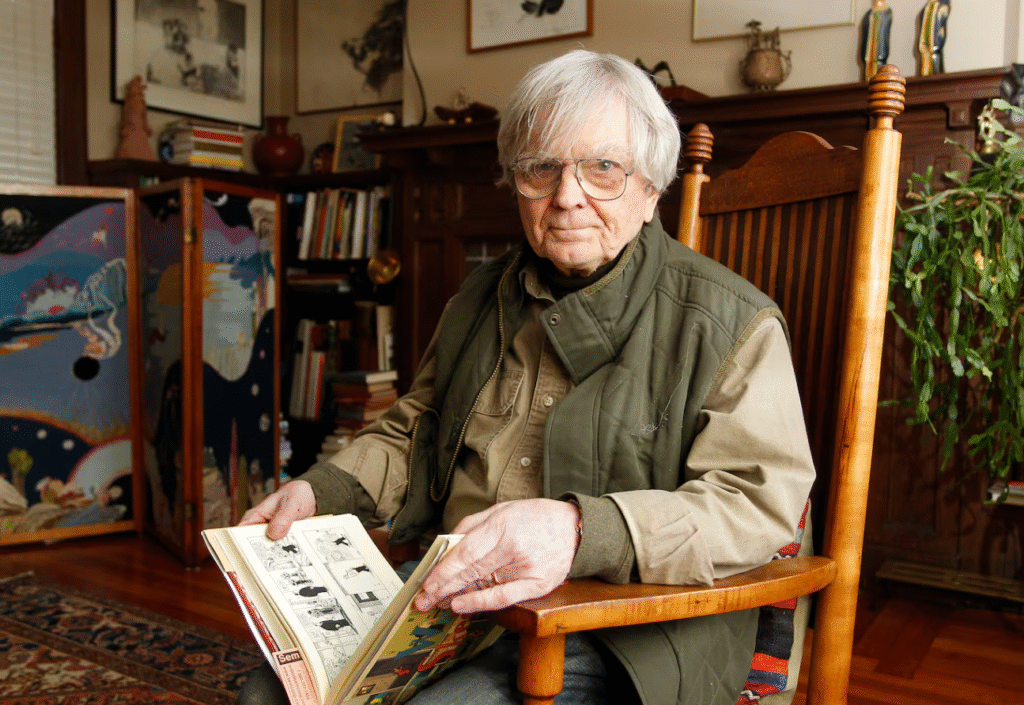
NEW YORK (AP) — Robert Coover, the exuberant and rule-defying fiction writer and educator who devised new adventures for literature through such works as “The Babysitter” and “The Public Burning” and through his decades on the faculty of Brown University, has died. He was 92.
Coover died surrounded by family on Saturday at a care home in Warwick, England, his daughter Sara Caldwell told The Associated Press on Sunday. Caldwell, an author and filmmaker, said he had been in declining health in recent months.
The writer T.C. Boyle said on X that Coover had been “a friend and mentor to me since I was in my early twenties. His first collection, ‘Pricksongs and Descants,’ opened up a new world for me.”
Coover was often grouped with William Gass, John Barth and other authors of post-modern or “meta-fiction” of the 1960s and ‘70s. They challenged and sometimes bludgeoned conventional storytelling and grammar, whether through experiments with language, the parody of fairy tales, mysteries and other literary genres or the self-conscious exploration of the writing process. Coover’s trademarks included macabre humor, graphic sex, broad takes on everything from baseball to small towns and an encyclopedic range of cultural references.
“Robert Coover writes from life, but not the one he has lived out in the world,” author Ben Marcus once wrote of him. “He writes from his life as a reader of narratives. His personal experience, which he draws on for his work, is the experience he has had inside of texts. He did not grow up in Iowa, but in Ovid’s ‘Metamorphoses.’ He did not suffer first love in the mid-west of America, but inside the Greek myths, or Aesop’s fables, or ‘The Decameron.’”
Rarely without something to say, he wrote dozens of novels, stories and plays. His notable works included “The Babysitter,” in which a night out for the parents multiplies into a funhouse of alternative realities; “You Must Remember This,” an X-rated imagining of the leads in “Casablanca,” and the novel “Huck Out West,” in which Coover continued the adventures of Mark Twain’s Huckleberry Finn.
“A lesson I learned from reading (Thomas Pynchon’s) ‘V’ has stuck with me all my life: All my work is basically comic,” he told the Boston Globe in 2014. “That’s the only thing I have ever written. Even though they’re not always viewed as such, the books are all meant as comic works.”
Coover’s most controversial work was the 1977 novel “The Public Burning,” a warp-speed satire of the 1953 executions of convicted communist spies Julius and Ethel Rosenberg that publishers hesitated to take on for fear of legal action by Richard Nixon, Roy Cohn and other then still-living historical figures who appear in the book. Coover alternated chapters about the Rosenbergs with the thoughts of then-Vice President Nixon, who laments his subservient role in the Eisenhower administration and confides to a growing sexual attraction between himself and Ethel Rosenberg.
“I was Eisenhower’s salesman in the Cloakrooms, that was my job,” Coover’s Nixon explains. “I was the political broker between the patsies and the Neanderthals, I had to cool the barnburners, soften up the hardshells, keep the hunkers and cowboys in line, mollify the soreheads and baby tinhorn egos. I was the flak runner, the wheelhorse, I had to mend the fences and bind up the wounds.”
Coover’s influence was on the page and in the classroom. At Brown, where he was on the faculty from 1981 to 2012, those he taught included Rick Moody and Sam Lipsyte. Coover and such fellow professors as John Hawkes inspired students to experiment and break away from the kind of spare, realistic style — as exemplified by Ernest Hemingway — that was the standard in mainstream American fiction.
For Coover, anything seemed possible. He was an early believer that the written word could be integrated with music and film and digital technology and championed what he called “Cave Writing,” which included placing students in a virtual reality simulator. Before e-books were widely available, he helped found “electronic literature,” storytelling designed specifically for digital devices.
