



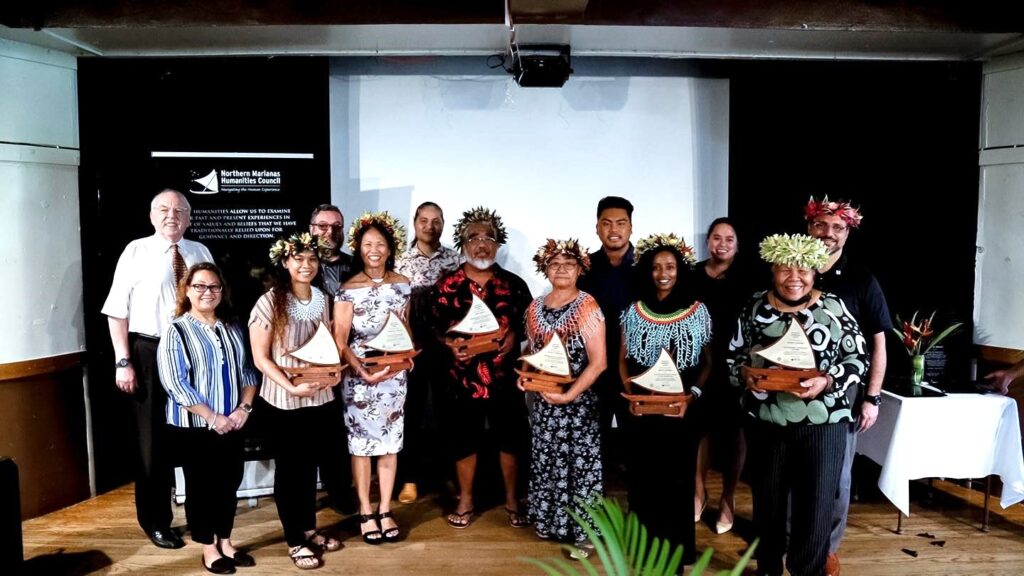
LOCAL cultural practitioners and scholars received this year’s Governor’s Humanities Award which is given to individuals who have made outstanding contributions to the civic and cultural vitality of the CNMI.
The 2022 awardees are Frances Manibusan Sablan, Mario Benito, Sofia Quitugua Tomokane, Beylul Solomon, April Quiambao Repeki, and Gloria Saralu Rasiang.
Frances M. Sablan received the Lifetime Achievement Award for her “ongoing and steadfast commitment to revitalizing, teaching, and leading Chamorro dance and language activities since…1978.”
“She was the founder of several Chamorro dance groups and contributed to several published and soon-to-be published works written in the Chamorro language,” the Humanities Council stated in a press release.
Sablan has served as president of the Pacific Islands Bilingual Bicultural Association, co-host of the Programan I Taitano-at Talk Show, a Saipan Tribune Chamorro language columnist, and a member of the Chamorro Dictionary Revision Group. She continues to serve as a Friends of the Marianas-Project H.O.P.E. ocean elder, a Chamolinian Cultural Village Inc. board member, and as a Chamorro dance teacher and cultural practitioner.
Sablan is also the recipient of the 2006 Governor’s Humanities Award for the Preservation of Traditional Cultural Practices.
Traditional canoe builder
Mario Benito, a traditional canoe builder and master navigator of the Houlpolowat clan, received the Preservation of Traditional Cultural Practices Award for “his enduring role in the community as a traditional canoe builder, teacher, and voyager, enriching our community and strengthening our cultural identity through the Cultural Maritime Training Center’s ‘traditional’ tracks: sailing and voyaging, in which students learn advanced open ocean sailing, and traditional navigation.”
He was elected mayor of Polowat, an atoll in the Caroline islands, and is recognized as chief of his clan and Relong, the northern half of Polowat.
Benito belongs to Utt Wenimai, Utt Wenipukuw, and Utt Hopweilol, educated in the Weriyaeng and Fenur schools of navigation, having studied under some of the most famous and revered Polowat navigators, including Hipour and Chief Manipy Rapung.
He achieved the rank of “pairoro,” or master navigator, when he received his “pwo,” from Grand Master Navigator Rainam Edward of Polowat.
Benito has joined 500 Sails to work in the boatyard, building and maintaining Chamorro canoes, conducting lessons in weaving and ropemaking using traditional materials, and is now building a Carolinian canoe named “Mikaela” using modern materials.
The canoe’s design follows that of “Mikael,” a canoe his grandfather built in Polowat.
Extensive knowledge
Local medicinal and cultural practitioner Sofia Q. Tomokane received the Preservation of Traditional Cultural Practices Award for passing down her “extensive knowledge of healing traditions to her family members, including her daughter and granddaughter who promote natural healing for birthing mothers through ‘labatorio’ or ‘sitz’ bath.”
She is commended “for perpetuating the knowledge and practice of using local medicinal plants to treat a variety of illnesses, and for sharing her knowledge of making traditional personal adornment pieces, such as the mwaar and lighatutuur.”
Her knowledge of weaving traditional necklaces was influenced by Margaret Titang, and Tomokane now serves as a cultural leader in her own family, designing unique pieces for her clan members to wear at significant events.
Author
Beylul Solomon, originally from Eritrea in East Africa, received the Research and Publications in the Humanities Award for her publication, “Indigenous Rights: A Vehicle to Address Mental Health and Academic Outcomes in the CNMI,” which is a chapter in the textbook, “Learning and Reconciliation Through Indigenous Education in Oceania,” published this year.
Her work “offers critical analysis of how the CNMI’s history has shaped current academic health outcomes, and proposes indigenous rights legislation and a new academic system” informed by local heritage as “a solution to alarming educational testing scores and suicide rate disparities in the CNMI.”
She grew up in Ethiopia and moved to the U.S. at the age of 17, eventually moving to the CNMI in 2016 to work as an instructor at Northern Marianas College.
She is an associate professor in the School of Education’s Rehabilitation and Human Services Program and principal investigator and curriculum developer for the college’s BUILD EXITO grant which allows her to provide research training to students from underrepresented backgrounds in health-related fields.
Non-classroom setting
April Q. Repeki received the Outstanding Humanities Teacher in a Non-Classroom Setting Award for her “significant contributions to the CNMI as a Chamorro and Spanish dance instructor, performer, and mentor to ‘Simiyan Marianas,’ a popular cultural dance group that performs at numerous public events representing the CNMI.”
She serves as the dance group’s manager, promoter, choreographer, instructor, and mentor.
The Humanities Council said her passion is “essential in revitalizing elements of traditional dances that were lost due to colonization.”
Repeki led the Songsong-mami project funded by the National Endowment of the Arts which provided participating dancers with immersion into the traditional seafaring culture to inform their dances.
Her choreography is currently featured weekly at Project Liffang at the Carolinian Utt.
Repeki’s role in the traditional sailing world has also identified her as an important leader in preserving traditional cultural practices.
Classroom setting
Gloria S. Rasiang, a Carolinian Language and Heritage Studies teacher at Francisco M. Sablan Middle School, received the Outstanding Humanities Teacher in a Classroom Setting Award for her “dedication in preserving and perpetuating the Carolinian language and culture as a teacher for over 25 years.”
Of Palauan, Chuukese, and Carolinian heritage, Rasiang has modeled teaching methods passed down from her mother, Delores, to include singing and integrating vocabulary words into the rhythm of her students’ favorite songs, propelling her students to place in competitions throughout the CNMI.
In her current role, she prepares students for the annual CNMI Public School System CCLHS Language and Cultural Performing Arts Competition, in which her past students have placed in various categories.
Her commitment to teaching and excellence is rooted in her sense of responsibility for preserving and perpetuating the Carolinian language and culture.
Between 2018 and 2019, she developed a script, and was filmed teaching lessons as part of the “Let’s Learn Refaluwasch” video series published by Rivera Pictures Inc.
Rasiang also wrote a book titled “Numwor e lo Ghirlandaio Filooris” to preserve the Carolinian words for flowers and villages on Saipan.
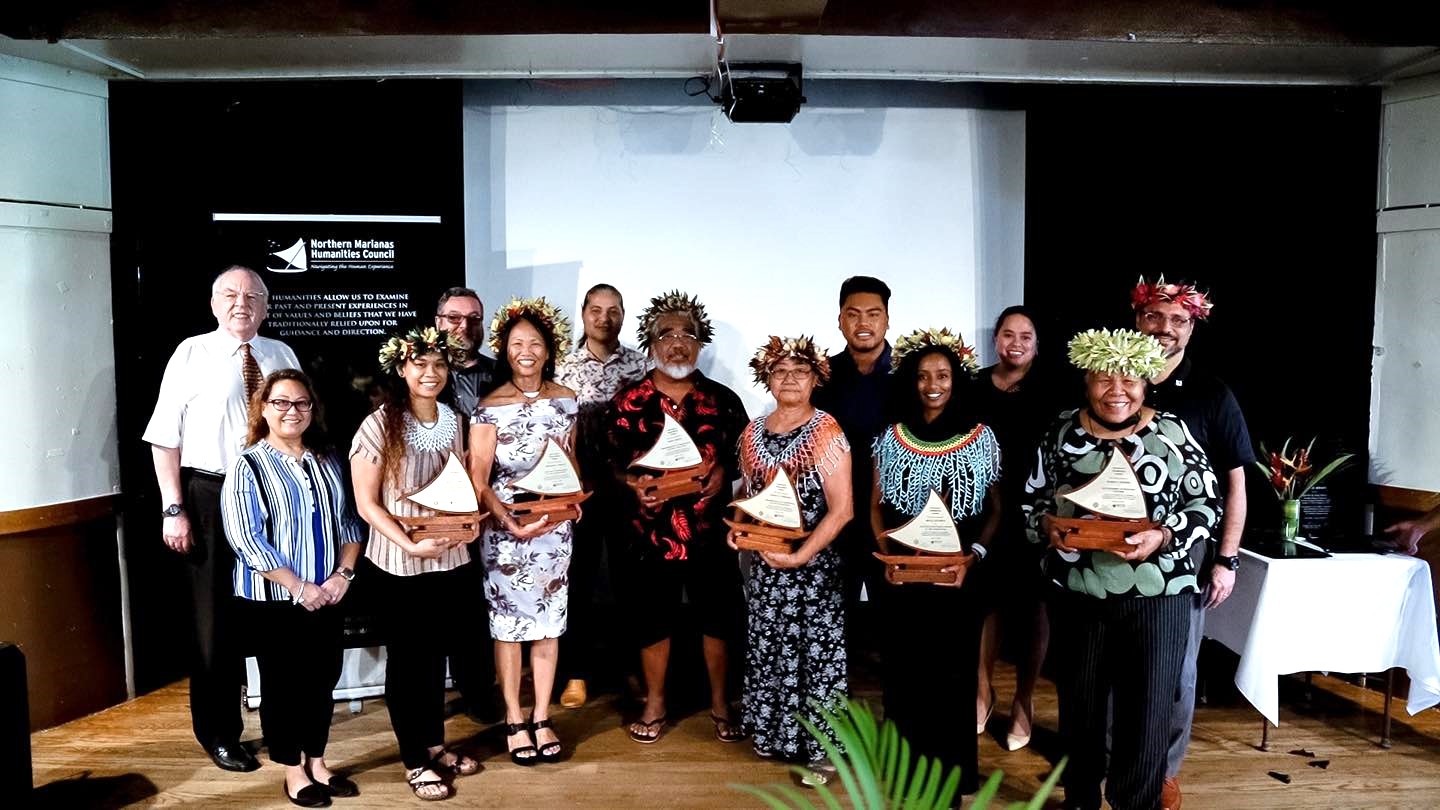
This year’s Governor’s Humanities awardees pose for a photo with the Northern Marianas Humanities Council officials at PIC-Charley’s Cabaret on Oct. 12, 2022.
