



HAGÅTÑA (The Guam Daily Post) — Certain provisions within Bill 175-37, the measure proposing changes to Guam’s Toilet Facilities and Sewage Disposal Act, drew various concerns from the Guam Environmental Protection Agency, while real estate agents and landowners testified in support of the measure during an extensive public hearing Thursday.
Bill 175 is intended to help landowners who cannot develop their properties because of sewer unavailability, while also attempting to address the threat of nitrate pollution in the Northern Guam Lens Aquifer, the largest source of drinking water on island.
The measure introduces new language for the definition of septic tanks, and adds definitions for private sewage disposal systems, advanced nitrogen-reducing on-site disposal systems and soil absorption systems. It also inserts a fourth type of toilet facility: those flushed with water and connected to an advanced nitrogen-reducing residential on-site disposal system.
Bill 175 also states that anywhere within the Groundwater Protection Zone, the density shall not exceed two dwellings each with private sewage disposal systems (including septic tanks) per acre, or four dwellings per acre, each with advanced nitrogen-reducing systems.
For lots subject to certain exemptions found in subdivision law, including properties resulting from parental subdivisions and decedent estates, density within the GPZ won’t be allowed to exceed one dwelling per lot, provided that each lot or property is at least 7,200 square feet – one-sixth of an acre – and an advanced nitrogen-reducing system in compliance with rules promulgated by Guam EPA is used for wastewater disposal.
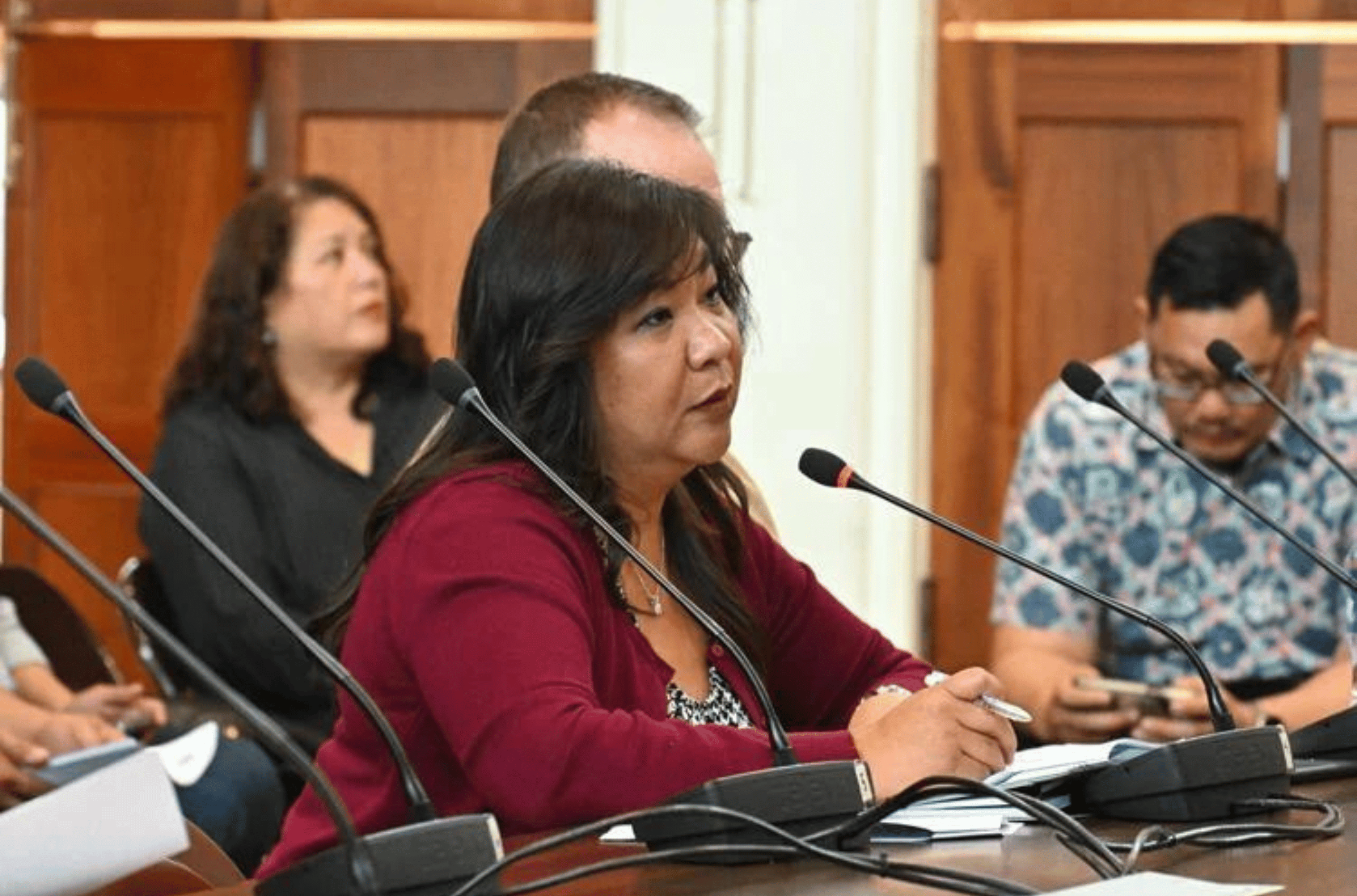
Although Guam EPA supports most of Bill 175, Director Michelle Lastimoza said the lot size provisions go beyond what the agency suggested.
According to Lastimoza, current law allows for development on unsewered lots that are at least a half-acre in size, and Guam EPA policy since 1997 has allowed development within the GPZ on lots down to a quarter-acre, as a limited exception for parental subdivisions only.
As later testimony from real estate agents and landowners would indicate, concerns lie with the disparate treatment of decedent estate owners.
Guam EPA maintains that development on quarter-acre unsewered lots should be limited to those already granted exemptions under the subdivision law – parental subdivisions and possibly decedent estates – but only with Type 4 treatment systems in place and the condition that owners of such systems obtain annual operating permits, Lastimoza said.
Instead, Bill 175 would allow “anyone” to develop on lots down to a quarter-acre in size within the GPZ, in addition allowing lots down to one-sixth of an acre for parental subdivisions and decedent lots, according to the Guam EPA director.
“This would result in a 100% increase of the annual increase in wastewater loading to the aquifer compared to the status quo, and a 200% increase in areas where land is subdivided under the parental or decedent provisions of the subdivision law,” Lastimoza said.
“Even with the use of advanced on-site treatment systems, this will result in the significant degradation of groundwater quality. While the proposed Type 4 systems (advanced nitrogen-reducing systems) are capable of providing very good treatment of traditional wastewater parameters, such as nitrate and overall wastewater strength, they are not capable of treating every contaminant associated with domestic sewage,” the director added.
As an example, Lastimoza said EPA officials know advanced nitrogen-reducing systems will not provide significant reductions of per- and polyfluoroalkyl substances, or PFAS, the “forever chemicals” that may soon be subject to new federal regulations limiting their concentration in drinking water.
“We know that domestic wastewater from septic tanks is a source of PFAS contamination to groundwater,” Lastimoza said.
According to statements made during an oversight hearing on Guam’s water supply, held before the public hearing on Bill 175, other causes of background PFAS contamination include sewer spills, trash and other land sources, as the chemicals are seen in wastewater.
Type 4 systems also require more maintenance, Lastimoza said, and failing to maintain the systems adequately could result in worse performance compared to traditional septic systems.
“Contamination of Guam’s sole-source aquifer to the point that it requires treatment will impose an enormous financial burden and hardship upon the government and the people of Guam, in addition to negative impacts to public health,” the director said.
The director also noted that the majority of parental subdivisions permitted over the last two years appear to have been developed by investors, not local residents. While the agency supports efforts to promote the ability of individual landowners to build on their family properties, developers should be held accountable to pay for infrastructure needed to protect public health and safety, she added.
“The public should not bear the risk and the cost associated with high-density unsewered development over Guam’s aquifer,” Lastimoza said, before going over a few other concerns with Bill 175.
The Office of the Attorney General also provided testimony, recommending technical changes to the bill’s language.
Realtor Gina Campos, who said she was testifying Thursday as an individual, said decedent estate landowners have been solely bearing the burden of current Guam EPA regulations.
“I say it is (Guam) EPA’s current interpretation since 2019 because, prior to that, there were no issues with obtaining a building permit if you were a parental or decedent estate owner. Prior to that, the interpretation was … these two entities of people will be treated equally,” Campos said.
She also stated that there won’t be “a free-for-all.”
“The subdivision law is distinct from this bill. … The subdivision law says if you subdivide your property into more than five lots, we’re no longer talking about the provisions addressed in this bill. It goes into another section of the law,” Campos added.
John Santos, a decedent estate owner, said Thursday that he is one of many landowners being affected by the denial of building permits by current Guam EPA regulations.
“All of the house lots we inherited through probate are on top of the northern aquifer with no public sewer available and doesn’t meet the land size required by (Guam) EPA to build a standard septic tank and leaching field. At this time, all our 13 lots are considered a liability, simply because of the existing laws and regulations by EPA,” Santos said.
“However, EPA recommends and supports the use of Type 4 system nitrate filtering systems. EPA wants to make it possible for us, the public, to build on our properties, provided we use the Type 4 filtering system. None of my siblings or my plans … with our properties will ever materialize without the passage of this bill,” Santos added.
Monty McDowell, chair of the legislative committee at the Guam Association of Realtors, said it was people such as Santos who would benefit from Bill 175, instead of anyone from the real estate community.
“I feel I have to say this because there seems to be a feeling that the Realtors are behind this for the benefit of the Realtors. The Realtors are not here to benefit. They’re here to benefit the people of Guam, so they can enjoy the absolute dream of homeownership,” McDowell said.