




HAGÅTÑA (The Guam Daily Post) — Following last week’s announcement that the Office of the Attorney General will withdraw from representing agencies under investigation due to potential conflict issues, Sen. Amanda Shelton has now introduced legislation that she says will keep procurement processes functioning while the OAG matters are resolved.
The measure authorizes the governor to hire independent legal counsel to review and sign off on procurements worth $500,000 or more when the OAG cannot do so because of a conflict of interest or other reason, according to a release from Shelton’s office. The governor can take that step only after the attorney general has issued a written notice of the office’s unavailability to the governor or impacted agency, Shelton’s office added in the release.
“The government is faced with an unprecedented situation,” Shelton stated in the release. “This bill provides the ways and the means for the vital review/sign-off function to continue while the underlying reasons that put the government in this situation are ironed out.”
Shelton introduced her measure just as the Guam Legislature is about to enter an emergency session to address the OAG’s withdrawal and a temporary power procurement bill.
The OAG currently is investigating 21 agencies.
On Feb. 28, Attorney General Douglas Moylan penned a letter notifying recipients of a possible conflict of interest and the OAG’s temporary withdrawal of legal representation for agencies under investigation.
Conflict concerns were raised against the OAG in two ongoing corruption cases, due to attorneys at the office having provided legal advice to agencies in which current or former officials are now facing prosecution.
Moylan has stated that he disagrees there is a conflict, but he needed the court to clarify the matter. Meanwhile, he said he has instructed his office to withdraw from representing affected agencies to avoid potential ethical issues.
The Office of the Governor, one of the entities under OAG investigation, criticized Moylan for “effectively” abandoning his duty in order to maintain the ability to “prosecute agency officials whom his office previously advised.”
The governor’s office stated that Moylan’s decision is halting critical government services and places tens of millions of federal dollars at risk, as the OAG is refusing to sign documents, including critical procurement documents and contracts.
Moylan said he had provided a workaround, where the OAG would be reviewing documents but not as agency attorneys, and documents may be used against agency officials in any investigation of potential wrongdoing.
Moylan’s Feb. 28 letter stated that for any document that requires the signature of the OAG, the office will simply insert a signature line stating “potential conflict, cannot sign,” but added that the office does not provide a legal opinion on whether law allows the processing of documents without the OAG’s signature. Moylan urged affected government entities to secure independent legal counsel.
One of the major projects currently under procurement is the temporary power project for the Guam Power Authority.
GPA is looking to acquire temporary power to bridge generation needs until the new power plant in Ukudu is commissioned, as well as mitigate load shedding in the summer months when power demand is expected to increase. GPA is hoping temporary power can be brought on board by around May.
However, there are three prerequisites before a temporary power contract can be approved by the Public Utilities Commission.
First is the enactment of Bill 206-37, which will waive the 90-day emergency period limitation for the project and the automatic stay that occurs in case of procurement protest.
Second, the governor would need to approve the proposed contract. And third, the attorney general would need to review it. GPA is another agency under investigation by the OAG.
The emergency session for Bill 206 is scheduled to begin Wednesday.
However, Speaker Therese Terlaje also called the session to address the emergency posed by the OAG’s withdrawal, stating in a letter to colleagues that it has “resulted in a threat to the welfare of the people of Guam.”
When Terlaje called for the emergency session, legislation to address the OAG’s withdrawal had not yet been introduced.

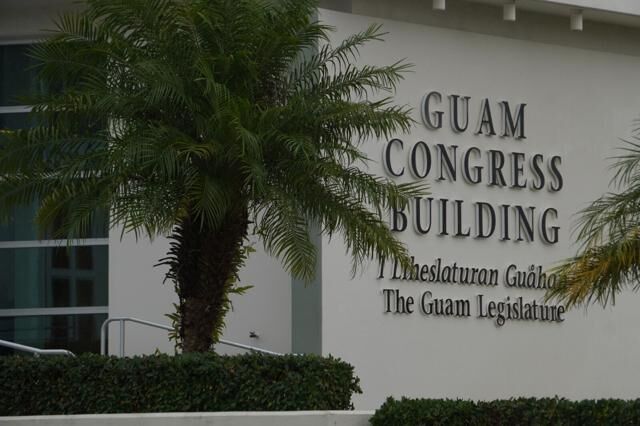
The Guam Congress Building is seen in Hagåtña on Monday, Jan. 22, 2024.
