




By Walter Ulloa
For Variety
HAGÅTÑA (The Guam Daily Post) — A week of intensive animal handling workshops last month exposed a challenging reality: Guam’s free-roaming dogs are getting smarter, and the island’s four animal control officers need the community’s help to outsmart them.
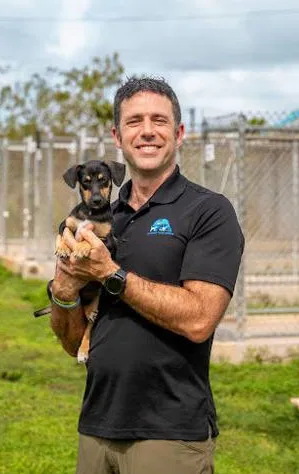
John Peaveler, a nationally recognized animal handling expert with over 21 years of global experience, spent the last week of January working with the Guam Department of Agriculture’s Division of Animal Health to overhaul how the island approaches stray dog capture.
“One of the really big things that I took out of what John was telling us, other than giving us some better strategies … he’s also looking at our team and our equipment and what we’re realistically able to do,” said territorial veterinarian Dr. Mariana Turner in an interview with The Guam Daily Post Friday. “And one of the things he mentioned or encouraged was getting community involvement.”
The problem is straightforward but tricky to solve. When animal control officers set traps in areas with pack dogs, they typically catch the easiest animals first. The rest of the pack watches, learns and becomes harder to trap.
“What happens is they’ll go to an area because there’s a complaint about a pack of dogs and they’re able to catch the quote, unquote, easy to catch dogs and the hard to catch dogs end up getting left,” Turner said. “And so, we end up inadvertently making smarter boonie dogs. They become smarter and breed…now we have even harder to catch dogs.”
Peaveler’s solution requires patience and community participation. Successful trapping of wary dogs means conditioning them to trust the equipment by placing food in and around traps repeatedly, at the same time each day, sometimes for weeks before attempting an actual capture.
“In order to be more successful with trapping, sometimes you can put the trap out and the dog will just be hungry enough to go in the trap. But when you have those smarter dogs, you do have to basically condition them,” Turner explained. “All (the community) really needs to do is just help out and throw some food into the trap or around it the same time every day.”
The ask from residents is simple: spend five minutes a day putting food in or around traps to help condition dogs to the equipment.
With thousands of free-roaming dogs, Turner said the department’s limited resources can’t tackle the problem alone.
“We have 68,000 dogs on this island and 8,000 are free roaming,” Turner said. “But the source of the dogs are those owned animals. We need to get the community to behave more responsibly around pet ownership, and then to help create the solution.”
The division has just four animal control officers who can go into the field.
“The more that the community is helping us out, the faster we can get to the solution. If we just want to rely on the four animal control officers, I’d like to say we’d get there someday. I don’t know, (but) we really need the community to be able to help us with this, even if it’s like small stuff like that,” Turner said.
Peaveler’s visit included multiple components beyond the main public workshop held Jan. 29 at the Mongmong-Toto-Maite Mayor’s Office. He conducted a bite prevention workshop for children on Jan. 27 in partnership with Island Girl Power and led specialized training on chemical capture using dart guns on Jan. 30-31.
The public workshop drew participants from animal control, Guam Animals in Need, Spay/Neuter Island Program, United States Department of Agriculture, rescue organizations and mayor’s office staff.
Peaveler, who owns Humane Innovations and has responded to disasters worldwide including the recent Lahaina and Palisades fires, donated handling tools including gloves and a leash pole to the team. His experience spans 40 countries and includes building animal welfare programs in Kuwait and leading one of the largest animal rescue teams in the country at San Diego Humane Society.
The training covered dog behavior, recognizing differences between socialized pets and street dogs, and various capture techniques.
“John really went into detail on all these differences. So first talking about dog behavior, the various types of dogs there are, right, because our friendly, socialized, indoor pets that are used to people are totally different than some of the street dogs that are just occasionally fed,” Turner said.
Turner emphasized the training wasn’t just about catching more dogs but catching them more humanely.
“Actually, we just had a meeting this morning with the team on some of the various changes, not only to improve our capture rate, but also to improve how we handle the animals because we want to do this as humanely as possible,” she said.
This was the second major animal handling training the division has hosted in the past year. Last year, another expert from Humane World for Animals focused on law enforcement aspects of animal hoarding and cruelty cases. Peaveler’s training concentrated on the practical challenges of capturing street-smart free-roaming dogs.
The department currently has three limited-term animal control officer positions open, though hiring remains challenging due to delays in the government recruitment process. Both administrative officers are currently out on medical leave, forcing animal control officers to handle desk work.
Despite being shorthanded, Turner is planning future workshops and community outreach on animal behavior.
Residents interested in helping with trap conditioning or learning more can contact the Division of Animal Health at 671-300-7966 or 671-300-7964, or email [email protected]/.
“Otherwise, we end up just chasing our tail,” Turner said. “We can only remove one dog until we’re gone for a couple years, and the dogs there then forget that we were there, and then we can go back and maybe remove one more. It’s not effective, and it’s not going to lead to a solution.”
