






HAGÅTÑA (The Guam Daily Post) — Lori Quichocho and her family of seven have been fighting to find adequate shelter after their Dededo home was leveled by Typhoon Mawar.
“(It was) completely totaled. There’s only one wall standing, the other three walls and the roof is gone,” she told The Guam Daily Post on Friday.
That left her, her disabled husband, and their asthmatic children out in the rain.
They loaded all their belongings into their vehicles after Mawar struck on May 24, but were unable to purchase gasoline for days due to long lines and station shutdowns. By the time they appeared in front of the emergency shelter at Astumbo Elementary School, they were rejected.
“I came here Saturday, and their sign was saying that their registration was closed, and for us to proceed to Wettengel (Elementary School) or Maria Ulloa (Elementary School),” she said. “When we did that they said all shelters were closed.”
Astumbo was the first school to stop accepting residents, due to occupancy limits, before Mawar hit the island last week. All shelters stopped admitting residents “effective immediately,” the Joint Information Center announced Sunday, and shelter capacity for the island was reduced to 815, down from 3,516 before the storm.
According to Dededo Mayor Melissa Savares, shelters at Upi Elementary School, George Washington High School, and Machananao Elementary School were shut down after the typhoon, compressing houseless residents into four shelters up north.
As of Friday afternoon, the Joint Information Center and the Guam Department of Education had not responded to questions about the conditions at northern shelters, or timelines for additional aid. Adelup spokesperson Krystal Paco-San Agustin said she had been trying to contact the Quichochos, but had been unable.
Struggles at the shelter
Quichocho on Friday told The Guam Daily Post that she did not get help finding a place to stay until she made a call to the Office of the Governor. Her family was admitted into the Astumbo shelter – their health conditions were what got them special consideration, she said.
“The problem was they weren’t able to accommodate my whole family of seven,” she said. “They only took four of us, which is my husband, myself and my two minor kids,” including her 6-year-old son.
She had to tell her adult children to leave, and with no phone service at Astumbo, she can’t get in touch with them.
“I don’t even know where my son’s at,” she said. “I don’t know where my daughter-in-law is.”
But conditions are not great inside the shelter, either, Quichocho said.
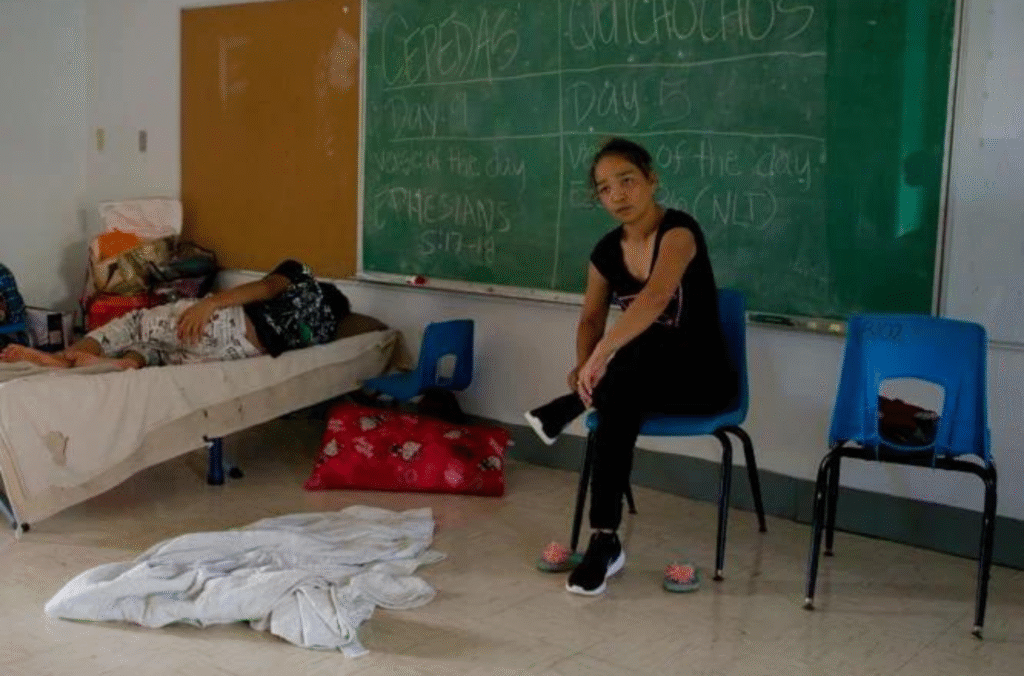
She, her husband, and their two children are staying in a classroom along with her sister’s family of nine. There’s no power to activate medical equipment for her husband, and they are sharing a single toilet, which itself is difficult to use due to the water outage at the school.
“They have portable toilets out here, but it’s not usable,” Quichocho said, as the toilets were nearly overflowing with human waste.
Food and water is provided every day, and workers with the Department of Public Health and Social Services have dropped by to check on their health. But no bedding was given to them, nor toiletries or attempts to help with basic sanitation, such as a shower.
With no reception, the Quichocho family has been unable to fill out any applications for federal aid online.
Taking a look around the village, Quichocho said she and her family are still doing better than many. That includes her niece, whose family of five could not get into Astumbo.
“There are hundreds of families out there that I’ve seen living in their own place because they can’t come in here,” she said.
‘I don’t know what to tell them’
Dededo Mayor Savares said families who have lost their homes have been streaming into her office seeking assistance. There isn’t much that can be done.
“They’re asking, ‘Where can we go?’ I have no shelter. My shelter was damaged. I had six to eight inches of water in my gym,” Savares said.
Attempts to reach the Office of Homelessness and Poverty Prevention have been unsuccessful as “their phone lines are down.”
For now, the most her office can do is take down the information and address of residents who come through, so they can be more quickly helped by the Federal Emergency Management Agency. The mayor’s office is provided bottled water and water for showers, courtesy of FEMA.
Social workers from the island’s hospitals have even taken to calling the Dededo Mayor’s Office for help finding family members of patients.
Savares said Guam Del. James Moylan stopped by Thursday and assured her that tents and other supplies were on the way. Word is, a tent city may be stood up for storm survivors, she told the Post.
The newspaper was unable to get confirmation from FEMA about a possible tent city or additional shelter, as of press time Friday.
Things are just as dire in the island’s northernmost village, according to Yigo Mayor Tony Sanchez.
“There’s no shelter up here in Yigo, they shut it down,” he told the Post. “I don’t know. Even me, I don’t know what to tell them. Ask the governor.”
The whole situation was “malafunkshun,” Sanchez said. Updates on when help would arrive were hard to come by, “and the sad part about it is that the people expect us to have all the answers, and we don’t.”
Nonprofit steps in
In the wake of Mawar, nonprofit organization Todu Guam Foundation has been stepping in to help fill services that the government has yet to cover, said Ashley Calvo-Rodriguez, an outreach coordinator with the nonprofit.
“When Typhoon Mawar hit Guam and devastated the north, we knew this population would be severely hit,” she said.
After surveying residents in northern shelters, Todu Guam found that the Zero Down and Gill-Baza areas “and their homes were completely gone.”
About 189 people were provided with food and water by the Office of the Governor, Calvo-Rodriguez said. Food, water, clothing, diapers, other hygienic supplies and shelter are among their immediate needs.
“(Todu Guam) will continue going out to the vulnerable communities and providing the care to fill the gaps until such time the national organizations that are linked up with FEMA and the government can take over,” she said.
“I don’t even know where my son’s at,” she said. “I don’t know where my daughter-in-law is.”
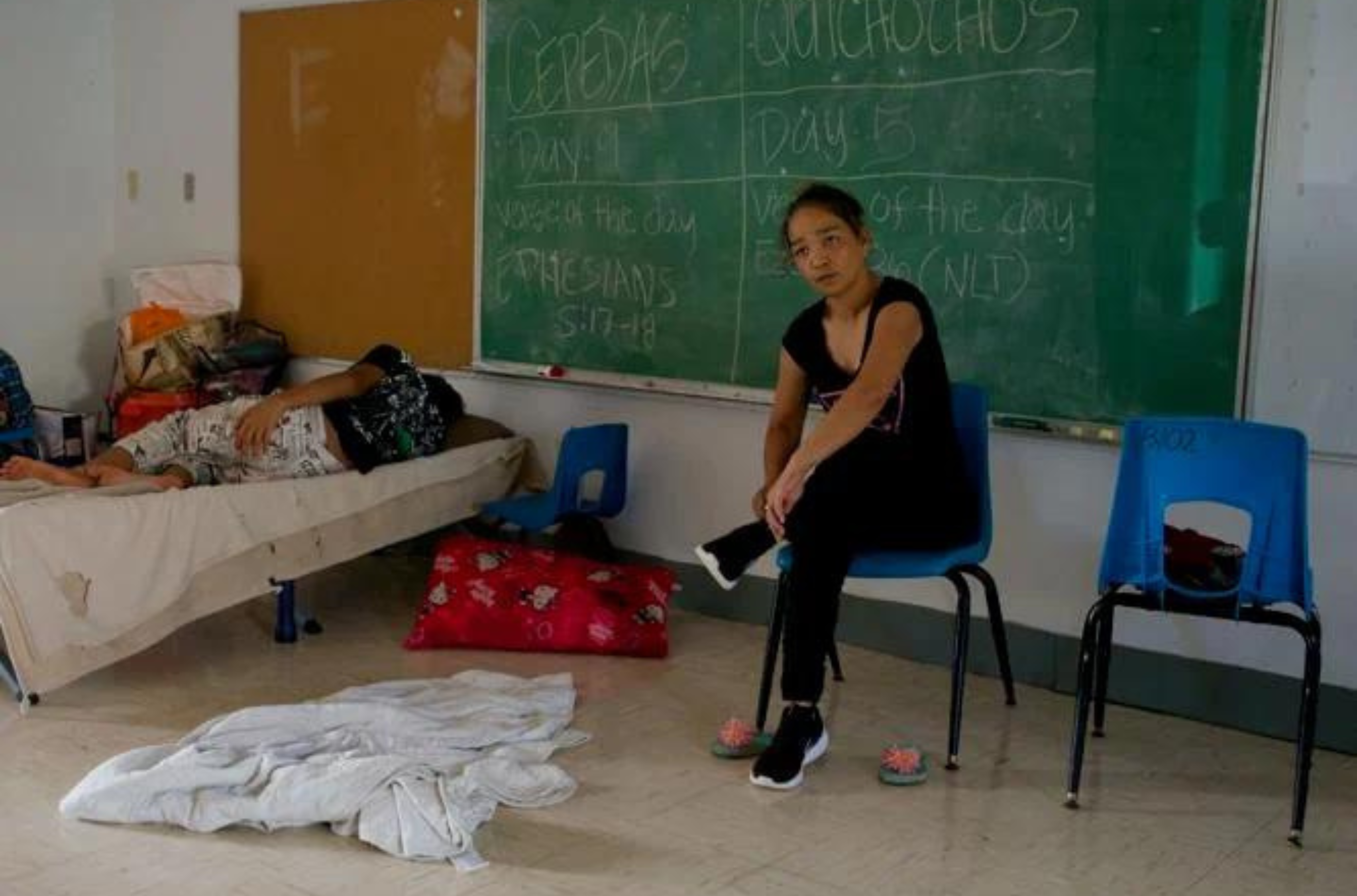
Lori Quichocho gets ready to leave for work Friday, June 2, 2023, while a family member sleeps soundly in a classroom at the Astumbo Elementary School emergency shelter.
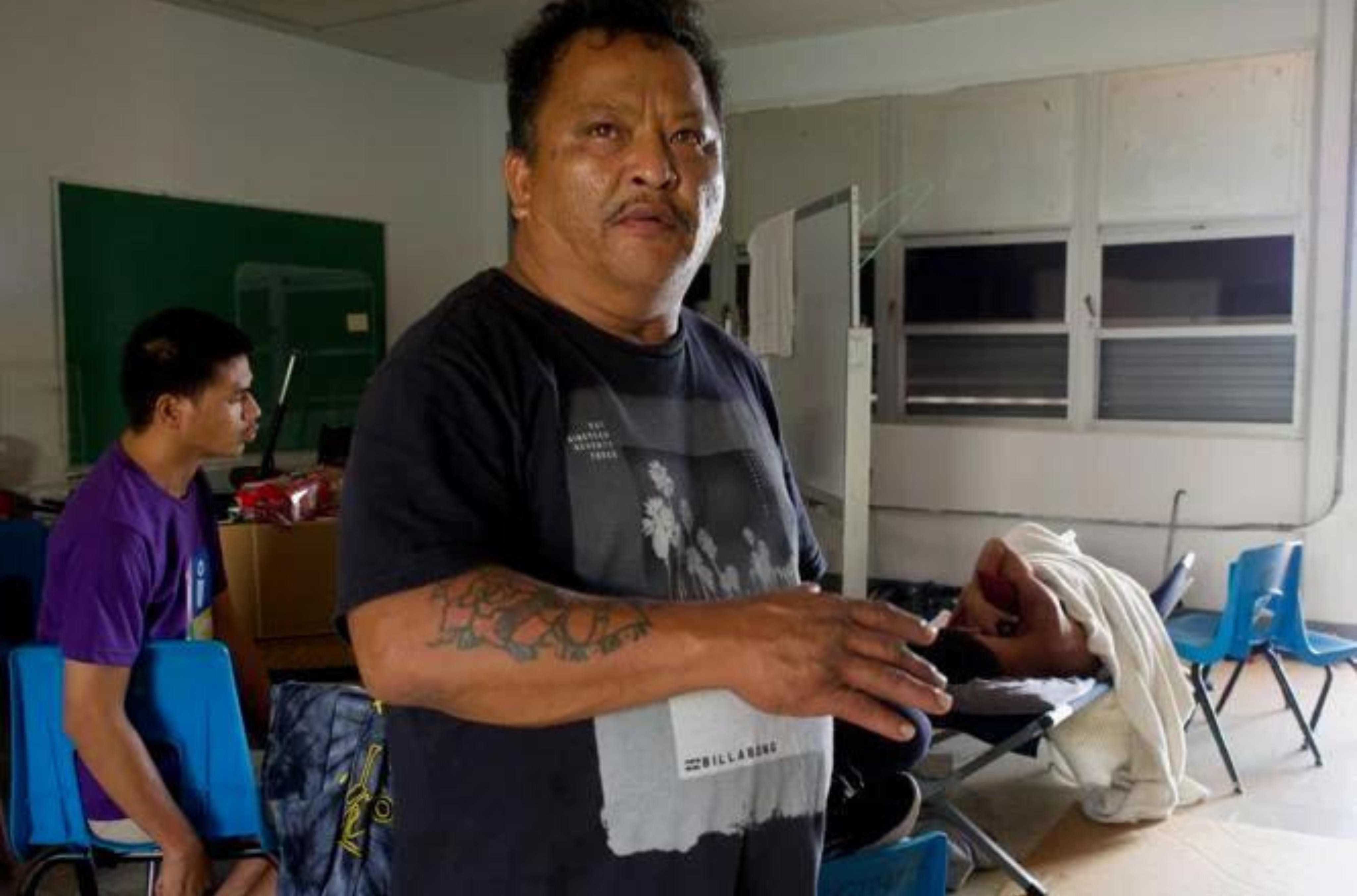
Jess Quichocho, Lori Quichocho’s husband, describes the struggle to keep himself and his asthmatic children healthy, as they shelter without water or power Friday, June 2, 2023, at Astumbo Elementary School in the aftermath of Typhoon Mawar.
