






THE business community should comply with federal labor reporting requirements, Saipan Chamber of Commerce board member Alex A. Sablan said.
“We need everybody in this community to fulfill the requirements of the public law that says you need to report your staffing, your training, your upward mobility of U.S. citizen workforce in lieu of non-resident workers, and when you don’t have that, then what are you doing with non-resident workers in terms of upward mobility and moving them through the process,” he said.
“This is a requirement of public law, and we need everybody’s support to make sure that we have the statistics so that we can get to [the U.S.] Congress and make changes,” he said during a chamber general membership meeting Wednesday.
Sablan said there have been recent and ongoing discussions between the business community and the federal government, including the White House, U.S. Citizenship and Immigration Services, the U.S. Department of Labor, and the Office of U.S. Congressman Gregorio Kilili C. Sablan, regarding legislation that proposes to strike a balance between prioritizing U.S. workers while augmenting the CNMI-Only Transitional Workers, or CW program which is set to expire on Dec. 31, 2029.
“[We] basically let them know that we are on fire here,” Sablan said. “We have problems. 2,800 of the 9,000 that were within the CW realm have lost their status in the Commonwealth. That is more than a quarter of our total workforce, so things are going to get rougher in the Commonwealth,” he added.
In these discussions with the federal government, it was learned that 60% of foreign worker applicants failed to provide required information that is due within six months of their arrival in the Commonwealth, Sablan said, adding that this has been delaying a significant number of applications within the USCIS Temporary Labor Certification, or TLC, process.
“We’re hopeful that we can somehow find a way to compel employers of all groups to fulfill this because this is the statistic that we need in order to justify to Congress why there is a requirement for continued [CNMI-Only Transitional Workers] when we are well below our 50-percentile of our quota in this timeline. We’re doing enough narratives and storylines, but we all need to come together,” Sablan said.
He noted that the federal government itself is also experiencing manpower shortages.
“We seem to, as is the usual scenario with the Commonwealth, come to the eleventh hour to try and put out fires. We are on fire, so we need to get this legislation in as quickly as possible,” he added.
Sablan said the business community is thankful that Congressman Kilili is supportive of their recommendations pertaining to the touchback provision, the impending diminishing number of laborers, and the TLC process.
Sablan said their recommendations include either repealing the touchback provision or modifying it.
The touchback rule requires certain CWs to exit the Commonwealth for 30 days before their employers can apply for their renewals.
Sablan said their proposed modifications would include allowing the applicant to submit his or her application while on vacation.
“The second item would be dealing with our impending diminishing number and the 13,000 that we started off with in the CW quota. This scenario, as we talked about, does not help us. We are going to be well below our pre-Covid-19 number once we come out of this whole mess that we’re in right now in the economy,” Sablan said.
“That’s not going to help new businesses, new hotels…and many other hotels and businesses across the spectrum.”
He said the third “item that we’re looking at is, at the end of the day, we’re trying to figure out how to bring the TLC process closer to home.”
Citing Guam as an example, Sablan said the island has had a provision since the 1960s that allows the Guam Department of Labor and the Guam governor to certify all TLCs on their island.
“They determine that there is no U.S. citizen present for a particular vocation, and they sign off on it. We’re asking for the same provision within the Commonwealth,” Sablan said.
“They have heard us. We have communicated our issues. We do have some good news that they are looking at a provision within the touchback for the remaining balance of individuals that are on island. If you have had a renewal within this recent timeline for about a year or a year and a half, they have established that they won’t take the time of which you apply, which has been the normal course, but that they will have the date from which you are approved, from the day you receive the permit… so the CWs who are in the realm of touchback seem to have a renewed timeline for touchback,” Sablan said.
“Again, this doesn’t help the 2,800 that have already fallen off the grid here, but at least we’ll get this provision and notice out soon. That’s coming in the next few days,” he said.
“We also talked about some of the provisions within the law, the 10-day return from the receipt of an actual CW permit from your home country. They said that absolutely, positively, they will not deny anybody at the border if they are and have exceeded on this timeline, so we don’t have to worry about that provision,” he added.
“They do recognize our situation. They understand the dilemma we’re in. We have explained that we were at 50/50 at the height of our economy, prior to Covid-19… 50 U.S. and 50 CW. Never before in our history had we obtained that. That was at the highest moment in our economy. So, to the degree that we can possibly explain the data away, the scenario is that today, yes, we have our U.S. citizens in place for our workforce, but that’s because we have a significant diminishing number in our CWs. Yes, U.S. citizens are filling those positions, and that’s great to see, but in order to open up the greater economy, we need our CW workforce in place, again, striking a balance, but explaining to everybody that we have the data. We’re going to continue these conversations. We’re going to continue to ask you for your support and help with [providing] this information,” he said.
The CW-1 program is for foreign workers who are ineligible for any other employment-based nonimmigrant status under U.S. immigration law.
For more information about the CW-1 program, visit https://www.uscis.gov/working-in-the-united-states/temporary-workers/cw-1-cnmi-only-transitional-worker/.
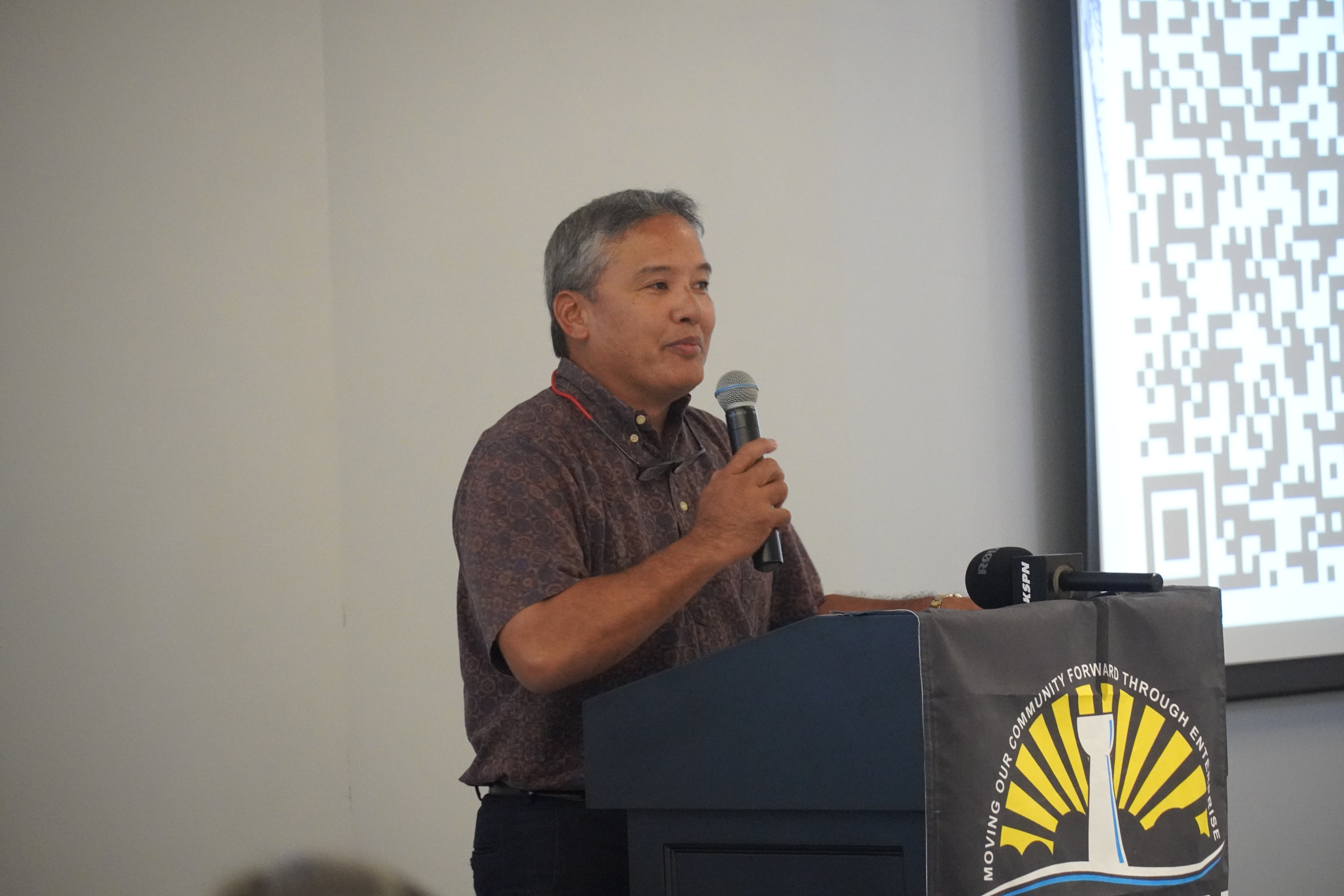
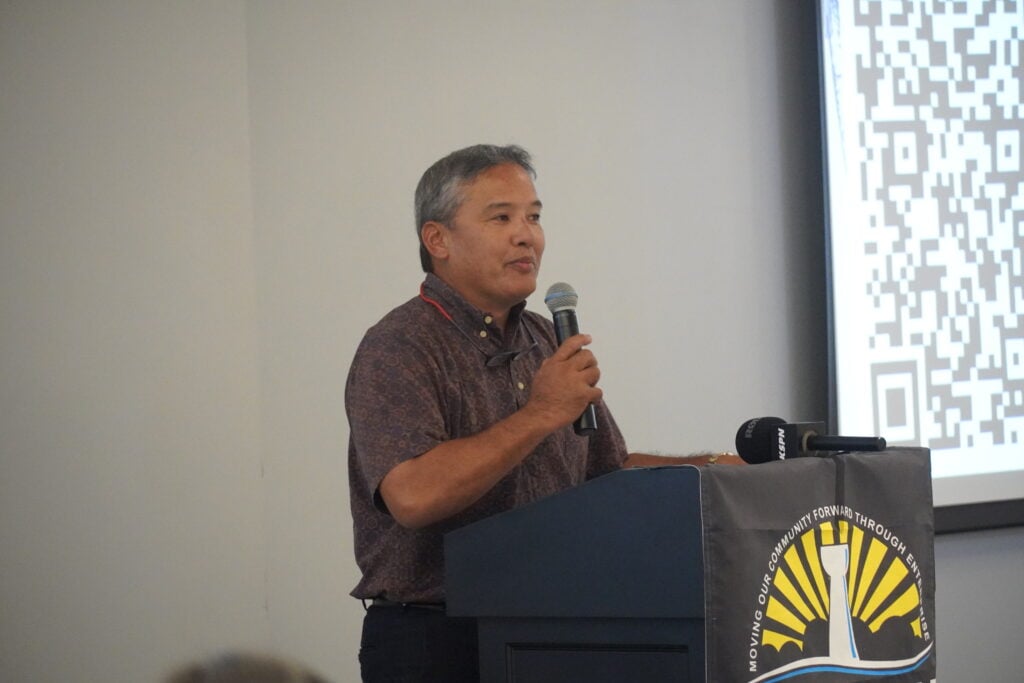
Saipan Chamber of Commerce board member Alex A. Sablan shares workforce updates with chamber members during their general membership meeting Wednesday at Kensington Hotel Saipan.
