



DESIGNATED Judge David O. Carter has granted the request of the U.S. Environmental Protection Agency, the Commonwealth Utilities Corp., and the CNMI government to modify the funding ceiling for CUC projects.
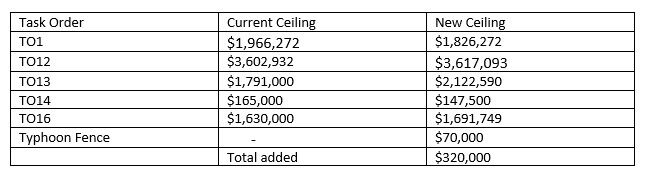
After reviewing the papers submitted by the parties, Judge Carter on Nov. 3 granted the request to modify funding ceilings for amended Task Orders 1, 12, 13, 14 and 16.
According to U.S Department of Justice attorney Bradley O’Brien, on Sept. 26, 2014, the court entered an Engineering and Environmental Management Company or EEMC order resolving the federal government’s motion against CUC and the CNMI, seeking a receiver and other relief.
That order resulted in the appointment of Gilbane Federal as the EEMC to assist with oil-related projects, Bradley said.
“As part of the appointment, the EEMC entered into a letter of engagement that defined the EEMC’s scope of work and other terms,” he added.
The instant request is intended to conform the task orders funding ceilings to the expected project costs, Bradley said.
“The modified funding ceiling levels reflect both the July 2021 status conference and subsequent discussions where the parties clarified EEMC projects and their associated costs,” he said.
He noted that Gilbane Federal’s reimbursement for work is limited to the ceiling level for each Task Order or TO.
Bradley said after recent discussions regarding EEMC projects and associated costs, the parties propose to modify the funding ceiling levels for a total additional funding level of $320,000.
Judge Carter finds these modified figures reasonable for each task order, and grants the parties’ request by approving the modified funding ceilings.
In November 2008, after the U.S. Environmental Protection Agency cited CUC for violating the Clean Water Act and the Safe Drinking Water Act, the federal court issued Stipulated Orders 1 and 2.
SO1 focuses on drinking water issues while SO2 focuses on oil issues, such as requiring CUC to repair and replace oil storage and operation infrastructure, manage tank and pipeline facilities, and establish spill and emergency response equipment and protocols.