





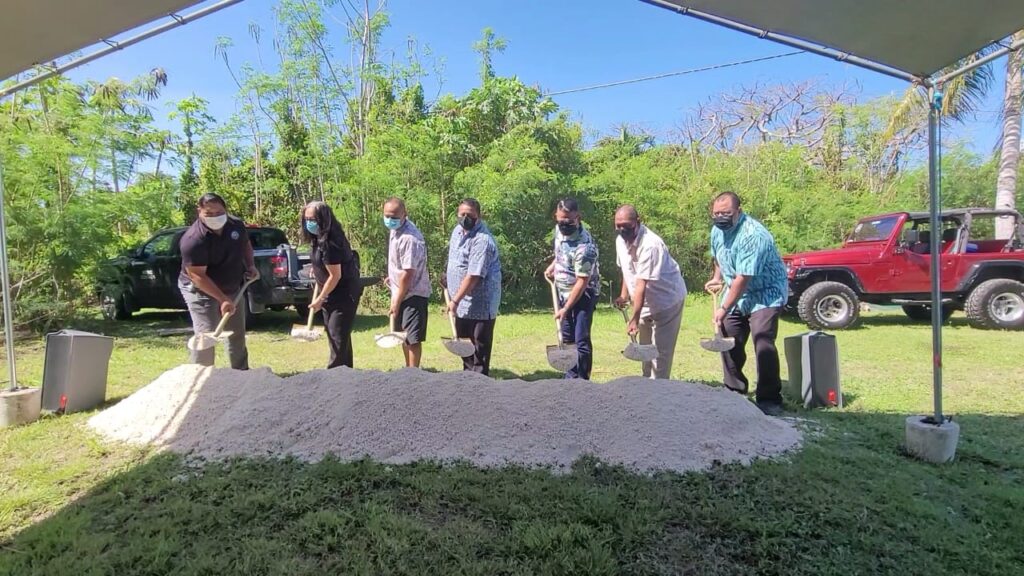
THE Northern Marianas Housing Corporation on Monday held a groundbreaking ceremony for the first home to be built through the Community Development Block Grant Disaster Recovery program.
The three-bedroom, two-bathroom typhoon-proof fully concrete house with typhoon shutters and a garage will be built in As Lito, belonging to one of hundreds of applicants, Joaquin P. Cepeda and his three-member household.
It will be a stay-in-place home with energy efficient materials, fixtures, and appliances.
This project is funded in whole or in part with funds provided by the U.S. Department of Housing and Urban Development, or HUD, administered by NMHC through the CDBG-DR program.
The contractor who won the bid for this roughly six-month project is GMP Construction.
In her opening remarks, NMHC board chair Marcie Tomokane shared that the program is made possible through HUD to help cities, counties, states, and U.S. territories to recover from presidentially-declared disasters, especially in the low-income areas, subject to availability of supplemental appropriations.
In response to these disasters, U.S. Congress may appropriate additional funding for the CDBG-DR grants to rebuild the affected areas and provide crucial seed money to start the recovery process.
“A lot of work was put into the planning stages, even if it was uncertain whether the program would be made available to our community and how much of U.S. Congress allocation would be given to our islands, a dot on the map. Despite the uncertainties, we did not let anything stop us from putting in effort to ensure that the CNMI was ready to take on what could be a once-in-a-lifetime opportunity. Whether the CNMI was going to receive $1 million or $100 million, NMHC’s leadership tirelessly worked with all stakeholders and other agencies in coordinating and compiling infrastructure projects,” said Tomokane.
Stakeholders and agencies included the U.S. Federal Emergency Management Agency, the U.S. Small Business Administration, the American Red Cross, the Northern Marianas Technical Institute, Northern Marianas College, and the Marianas Visitors Authority.
The CNMI received $244 million through the CDBG-DR program, the single largest grant it has ever seen and received in Commonwealth history.
The program was officially launched in November 2020, after the CNMI action plan was approved by HUD.
“We knew that this announcement would change thousands of lives and that finally, our CNMI households will be able to live in more resilient homes, and that our community will continue to see the improvements of our infrastructure after many decades… We’re finally here breaking ground on the first home funded by CDBG-DR. This here today is truly a momentous and historical event, and it doesn’t stop here,” said Tomokane, noting the lengthy process of navigating through the program’s requirements and implementing policies and procedures.
NMHC anticipates hundreds of homes to be assisted through this program, as well as infrastructure projects to break ground in the near future.
To date, there has been a total of 391 loan packages approved, of which 341 are on Saipan, 32 on Tinian, and 18 on Rota.
NMHC allocated close to $150 million to housing, about $105 million to infrastructure, $8.6 million to economic development, and about $15 million to planning and administrative costs for the program.
Tomokane said the $15 million in planning and administrative costs include the ongoing hiring of employees to run the program.
“This reflects all of the good work that’s going into our community and that NMHC’s mission of ensuring that CNMI residents have access to affordable, safe, decent, and sanitary housing is met,” she added.
The NMHC board chair thanked the CNMI leadership and all critical stakeholders for their support of the successful implementation of this program.
Gov. Ralph DLG Torres, for his part, said: “We want to move forward as fast as we can, but there are a lot of guidelines. It’s the same with [American Rescue Plan Act] funds. This is one of those challenges: that we have to create our own program that will assist the people of the CNMI.”
He thanked the NMHC board of directors, management, and staff, encouraging them to continue to work diligently to reach out and to assist the people of the CNMI; thanked the contractor, and congratulated the Cepeda family on this milestone.
House Speaker Edmund S. Villagomez, who was also present for the ceremony, congratulated the Cepeda family on this historical groundbreaking.
“I’m happy for the homeowner. I’m sure, like they said, there are about 400 more to go. I’m looking forward to those projects being done. It’s very unfortunate that in order to avail [oneself] of this program, a big disaster has to happen. Even some small disasters can really, really change our lives. It’s good to have this type of assistance coming from the federal government and also our local partners to do all that they can to make sure that these families are back on their feet, safe, secured, and even more prepared for the next disaster. I’m not asking for another natural disaster to occur, but now they’ll be more prepared and safer,” he said.
NMHC executive director Jesse Palacios, for his part, said, “This is the first time in the history of the CNMI that we have availed of the CDBG-DR program. Unfortunately, in order for us to avail [ourselves] of such funding, a major disaster must first occur, and then the governor must request for approval from the President of the United States a major disaster declaration.”
In 2018, the CNMI had two presidentially declared disasters: Typhoon Mangkhut and Super Typhoon Yutu.
However, HUD did not just simply hand over the $244 million that the U.S. Congress had allocated to the CNMI for recovery efforts following these two disasters.
“We had to earn it, if you will. We had to prove to HUD that the CNMI, among other things, has the financial management, internal controls, and capacity to be able to implement and the capability to administer this disaster program,” said Palacios.
He noted that the NMHC board, management, and staff appreciate the community’s patience as the agency worked to ensure that all of the applicable federal requirements — such as the submission of an implementation plan, capacity assessment, and certification as to the proficiency of financial procurement and grant management policies, and the action plan — were being complied with.
The administrative requirements, such as policies and procedures, must be reviewed and approved by the NMHC board of directors, as well as to ensure that forms, contracts, and agreements are all in order prior to the home’s construction.
NMHC anticipated the first home to be built in the summer of 2021.
However, a HUD review of the CNMI home ownership program caused some delay.
The review brought about the creation of the CNMI’s own set of green building standards under the CDBG-DR regulations for HUD approval.
“Needless to say, the journey has been a bit round and widened, but we’re finally here at the finish line to witness the very first groundbreaking program under the CDBG-DR home ownership program…. One down. 400 more to go,” said Palacios.
Homeowner Joaquin P. Cepeda expressed his deep gratitude to NMHC and everyone involved for the work they have put into building this home for him and his family.
He said he submitted his application for the program roughly two years ago, noting that it was a lengthy process, given the various federal requirements.
Cepeda noted that if there are any errors in an application, the process may take a little longer than anticipated.
NMHC CDBG-DR program manager Kimo Rosario, for his part, said, “It is with distinct pleasure and honor that I join everyone this morning on this historical event — yes, this is historical, like the corporate director had mentioned. It’s huge.”
He thanked everyone on behalf of the NMHC board of directors and management for their presence at the groundbreaking, and congratulated the Cepeda family on the inception of this homebuilding project.
“NMHC is pleased and excited for reaching this historic milestone. Congratulations NMHC team on a job well done as well. Even the ones who call after hours, we also want to thank our CDBG-DR clientele for your continued patience and understanding. We will get to you. All of the homes will be constructed. Not a penny is going back to HUD,” he said.
For more information on the CNMI CDBG-DR program, visit https://www.cnmi-cdbgdr.com
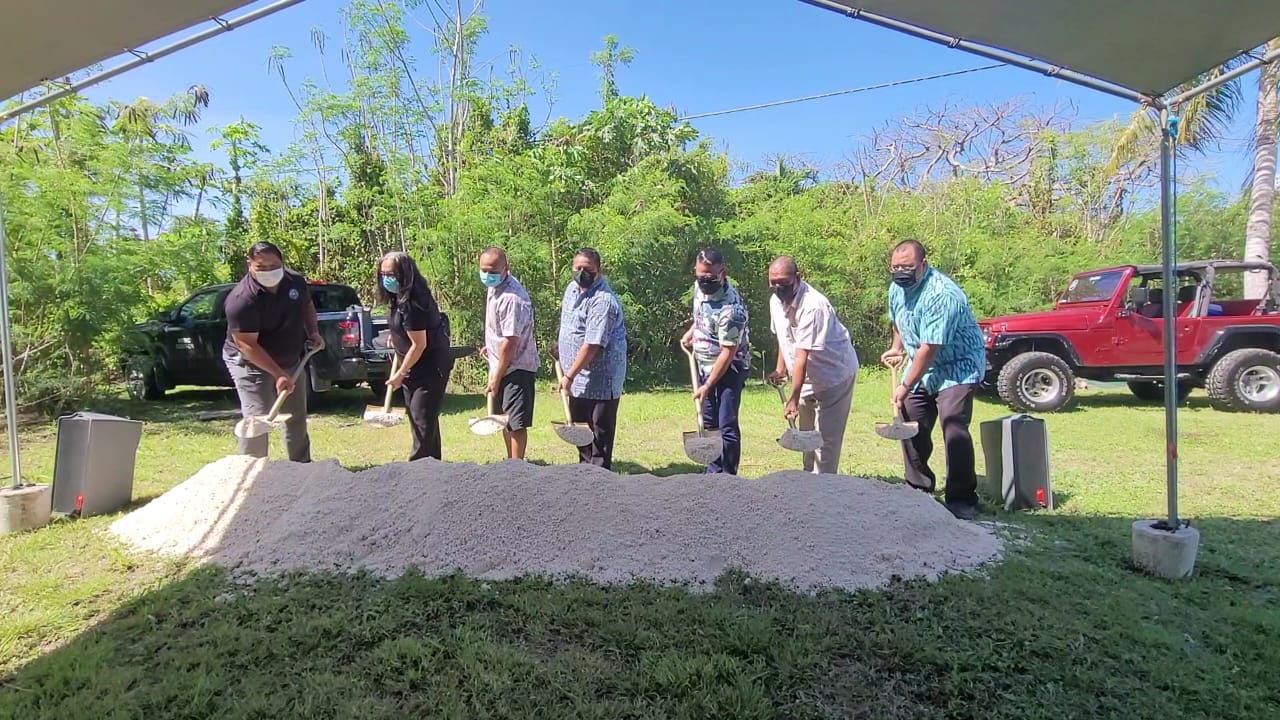
From left, Department of Lands and Natural Resources Secretary Anthony Benavente, Northern Marianas Housing Corporation board of directors chair Marcie Tomokane, Joaquin P. Cepeda, Gov. Ralph DLG Torres, Senate Floor :eader Vinnie F. Sablan, Department of Public Works Secretary James Ada, and House Speaker Edmund S. Villagomez break ground on Monday at the site of the first home to be constructed through the CNMI Community Development Block Grant Disaster program.
