








HAGÅTÑA (The Guam Daily Post) — The Guam Department of Education is in its second year of implementing the 5-year State Strategic Plan and education officials are ready now to establish the baseline for student proficiency through summative assessment.
GDOE chose the Smarter Balanced assessment tool as the new summative assessment for gauging how well students in grades 3 through 11 are learning. The assessment tool switch was made after the ACT-Aspire assessment tool was phased out nationally, but delays in implementing the Smarter Balanced assessment prevented GDOE from testing students last school year.
“The procurement has gone through. … It’s complete. We are already communicating with the publisher. We look for our assessment round in the summative assessments to be the last two weeks of March, the beginning of April, and that will be the window we use annually,” Superintendent Kenneth Erik Swanson reported to the Guam Education Board on Dec. 19.
That contract is renewable up to five years, so it doesn’t have to be renewed each year, he said, adding, “The tool has two different kinds of assessments that are key to the common core state standards that we use in our formative assessments that teachers can use along the way and the summative assessment that we use to benchmark our progress with what’s going on nationally.”
Before the COVID-19 pandemic, results from 2019 ACT-Aspire assessment showed GDOE students already were behind in mathematics, with only 10% of students proficient.
With no results for last school year, GDOE presented school year 2021–2022 data in the Annual State of Public Education Report, or ASPER.
The report showed that 14% of third-graders, 4% of fourth graders, 5% of fifth graders, 5% of sixth graders, and 3% of seventh graders were proficient in math.
When it comes to reading, students didn’t fair much better.
Nine percent of third graders, 15% of fourth graders, 9% of fifth graders, 10% of sixth graders and 10% of seventh graders were proficient in reading, according to the report.
But now that GDOE is ready to establish a baseline, Swanson said, “We know we are going to have a good data matrix to work from. The data that will be developed out of the assessments will provide comparison between GDOE and U.S. standards and also give us specific areas that we will know we need to work on instructionally.”

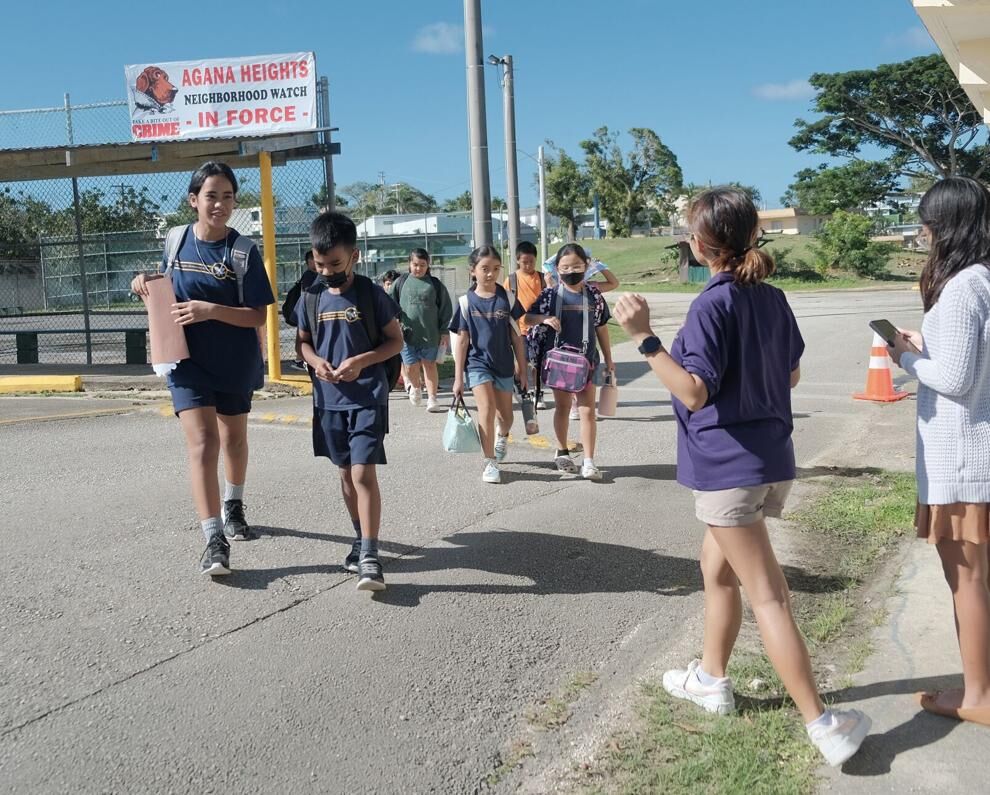
Agana Heights Elementary School students leave campus in Agana Heights on Wednesday, Nov. 22, 2023.
