




WITH Typhoon Mawar and its destructive winds moving away from the Marianas, Variety spoke with some residents of Guam about their experiences with the island’s first catastrophic storm landfall since 2002’s Typhoon Pongsona.
Victoria Naputi lives in Guam’s second northernmost village, Dededo, which was greatly affected by the eye of the typhoon. She said that as the eye passed over Guam, the wind was “rough and howling.” Her home is semi-concrete, with a tin and wood roof, which Naputi said managed to make it through the storm in one piece.
In the wake of the storm, Naputi is going to have to clear the storm debris, put up the tent canopies she took down prior to the storm, make use of food in her freezer, and collect rainwater for use around the house.
“[The house] was prepared but I’m not sure it can weather another typhoon,” Naputi said.
Georgiana Tyquiengco also lives in Dededo. As the storm passed over Guam, Tyquiengco found it difficult to rest, because she worried about family, especially her grandmother who lives alone. Even with a storm above her, Tyquiengco was thinking of the cleaning she needed to accomplish once the storm passed.
“I knew I’d need enough energy to help with the damage the next day,” she said, but her anxiety over a window breaking kept her awake.
“We prepared as best we possibly could with all essential supplies. We strategically parked our cars. Anything we didn’t want flying, we took down,” Tyquiengco said of her pre-storm check list. “Luckily, we even took in our washer and dryer, or else we would be lugging them out of the neighbor’s yard.”
John Bermudes was “fresh out of college” when the last super typhoon — Pongsona — made landfall on Guam. He said Mawar was similar, but “less damaging.”
He felt “very prepared” for this storm.
“I was just hoping that everyone was safe. Luckily I had data and was in constant communication with my family,” Bermudes said.
Tyquiengco and Naputi were children when Pongsona hit, but they share Bermudes’ sentiments. They said Mawar was damaging, but that Pongsona was more so.
Raina Okada is 21, and so has no recollection of what Pongsona was like. Mawar is her first major storm. She lives in Santa Rita, which is in the southern part of Guam, adjacent to Agat.
“The eye mainly passed through the northern part of Guam,” Okada said. “Yet we still faced heavy rainfall and drastic winds.”
Still, Okada said she and her family avoided major damage of property.
However, Okada is also a traditional sailor under Traditions Affirming Our Seafaring Ancestry, an organization that builds and sails traditional Micronesian canoes. When Okada visited the TASA canoe house in Hagåtña, she was dismayed at what she saw.
“We were hit hard,” Okada said. “Major damage.… The canoes have lots of water damage that we have yet to see if we can salvage.”
Okada understands that typhoon recovery is going to take a lot of work, but she remains hopeful.
“Most of our bloodlines are stained with hardships, traumas, trials and tribulations,” Okada said. “Despite the situation we’re in now, I have no doubt we will recover from it. Like we always have and will continue to do so.”

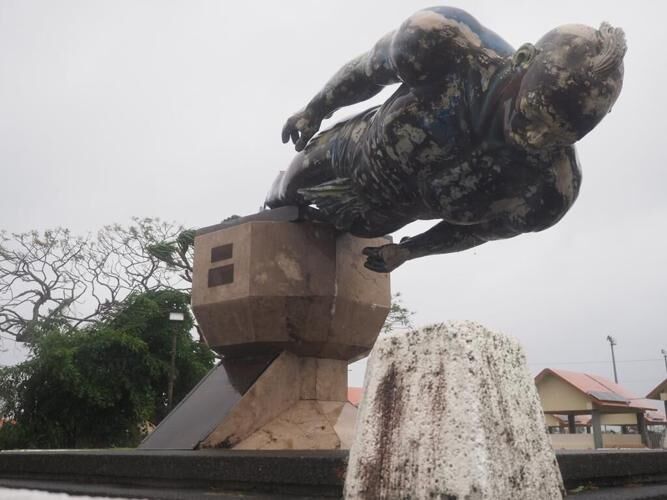
The statue of Chief Kepuha in Hagåtña is seen severely damaged in the aftermath of Typhoon Mawar on Thursday, May 25, 2023.
