






HAGÅTÑA (The Guam Daily Post) — The Guam Waterworks Authority is already in the process of installing treatment systems at water well locations that yielded the highest concentrations of dieldrin, a banned insecticide, according to GWA General Manager Miguel Bordallo.
“Engineering assessment and design work is being conducted now with construction activities to follow as soon as possible,” said Bordallo, who noted that these actions are being done in response to concerns from the Guam Environmental Protection Agency and in advance of any regulatory requirements.
Dieldrin was banned for all uses in 1987 along with a similar insecticide, aldrin. The latter tends to convert into the former, so it’s only dieldrin that’s seen in the water supply, according to presentations at the December meeting of the Guam EPA board.
There are no federal maximum contaminant levels for either chemical, but the U.S. Environmental Protection Agency does classify them as probable human carcinogens. Guam EPA is now working on developing interim action levels whenever dieldrin is detected in the water supply.
The proposed action levels include a notification level, which will mandate public notification whenever dieldrin concentrations are detected at 0.002 micrograms per liter at production wells, and a response level, which will mandate a “do not drink without treatment” advisory when concentrations reach 0.2 micrograms per liter.
It was reported in the December Guam EPA board meeting that 80 GWA entry points yielded dieldrin sample results over 0.01 micrograms per liter.
Production wells with the highest concentrations of dieldrin – Y-15, D-17 and M-4 – had above 0.2 micrograms per liter of the chemical, which would trigger the response level if it were already in effect.
“Public notification of dieldrin in GWA’s water supply has been contained in GWA’s annual water quality reports. Additional notifications and advisories will be issued once the necessary and appropriate information is received from Guam EPA,” Bordallo told The Guam Daily Post.
U.S. Naval Base Guam and Andersen Air Force Base do not currently report dieldrin results, but 2007 results from the Navy did show concentrations above 0.01 micrograms per liter at seven entry points, according to discussions at the December Guam EPA board meeting.
In light of these reports, the Post asked GWA what kind of filtration or treatment systems are already in place for dieldrin.
According to Bordallo, Guam EPA and GWA have discussed the use of granular activated carbon treatment systems for the removal of dieldrin compounds. These systems are already in use at a few locations for the treatment of chemical compounds, such as the much-talked-about per- and polyfluoroalkyl substances, or PFAS. But Bordallo said they are not for dieldrin as it wasn’t until recently that U.S. EPA or Guam EPA raised that concern.
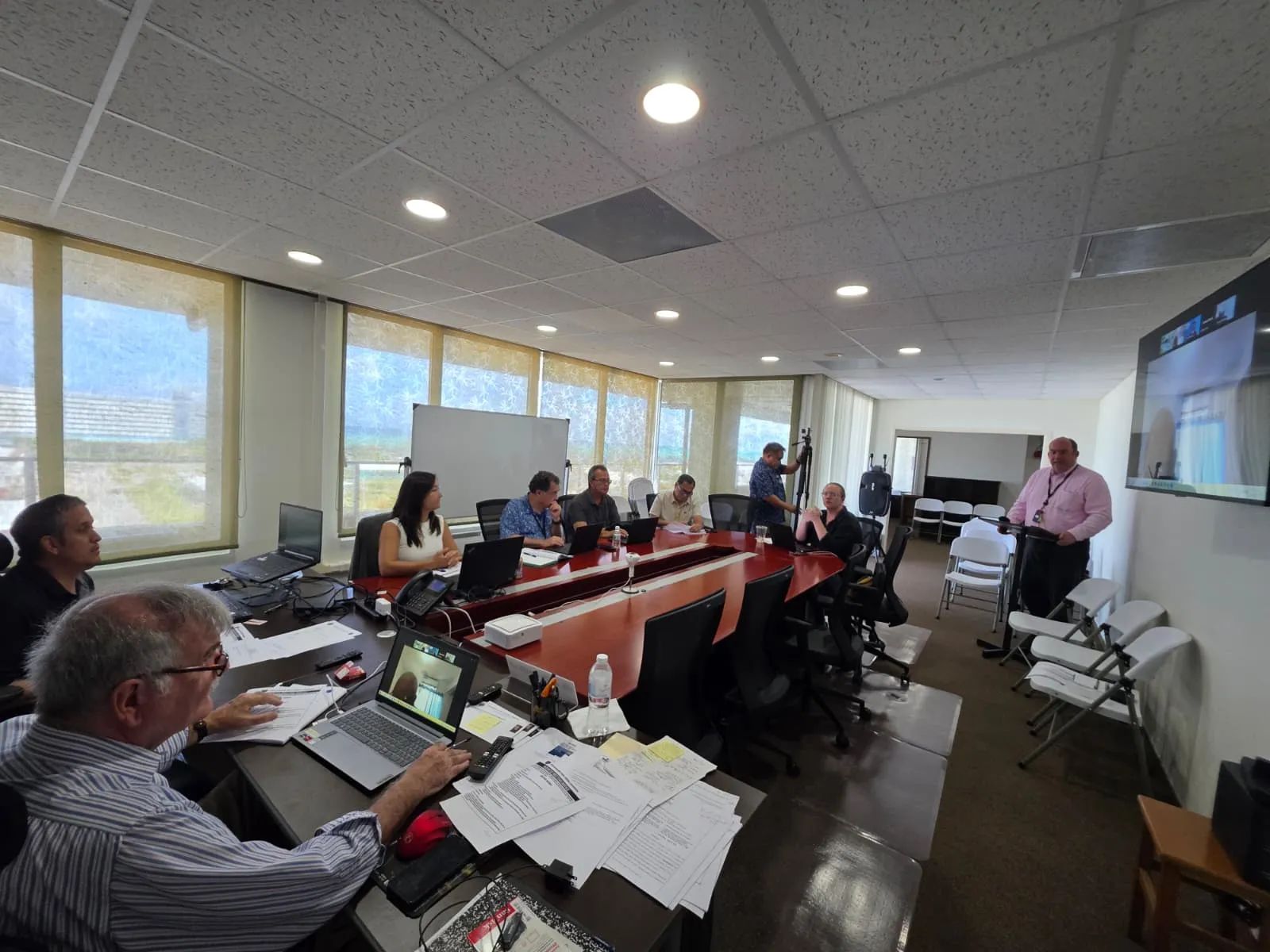
Guam EPA has to go through its own procedures before its proposed interim action levels can be implemented. The agency has to issue a public notice regarding the proposal and then hold a public hearing and gather input before the interim action levels can be brought to the board for final action, according to discussions at the December meeting.
In the meantime, the agency is investigating where the dieldrin could be coming from.

A Guam Waterworks Authority water tank on Wednesday, Dec. 20, 2023, in Agana Heights.
