







SUBSTANCE abuse counselor Grace Pitu Sablan-Vaiagae on Thursday told the House Committee on Official Conduct and Ethics, “If you are neutral in situations of injustice, then you have chosen the side of the oppressor.”
Sablan-Vaiagae was one of those who lodged a complaint with the committee accusing Rep. Edwin Propst of committing sexual abuse about 20 years ago.
The other complainant is Robert Hunter, a former senior policy advisor to Gov. Ralph DLG Torres. Hunter accused Propst of threats and inappropriate language on social media in December last year.
Chaired by Rep. Donald Manglona, the committee voted to obtain more information on Sablan-Vaiagae’s complaint and to move ahead with the investigation of Hunter’s complaint.
The members of the committee are Reps. Sheila J. Babauta, Leila Staffler, Corina Magofna, Joseph Leepan Guerrero, Patrick San Nicolas and House Minority Leader Angel Demapan.
It was Rep. Leepan Guerrero who recommended that the committee table Sablan-Vaiagae’s complaint until the committee obtains more information from the Department of Public Safety.
‘Don’t be neutral’
Sablan-Vaiagae who is also a former educator and an advocate for women and children, quoted Blaise Pascal at the end of her testimony, saying, “If an elephant has its foot on the tail of a mouse and you say that you are neutral, the mouse will not appreciate your neutrality.”
She urged the committee members to protect the victims’ personal rights.
She told them that personal rights, privacy and security “are important for victims and/or survivors of sexual abuse as it can be traumatic and scarring, hence long-term symptoms include anxiety, fear, or post-traumatic stress disorder.”
The committee, she added, must not merely investigate a representative “who has been alleged to have committed such behavior with minors while assuming the role of a professional. Rather, it is also allowing for victims to feel safe and be able to come forth and disclose their experience whether you believe them or not.”
Sablan-Vaiagae said the venue of the hearings is critical “as it will determine if victims and witnesses will come forth, as well as how you go about it. This is a very sensitive matter at hand and confidentiality is a must where the victims are assured that their identity is protected.”
She asked lawmakers the following questions:
• Will the committee rules also take into consideration confidentiality and protection of victims?
• The location where a hearing will be held is critical. The public should not be present when victims are walking in. Will the hearing be open to the public when there are witnesses and victims testifying?
• Will there be restitution?
• Who pays for treatment for victims? Will the perpetrator pay?
• Will there be a psychological evaluation if deemed necessary?
• Will the Community Guidance Center be involved?
‘Moral turpitude’
Sablan-Vaiagae told the committee that a probable cause for investigation is clearly a “moral turpitude” manner “where it is evident that [a member of] the House of Representatives has violated the constitution in the regard of sexually abusing women assumed to be minor as well as [women who were] eighteen years of age.”
She added, “His role as a teacher clearly is to be in authority with trusted leadership to ensure his pupils were protected and safeguarded from personal interests or gain. [T]he…victims’ report…and the detailed encounters written in the Department of Public Safety investigative report are of great concern and noteworthy of further inquiry, probing and/or investigation.”
She told lawmakers that sexual violence “is a pervasive problem and prevalent on Saipan. Studies show that personal, societal, and legal hurdles often prevent survivors from disclosing abuse and receiving the help they deserve.”
In the CNMI, she said there are documented and undocumented reports of sexual abuse and it is currently a hurdle to obtain statistics to determine the level of the problem’s severity as the CNMI is fairly new in addressing such issues.
“Cultural norms and traditions play a role where shame and fear prevent many victims and survivors from reporting abuse. Our community and society have become permissive in the form of tolerance and ignorance. We no longer look at evil as wrong, it has become a norm and when the whole of society turns a blind eye to such behavior, it becomes an accepted and tolerable normalcy of lifestyle. That is what ‘turpitude’ translates to and this is where ‘we the people, for the people, of the people’ are no longer the foothold of what our constitution stands for,” she said.
“Conduct of behavior however far back, is unbecoming of a statesman and brings to light the standards and precedents that the legislative branch of government is allowing to go unnoticed…and/or brushed off as if it never happened,” she added.
“Today is the swearing-in of ethics committee members and adopting their rules of conduct. I would like to make mention that the Constitution should be the ruler of ethics and moral compass of directing this body of decision-making leaders elected by the people to now ensure that justice is served…. When you ran for office and got elected to sit in that official seat, you made a vow to represent your constituents.”

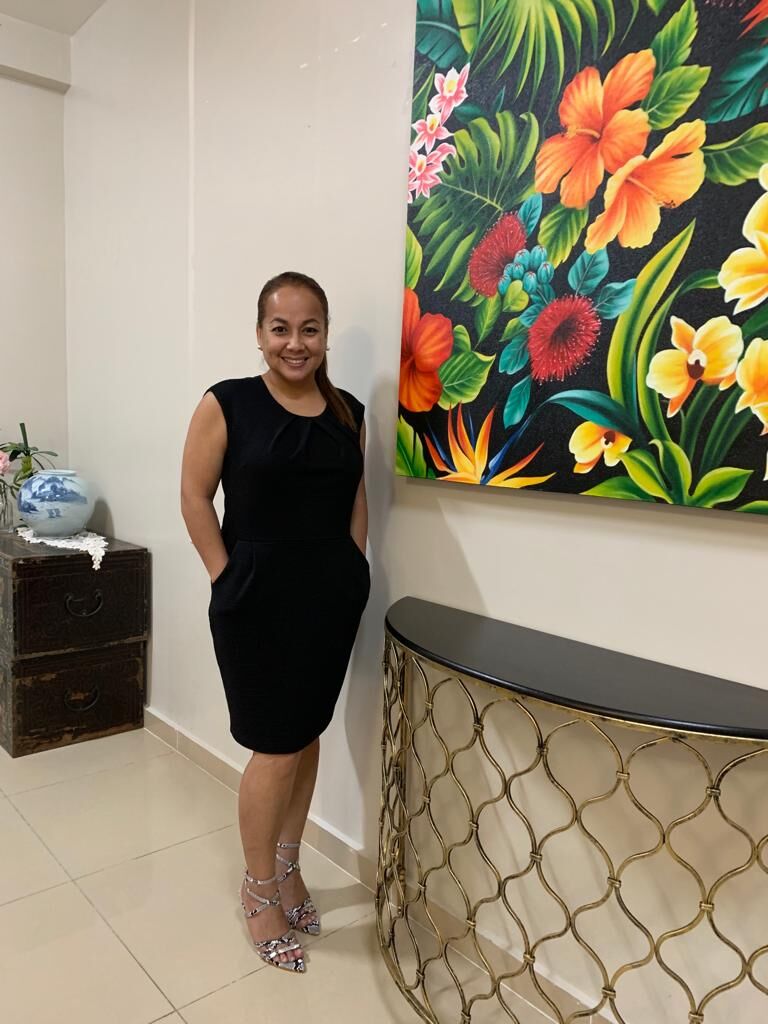
Grace Pitu Sablan-Vaiagae
