




THE House Judiciary and Governmental Operations continued its hearing on Friday morning with Department of Public Safety-Boating Safety Lt. Emery Kaipat and designated interpreter Jesus Elameto exchanging arguments about the Refaluwasch or Carolinian language.
Reading from a statement, Elameto said he felt offended by Kaipat’s use of their indigenous language — “which is an insult to Carolinian culture” — to disrupt an investigation.”
“In your letter written in plain English, you asked to testify in Carolinian,” Elameto told Kaipat. “The committee granted the request. The committee chairwoman has told you and your counsel that you may testify or speak in Carolinian, or Chamorro, or English. How you respond to the questions is entirely up to you.”
Elameto said when Kaipat was sworn in, “the oath was in English, and you responded in Carolinian without any problems. So just to be clear, we will ask questions in English, if you can understand the question, there is no need to translate anything that you already understand.”
Elameto said the committee chairwoman, Rep. Celina Babauta, “will provide any translation of the English question if you do not understand the question. You may also utilize your interpreter Mrs. [Florence] Kirby if you prefer. And again, you may respond to the question in Carolinian or any language that you prefer.”
Elameto distributed copies of his statement to the people in the House gallery.
Kaipat, through his legal counsel, Anthony Aguon, requested the committee to allow him to read his own statement.
The committee said Kaipat could read his statement during recess. Aguon objected and asked to allow his client to read his statement for the record. The committee said no.
Highest law
Kaipat then read his statement during recess and distributed copies of it to the people in the House gallery.
“The Constitution protects my rights and the rights of the people,” he said. “The Constitution is the highest law in the CNMI. And the inclusion of Chamorro and Carolinian as the official languages of the Commonwealth in the Constitution is a recognition of the culture and traditions of our people. The government should encourage the usage and preservation of our native languages. Instead, the committee’s decision to deny my simple and reasonable request to have its questions translated into Carolinian has turned my testimony into a big spectacle, which only discourages the use and preservation of our native language.”
Kaipat said the local Supreme Court’s opinion “also protects my rights. The Supreme Court is the highest court in the CNMI and has ruled that a native speaker has an absolute right when it comes to his native language. The CNMI Supreme Court has said that it is not about proficiency in English. I am a native Carolinian. Carolinian is my native tongue that I grew up speaking and it is the language that I am most comfortable with. To be clear, I never stated that I was unable to understand English. I can speak English and Chamorro as well. But, I understand best in Carolinian. This is not an issue of my proficiency in English and this is not an attempt to delay my testimony. This is about making sure that I understand your questions fully and clearly, so that I may provide the best response. And most importantly, this is about promoting and preserving the culture of our islands.”
Kaipat said the committee “questioned the content of my notice to speak in Carolinian but has laid no rules or procedures on how to go about making such request or how any of those requests are processed. The committee also doesn’t have any procedures for how translations are made at hearings. When a prior witness provided the same notice to testify, but in Chamorro, a translator sat next to the chairwoman and statements by both the committee and the witness were translated right after they were spoken. At the next hearing for the same witness, the committee decided to limit translations only to when questions were directed at the witness. Now, the committee insists that it will only provide translations when I request them. Yet, when I did request…for each of the committee’s questions to be translated after it was asked, the committee still refused to do so.”
Boat trips
The committee, which is looking into Gov. Ralph DLG Torres’s public expenditures, then presented to Kaipat several documents including log sheets pertaining to the governor’s several trips to Guam using DPS Boating Safety boats.
To most of the questions, Kaipat’s answers in Carolinian were either “I don’t remember” or “I don’t know.”
The committee then recessed at lunchtime and resumed the hearing at 2 p.m.
Several more boating trip documents were presented by the committee to Kaipat who answered “I don’t remember” to most of the questions.
Toward the end of the hearing, the committee chair, Celina Babauta said: “It’s our duty to continue with this examination of the governor’s expenditures of public funds. Thank you for your cooperation. We are serious about our job that we do for the people of the Marianas.”
On Monday, Aug. 30, the committee will hear the testimony of the DPS-Boating Safety chief, Capt. Kelvin Aldan.

The designated translator of the House Judiciary and Governmental Operations Committee, Jesus Elameto, speaks during a hearing in the House chamber on Friday.
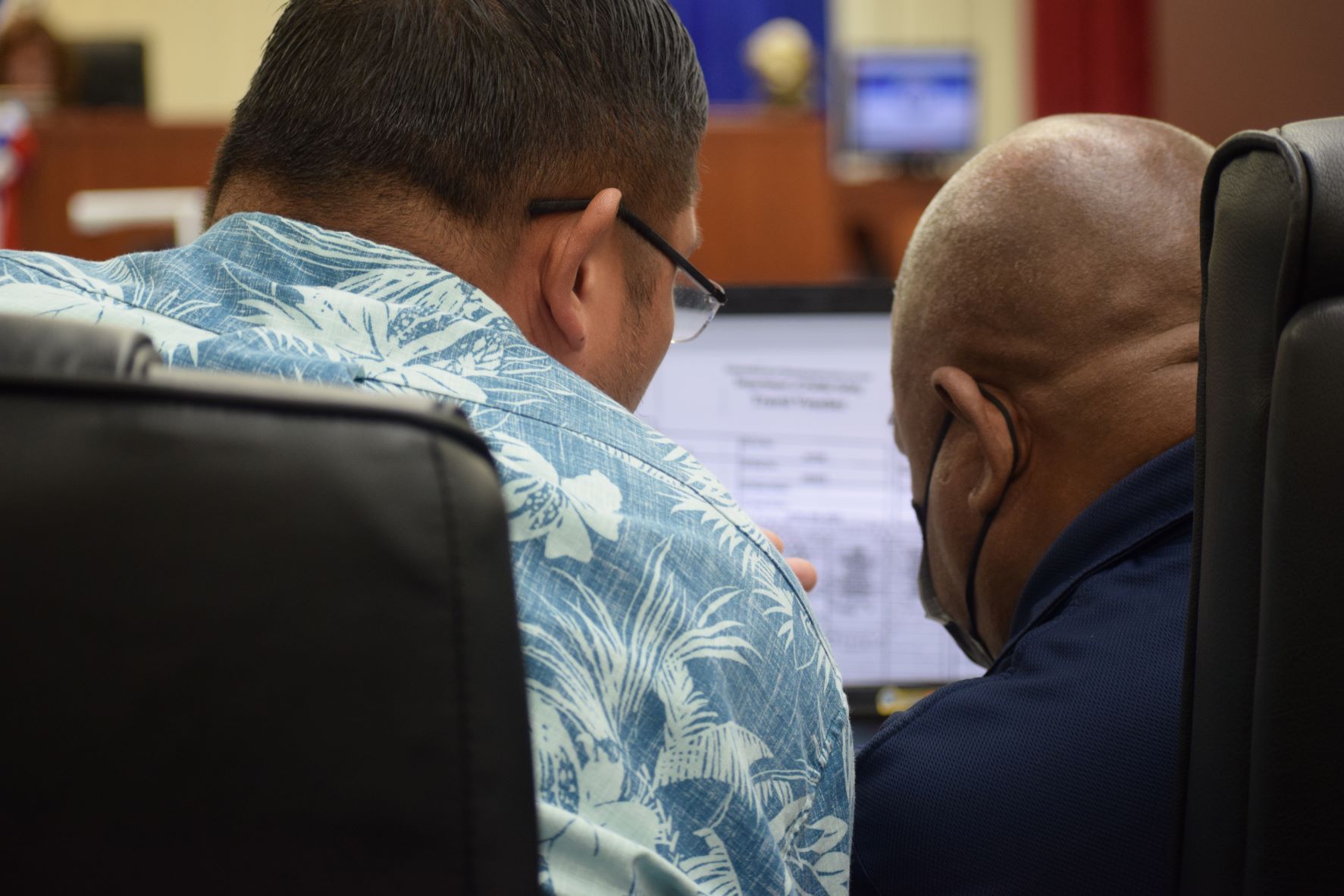
Department of Public Safety-Boating Safety Lt. Emery Kaipat, right, listens to his legal counsel, Anthony Aguon, during a hearing in the House chamber on Friday.
