




HAGÅTÑA (The Guam Daily Post) — Two sides, but one goal.
That’s how District Court of Guam Chief Judge Frances Tydingco-Gatewood on Monday described the “difficult” situation the Archdiocese of Agana and the survivors of sexual assault find themselves in, as both parties identify sources of assets to compensate more than 290 abuse claimants.
The judge said she believes both parties have the same goal of compensating the “many victims” of clergy abuse.
“It comes down to what the archdiocese is capable of paying without losing their entire community. That’s really the bottom line,” the judge said on the second day of the trial that would determine whether the assets of Catholic parishes and schools could be used to pay clergy sex abuse survivors.
However, no amount can ever restore the survivors’ “lives or innocence,” even if there’s $500 million available, Judge Tydingco-Gatewood said.
The Archdiocese of Agana’s latest plan to get out of bankruptcy involves a proposal of up to $34 million for abuse survivors’ compensation.
The committee of creditors representing mainly abuse survivors, meanwhile, is proposing payouts to be at a minimum of $100 million from insurance firms and real property assets, including the assets of parishes and schools.
The judge shared her thoughts about the case after archdiocese attorney Keith Talbott suggested witnesses’ testimony should not be cut off just by sharing their beliefs based on canon law or the law of the Catholic Church.
Attorney Edwin Caldie, representing the Official Committee of Unsecured Creditors, objected to the suggestion, saying it would entangle the court in canon law.
It was the second day of the marathon trial, which starts at 8 a.m. and ends at 3:30 p.m. daily over the next two weeks.
Archbishop as witness
Archbishop Michael Jude Byrnes, who took the witness stand Monday, acknowledged the archdiocese’s stand that he, as archbishop, only holds the assets of schools and parishes in trust, for the benefit of schools and parishes.
Responding to a series of questions, the archbishop said he signs off on parish and schools’ spending exceeding $25,000.
Caldie said because the archbishop himself described the Catholic Church on Guam as “one body,” he, therefore, administers the church for the benefit of the whole archdiocese.
Hundreds of pages of documents were marked and admitted as evidence, including the archdiocese’s original and amended articles of incorporation and Byrnes’ statements about the filing of the archdiocese’s bankruptcy in January 2019.
At the time, Byrnes asked parishes, schools and other entities under the archdiocese to comply with financial restrictions during the Chapter 11 bankruptcy.
‘Planning, scrutiny and prayers’
Former Archdiocesan Finance Council President Richard Untalan, who also took the witness stand, testified on the finance council’s work in 2016 to 2018 in identifying so-called essential and nonessential assets of the whole archdiocese, including parishes and schools, that could be used to “settle” the claims of survivors of clergy sexual assault.
Untalan, a real estate developer who holds a law degree, said there was a lot of pushback from the parishes and schools at the time, until Byrnes asked “everyone” for their help.
He also corroborated earlier witness testimony of the financial difficulties the archdiocese, its schools and parishes faced, at the time the council was tasked to assess the archdiocese’s assets and debts.
Untalan said there was lots of “planning, scrutiny and prayers” that went on.
At the time, he said, there was some confusion about some of the properties they thought were owned by the archdiocese, but that were later found to be owned by other entities such as the Sisters of Mercy and the Catholic Social Service.
Leo Tudela, the chairman of the creditors’ committee representing survivors of clergy assault, was also present in court Monday, along with committee co-counsel Andrew Glasnovich.
Donations
The judge also heard from three other witnesses who are parishioners from Yigo, Toto and Chalan Pago, including Francis Guerrero, Maria Taitano and Joseph I. Cruz.
Archdiocese attorney Geri Diaz asked them about their individual parish operations and finances, as well as the local culture and traditions of families donating properties for use as parishes and schools.
Caldie asked the parishioner-witnesses whether they would ask the archbishop or the archdiocese to give them back their donations to their parish in the event their parish building closes or is merged with another parish.
“No” was the consistent answer from the parishioners.
The creditors’ committee argued earlier that at the time the donations of properties were made, there was no intent to create a resulting trust that the archdiocese is now using to shield school and parish assets.

Archbishop Michael Jude Byrnes leaves the federal court in Hagåtña after testifying Monday.
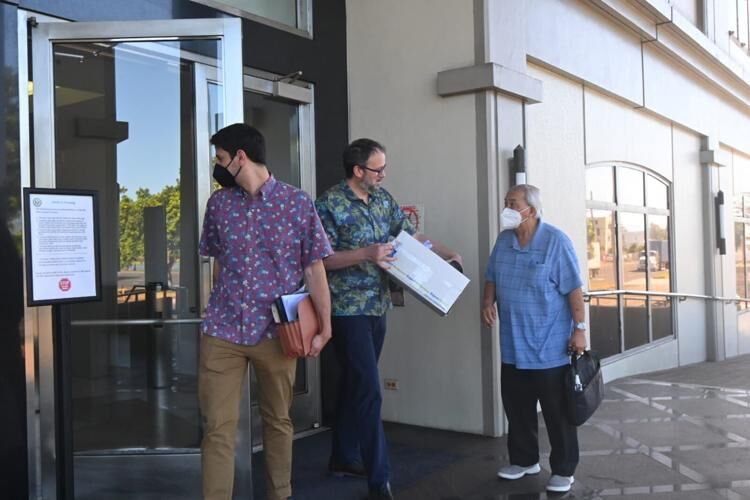
Edwin Caldie, attorney for the Official Committee of Unsecured Creditors, speaks with Leo Tudela, right, who represents clergy sex abuse survivors, as they and co-counsel Andrew Glasnovich exit the federal court Monday in Hagåtña.
