




Students from most of the 441 congressional districts around the country compete to have their art displayed at the U.S. Capitol for a year. Tomokane, a Kagman High School junior, is this year’s winner from the Northern Marianas, selected from about two dozen contestants by a panel of local artists.
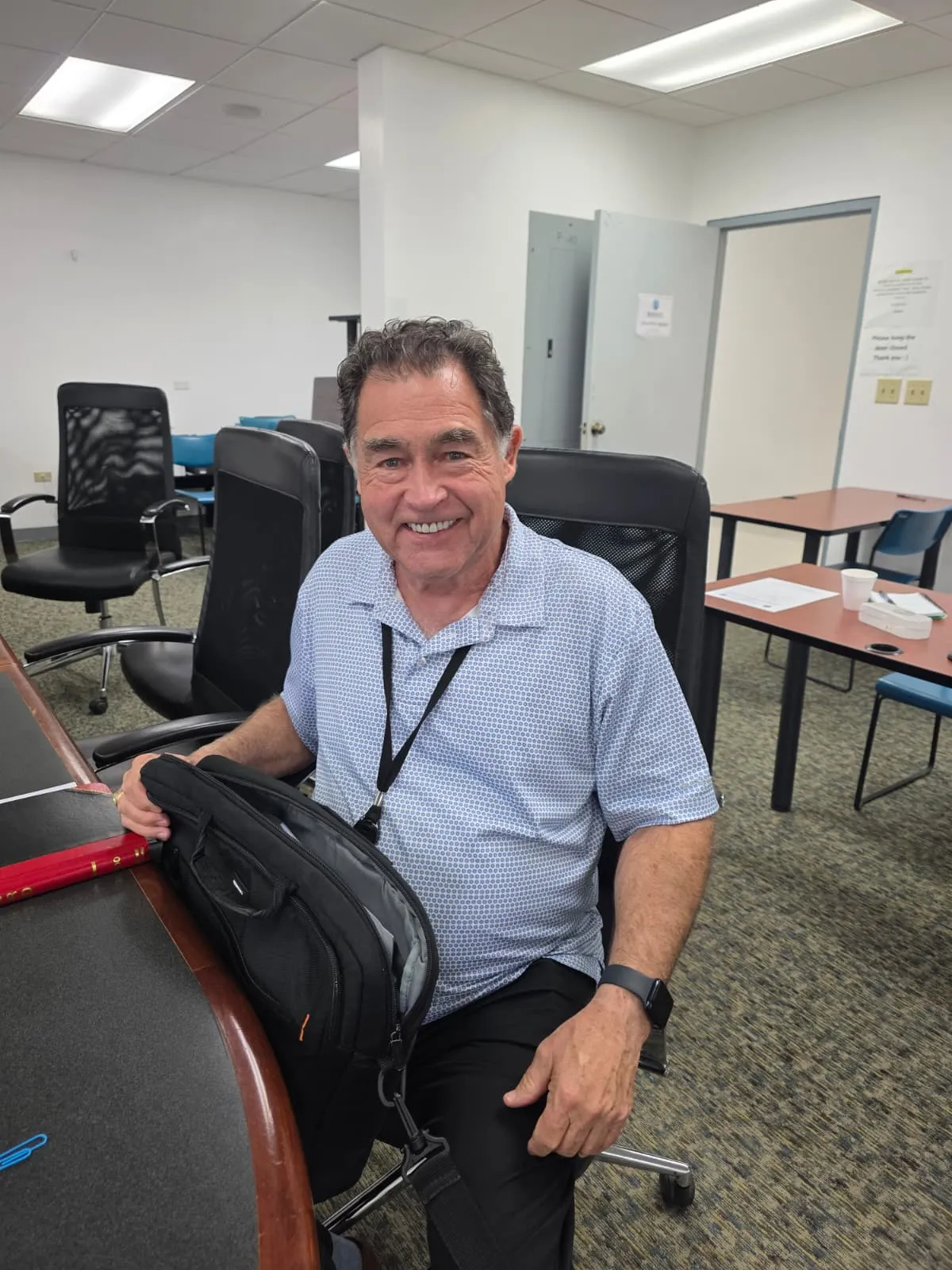
While at the office of Congressman Gregorio Kilili Camacho Sablan, Tomokane and Aldan talked about their experience and about the role of art in education.
What was your reaction when you saw the art downstairs from all 50 states and the territories?
Peter Aldan: Hard to believe that students did that work. The quality, the professionalism, everything was there, evident. I’m glad that we were able to see that and he’s able to see, also, what the rest of the world does for art. That was a good learning experience for both of us.
Were you inspired by what you saw? Or did you see things that were surprising to you?
Aaron Tomokane: I was surprised by a lot of them. I didn’t know that teenagers my age could do a lot of stuff that I saw. And I’d advise my fellow classmates or peers that whoever would join this competition next year to not have second thoughts about it. Just go for it. Don’t think about it. Just do it. Because there’s a lot of amazing stuff that can happen through art.
Peter Aldan: I’m going to expand on Aaron’s response: to take every opportunity that comes at you. Because whether it’s a competition or not. There’s still an opportunity there to express yourself and to make a difference, to make some kind of a change, to give an impression to somebody else.
Aaron, can you think of anything specifically that surprised you that you saw in the art downstairs?
Like the different ways that people can do art. Like with acrylics, oils, charcoal. I mean I only grew up using a pencil and a sharpie and that’s the farthest I ever used. I’d like to try out the new stuff that I haven’t done yet.
Have you been drawing for a long time?
Aaron Tomokane: I found out how to draw when I was in kindergarten. First year of school they asked us to draw in our journal and I drew dinosaurs eating people. You know, it was pretty good for a kindergartener.
Do you get a lot of encouragement and help in the school system? Are there good art classes?
Aaron Tomokane: I’ve never taken an art class. I get a lot of encouragement from everyone that’s seen the way I draw. And I thank a lot of them for that, because if it weren’t for that I know I wouldn’t even think about doing this whole thing. Mr. Aldan was the one who told me about this.
And he advised you?
Aaron Tomokane: Yeah, how to fulfill the theme for the drawing.
Peter Aldan: I haven’t had the chance to have [Aaron] as a student. But in the two years that I’ve been teaching [at Kagman] I always ask around and I find out through the word of mouth from students that Aaron is one of the guys that everybody asks to draw something for art — if they want something drawn they will check Aaron.
So when I was aware of the contest I approached him and told him that this was something that he really ought to think about doing.
We went through about a week and a half of just brainstorming, coaching, and getting him to finalize, and narrow his ideas.
Is there anything you would have done differently?
Aaron Tomokane: Took my time. I did it in, what, three hours.
Peter Aldan: Well three hours is physical labor, but mental labor can last days. There is a lot of outlining and planning prior to that. Once we had it laid down and he knew exactly what he wanted, it was a matter of dishing it out within a couple of class periods.
Do you start with the whole picture in your mind? Or do you just start drawing and develop the idea as it emerges on the paper?
Aaron Tomokane: Usually, when I do it, it tends to not turn out the way I first imagined the whole idea. But later on I just do it little by little and that’s how it builds, builds and then little by little it all works out together at the end.
What was the first part of your drawing?
Aaron Tomokane: The first part was the fire, the fire place, and then the clouds, and then that’s when I drew the coconut tree with the guy climbing it. And then Serena with her hair. And that’s when I started adding on all those, like the proa, Chief Aghurub, Taga, the Chamorro house, and then when I put everything together that’s when I put the final ink.
You started with the campfire and the people around the campfire telling stories.
Aaron Tomokane: Actually, it was the father telling the story to the two kids, a son and daughter. That was the theme so that was what I really wanted to fulfill.
A lot of schools around the country are cutting art programs, but apparently PSS has decided to put more money into art, because you’ve gotten a grant of Recovery Act funds to set up a pottery studio at Kagman High School. As an art teacher, what’s your vision of the role of art in the school system?
Peter Aldan: I’m aware that across the nation, across the world that art was one of those subjects that maybe wasn’t taken seriously at first. But recently there has been some kind of a renaissance in bringing it back.
Because in every subject, everything that we do, art is there. And it’s because of the arts that we’re able to understand diagrams, charts, tables — illustrations are sometimes easier to understand than the actual words.
Do all the students at Kagman High School get a chance to be in an art class at some point in their high school years?
Peter Aldan: The art class there is an elective. It falls under vocational education or, now, the career technical education, CTE. It’s not a grade level course. I have classes where, from ninth to twelfth grade, everyone is classmates with each other. Most of them come in early and a lot come in later on during their senior year after they’ve fulfilled all their credits.
But also within the first couple years I’ve managed to be able to address them by offering an Introduction to Art, and then in Art II we focus on a certain medium, printmaking. Hopefully with the grant, there’ll be an Art III class for the even more experienced and those who really want to take on the challenge.
Peter, what words of encouragement do you have for other aspiring artists in the Marianas?
Peter Aldan: My words of encouragement would be keep on doing what you’re doing. Because just as there are millions of different people in the world, there are a million different views and expressions, cultures, people, ideas, mentalities — and each one is entitled to that. So your work — whether you see it as fine art or something that’s scratched onto a wall — is still your art work. Not that I’m promoting graffiti or anything. But I’m saying whatever form it comes in, stick with it.
Aaron, will you be participating again next year?
Aaron Tomokane: Oh, yeah. So they have to go up against me. I’m sorry.
