

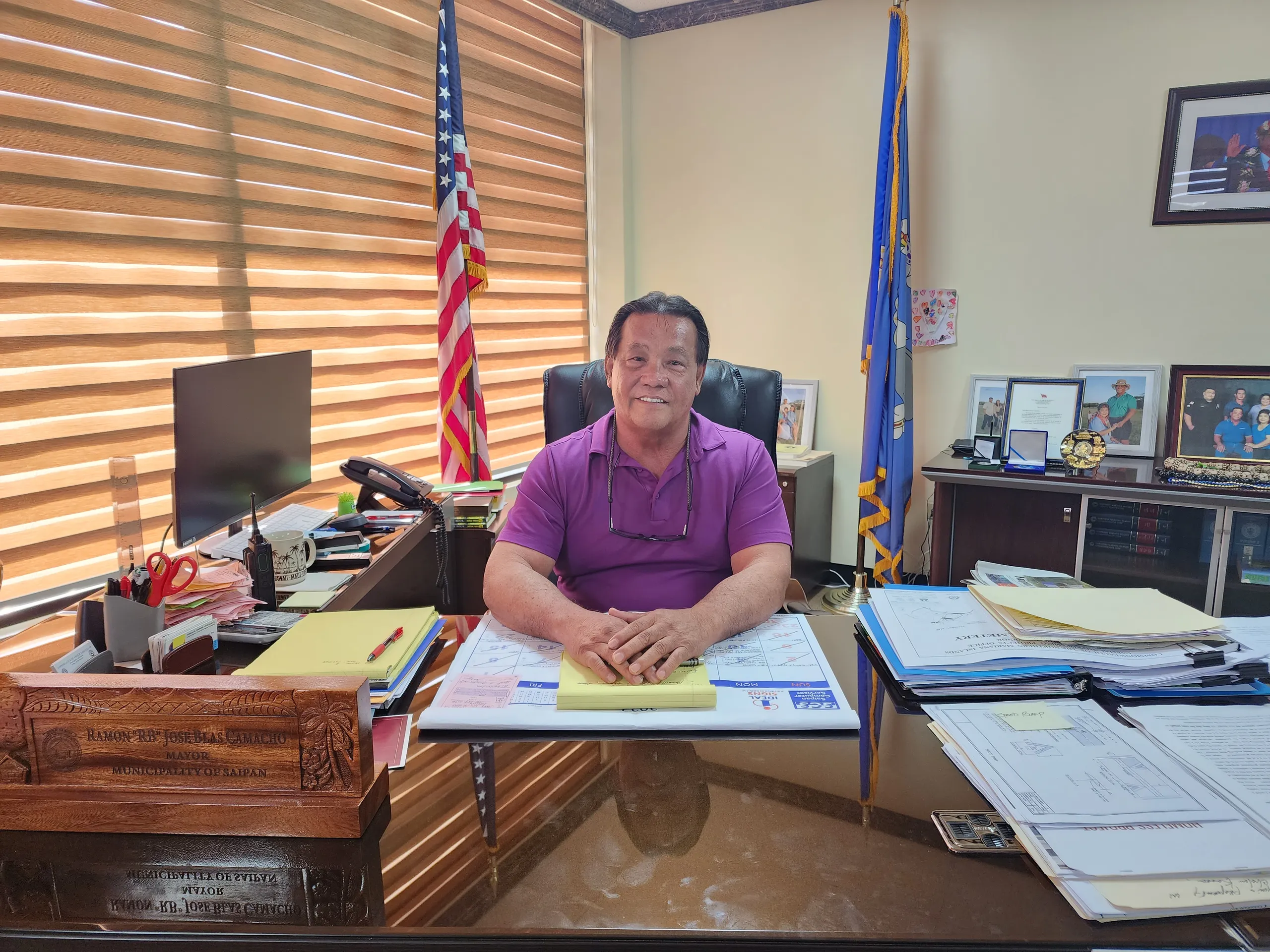

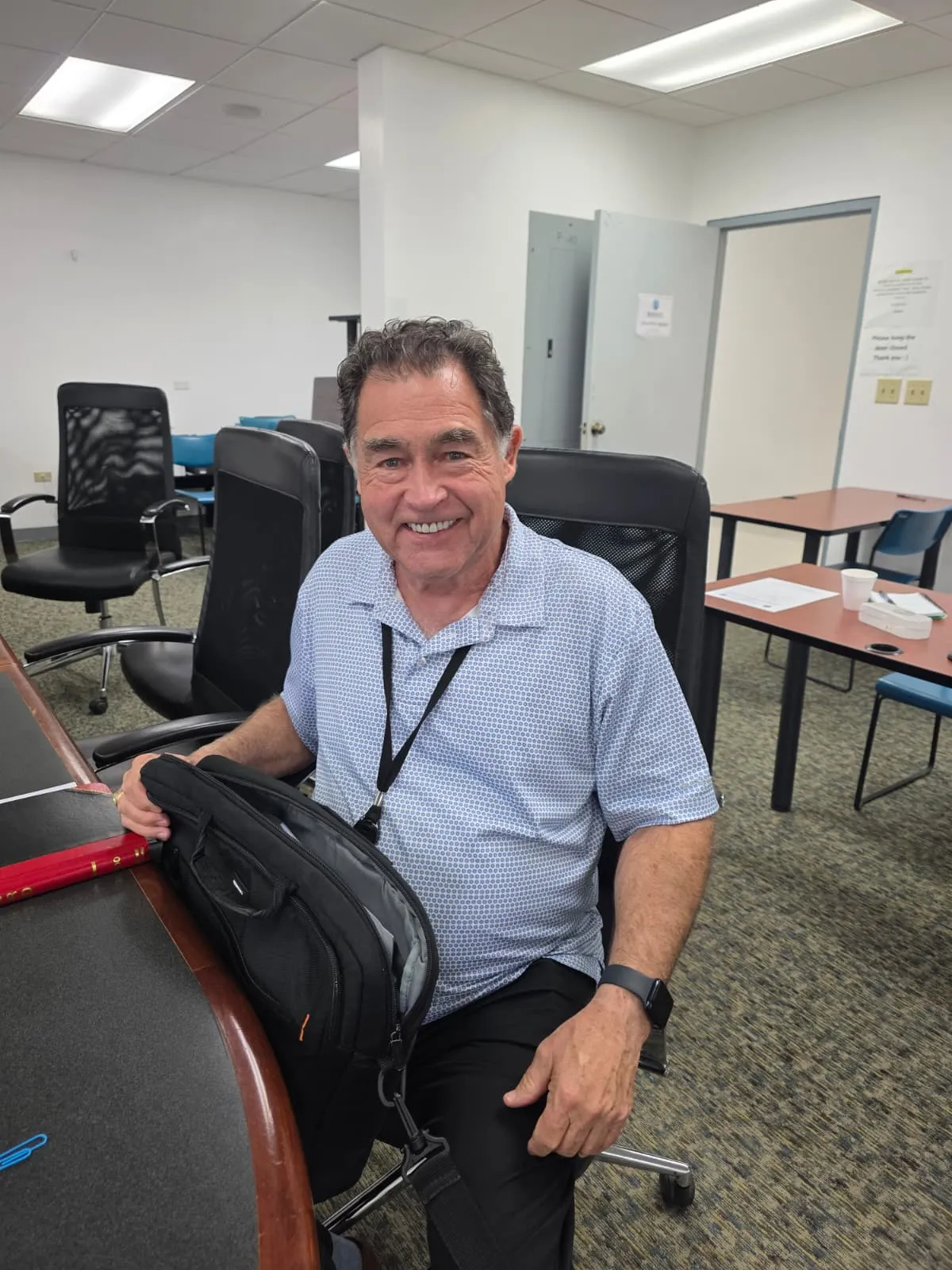
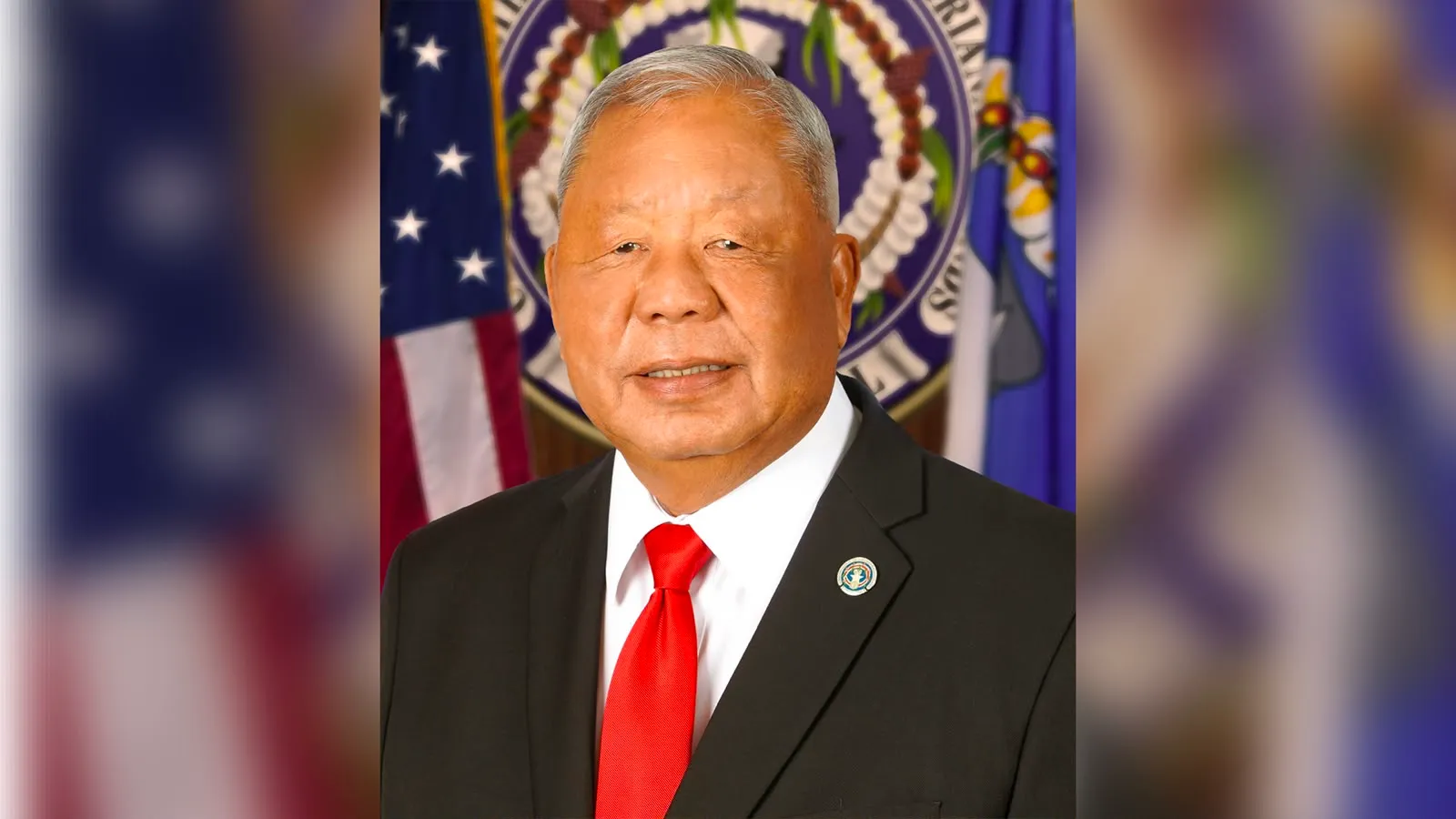


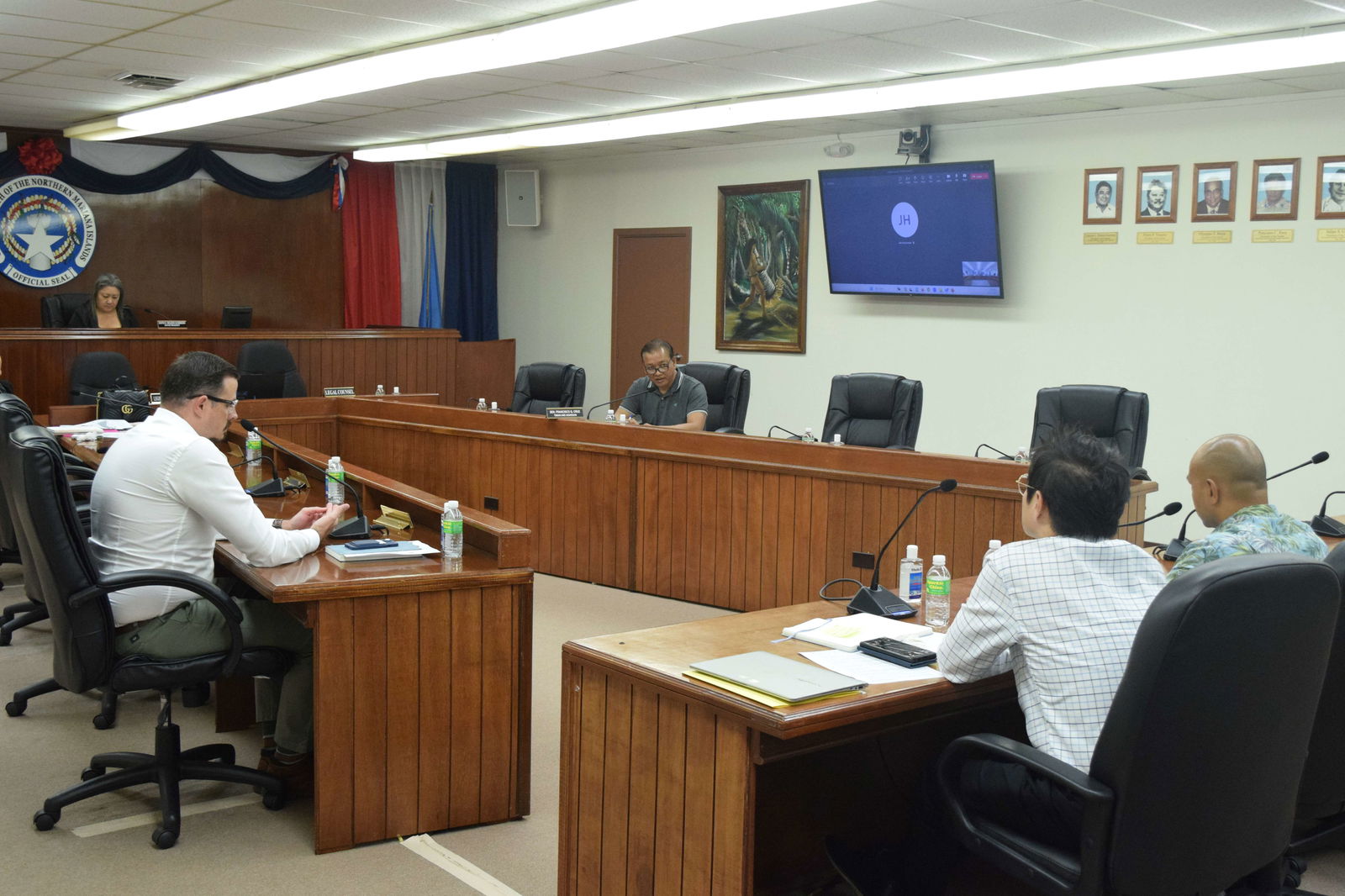
Senate President Edith Deleon Guerrero presides over a meeting with the officers and members of the Saipan Chamber of Commerce and the Hotel Association of the NMI in the Senate chamber on Wednesday.
THE recommendation by some U.S. lawmakers to implement the B-1/B-2 visa requirement for Chinese traveling to CNMI will be “devastating” to the Commonwealth, the Saipan Chamber of Commerce and the Hotel Association of the NMI told the Senate.
In a joint letter to Senate President Edith Deleon Guerrero on Tuesday, Chamber President Joe C. Guerrero and acting HANMI Board Chairman Dennis Seo expressed their concern about the joint letter of four U.S. senators and 24 U.S. House members to Department of Homeland Secretary Alejandro Mayorkas on Nov. 30, 2023, “strongly urging” him to change the visa policy for Chinese nationals entering the CNMI.
During a meeting with senators on Wednesday, Guerrero and Seo reiterated their concern and offered alternative ideas to address the national security issues without “killing” the CNMI’s tourism industry.
Prior to the pandemic, China was the CNMI’s second largest tourism market.
The chamber and HANMI said “Chinese tourism had made a significant impact on the CNMI economy,” and “have given rise to the expansion of local employment, growth of small businesses and provided significant amounts of government revenue to our community, which is reliant on tourism arrivals…to sustain commercial activity.”
With Guerrero and Seo were representatives from various hotels and other business establishments on island.
Society of Human Resource Management-CNMI Vice President Roman Tudela Jr. talked about the significant challenges their members are facing as a result of the decline in tourism arrivals.
These challenges, he said, include employment uncertainty, financial strain as well as mental health and well-being concerns among members of the private sector workforce.
The joint letter of Guerrero and Seo stated: “Solutions are available to our federal government partners to provide for the security of our national borders, but the solution proposed in the [U.S. lawmakers’] Nov. 30 letter comes with devastating costs to the CNMI and our ability to truly be the self-governing territory envisioned by the Covenant.”
They added, “Operating a sustainable economy in the CNMI is a greater challenge than in any other jurisdictions in the nation. These challenges were exacerbated by the disproportionate impact of natural disasters and the Covid-19 pandemic had on our economy and our way of life,” they said.
EVS-TAP
Guerrero and Seo said Section 702 of the Consolidated Natural Resources Act of 2008, which extended the U.S. immigration law to the CNMI, allows for the establishment of the CNMI Economic Vitality & Security Travel Authorization Program or EVS-TAP, as a restricted sub-program of the Guam-CNMI visa waiver program.
The EVS-TAP, they said, “would provide a remedy to the concerns of Congress and will safeguard our Commonwealth from unwanted visitor arrivals that may harm the security of our nation. The use of the Guam-CNMI visa waiver program formalizes the reality that the CNMI’s geographic location near the largest population centers of Asia, and our persistent limitations on diversification away from tourism requires the kind of unique access to tourism markets beyond those contained in the national visa waiver program as intended by the federal law.”
Guerrero and Seo said tourism is only one method by which Chinese nationals gain entry to the CNMI. They said Chinese nationals can also enter the CNMI and potentially overstay their authorization under the CNMI-Only transitional worker visa or CW-1. The misuse of the CW-1 program by Chinese nationals, Guerrero and Seo said, “suggests the need for stricter controls,” such as barring Chinese nationals from obtaining CW-1 permits for work in the CNMI to prevent illegal entry to Guam.
Everyone’s affected
Guerrero said he and the owners of the 140 other businesses in the CNMI want to share their concerns with the Palacios-Apatang administration and are seeking a dialogue “because we feel that we really need to work together.”
“It’s not about politics. This is about our own people. And I said this passionately because I am born and raised here. It pains me to see my relatives suffer because they can’t get a job or their work hours are cut. So this really is affecting everybody, especially the silent voice that we represent,” Guerrero told the senators.
The national security concern, Guerrero said, “is not new to us here. We are as patriotic as any Americans out there. So we don’t take that lightly. But I think at the end of the day, it’s [all about] finding a balance and speaking together as one, and then sitting down…talking and coming up with solutions.” He reiterated that EVS-TAP is very important, too, for national security “and for us here,” as he expressed hope that visa-waiver alone can resolve a lot of issues.
Dead economy
For her part, Senate President Edith Deleon Guerrero, said: “The reality is, our economy is dead. We don’t have sufficient revenue to bring everybody up to the standard, meaning, to give the life that they once lived before the pandemic, before Typhoon Yutu and all the disasters that happened. This is serious. I could see the impact.”
Deleon Guerrero said this is why there is an urgent need to hold 902 talks with the federal government.
“If they pull the discretionary parole program [for Chinese tourists], [they should] immediately implement also the EVS-TAP. I think that’s the ultimate direct solution right now as we speak with the urgency of what we are facing today here in the Commonwealth,” the Senate president added.
She said she appreciated the business leaders’ presence on Wednesday. “We had a very good conversation; I think we understand the urgency of what is facing us today. We are all in this. Without you, the private sector, there is no economy for the public sector. That is given.”
Strong voice
Sen. Frank Q. Cruz said, “It is important that elected leaders seriously get involved in this discussion.”
He said the U.S. Congress is concerned about Chinese nationals illegally entering Guam via the CNMI.
“I think they are making that a big issue,” he added. “If our own elected leaders get seriously involved, we are going to have a strong voice — perhaps a joint letter calling for the retention of the visa waiver.”
“And let’s not forget about U.S. Congressman Gregorio Kilili Camacho Sablan,” Cruz said. “He needs to be also involved in this. This is a very important issue affecting our tourism industry. Everyone should be working together for the betterment of the Commonwealth.”
In an interview after the meeting, Cruz asked, “Why should the CNMI suffer the consequence [of Chinese nationals illegally entering Guam] when we no longer have jurisdiction over immigration matters?”
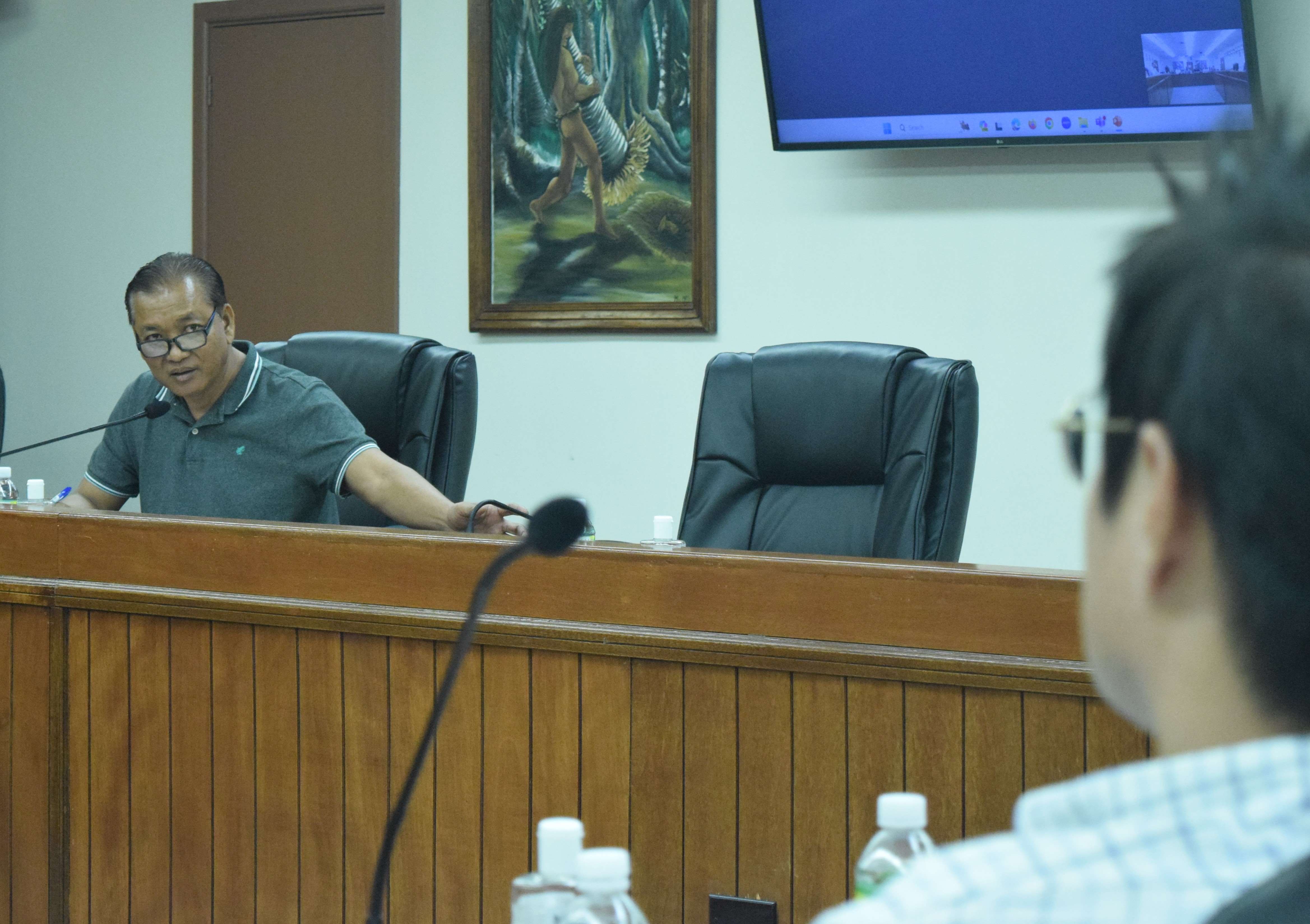
Sen. Frank Q. Cruz speaks during a meeting with officers and members of the Saipan Chamber of Commerce and the Hotel Association of the NMI in the Senate chamber on Wednesday.
