







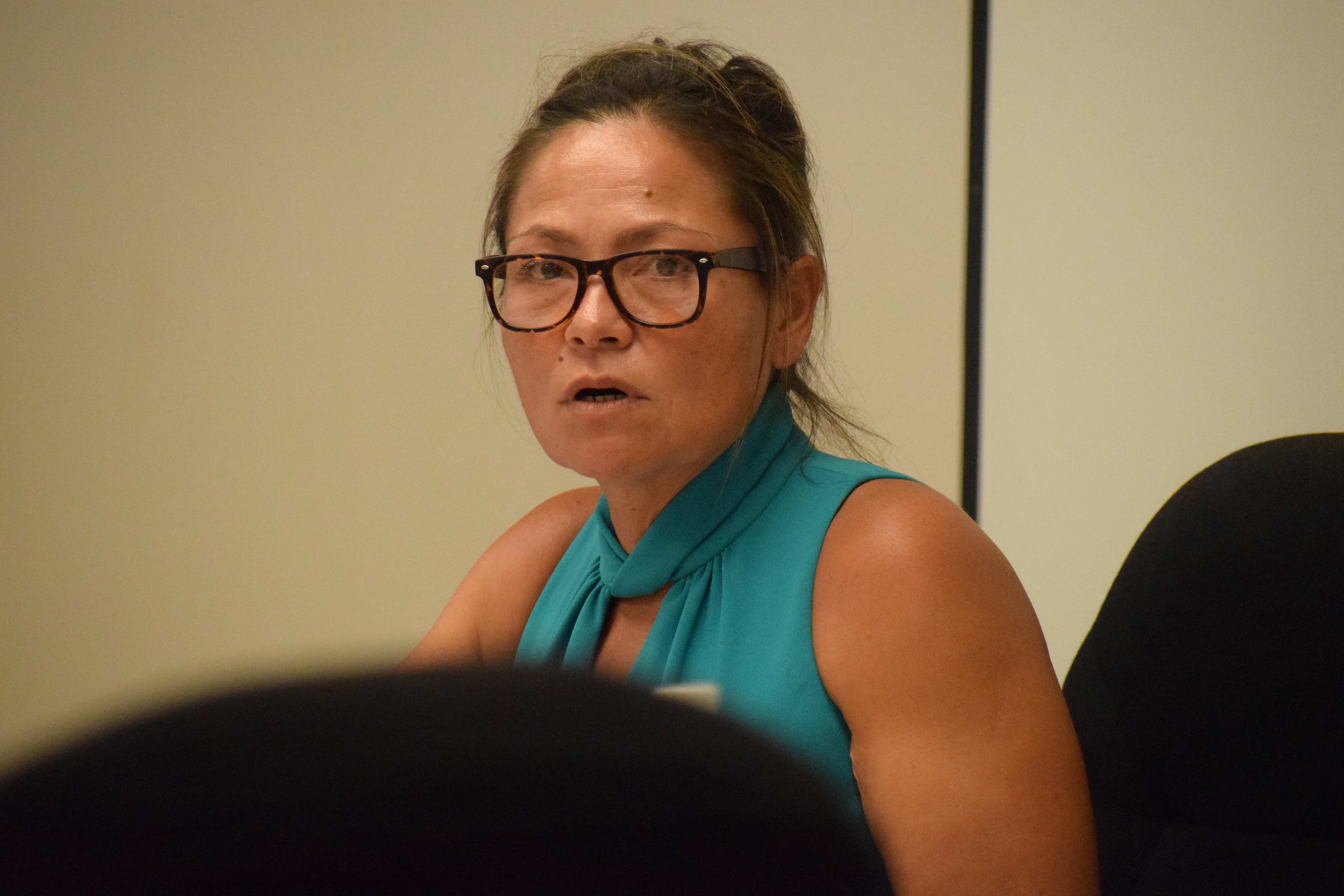
Commonwealth Port Authority Board Chair Kimberlyn King-Hinds speaks during a board meeting on Tuesday in the Aircraft Rescue and Firefighting classroom.
THE lack of Chinese tourists is hurting the Commonwealth Ports Authority, its board chairwoman, Kimberlyn King-Hinds, said.
CNMI tourist arrivals have not reached the pre-pandemic numbers, she added. “I tell you this, absent the China [tourist] market we will not reach those numbers unless we get a new market,” she added.
And that, in turn, “has a significant impact on CPA’s ability to keep its airport rates down,” she said.
“We are in a world of hurt because we don’t have the China market,” King-Hinds said.
Prior to the pandemic, China was the CNMI’s second largest tourism market.
In 2019, there were 185,536 arrivals from China, but this figure dropped to 18,550 in 2020; 12 in 2021; and 186 in 2022.
In April 2023, arrivals from China totaled 164; in May, 392; in June, 503; and in July, 1,075.
In March 2023, Gov. Arnold I. Palacios informed the U.S. military about “the CNMI’s pivot away from its reliance on the Chinese tourism market, which comprised more than 50% of our tourism base….”
CPA board meeting
On Thursday, Aug. 31, at 8 a.m., King-Hinds said the CPA board will act on a proposed fiscal year 2024 budget that will include proposals to raise charges and terminal rental rates at CNMI airports.
She said the board has adopted a new rate methodology based on cost recovery.
They are looking at “different scenarios” to try to reduce the impact on the airline carriers, in terms of airport fees and charges, King-Hinds said.
But “you [still] have to find money to operate, right?”
She said CPA’s FY 2024 budget will be lower than its current budget.
She noted the “increase in arrivals” reported by the Marianas Visitors Authority, but “if you compare post-pandemic numbers with pandemic numbers, then obviously it’s going to be ‘a thousand percent increase’ because we had zero during the pandemic.”
Comparing today’s tourist arrivals with the pre-pandemic numbers shows that “we are nowhere where we need to be,” she added.
She said even if CPA cuts its cost of operation, its ability to raise revenue will still be “minimal” because of the low arrival rates.
“So we anticipate what we have been saying since April. We are going to raise charges at the airport, significantly,” she added.
CPA is looking at, among other scenarios, a 79% increase in rates, she said. For example, the current terminal rent of $18 per square foot may increase to $32.78 in FY 2024.
“So how do you think that is going to work out and attract airlines?” King-Hinds asked.
“My job is to keep the airport open. And I will do whatever it takes to keep it open,” she said.
The CPA board is also considering the elimination of the airlines incentive program. “Do you think it’s a good idea to eliminate that program? However, that is a source of revenue. So all these are problematic, and all these are before the board. And because we have a deadline and a notice requirement for airlines, we have to adopt a budget by Thursday and it’s why we are having an emergency meeting on that day at 8 a.m.,” King-Hinds said.
She said CPA has to increase its airport rates because it no longer has American Rescue Plan Act funds to supplement its budget. Moreover, CPA no longer has an adequate number of carriers coming in to share the costs in terms of rentals and landing fees, she said.
Its budget is going to be lower because CPA will cut down its operations, King-Hinds said.
“And if the expectation is to get rid of employees, who’s going to run the airport? We go half-time operation? How is that going to impact our ability to attract more airlines? It makes me sick having to adopt a budget like this, but what option do we have?” she asked.
