



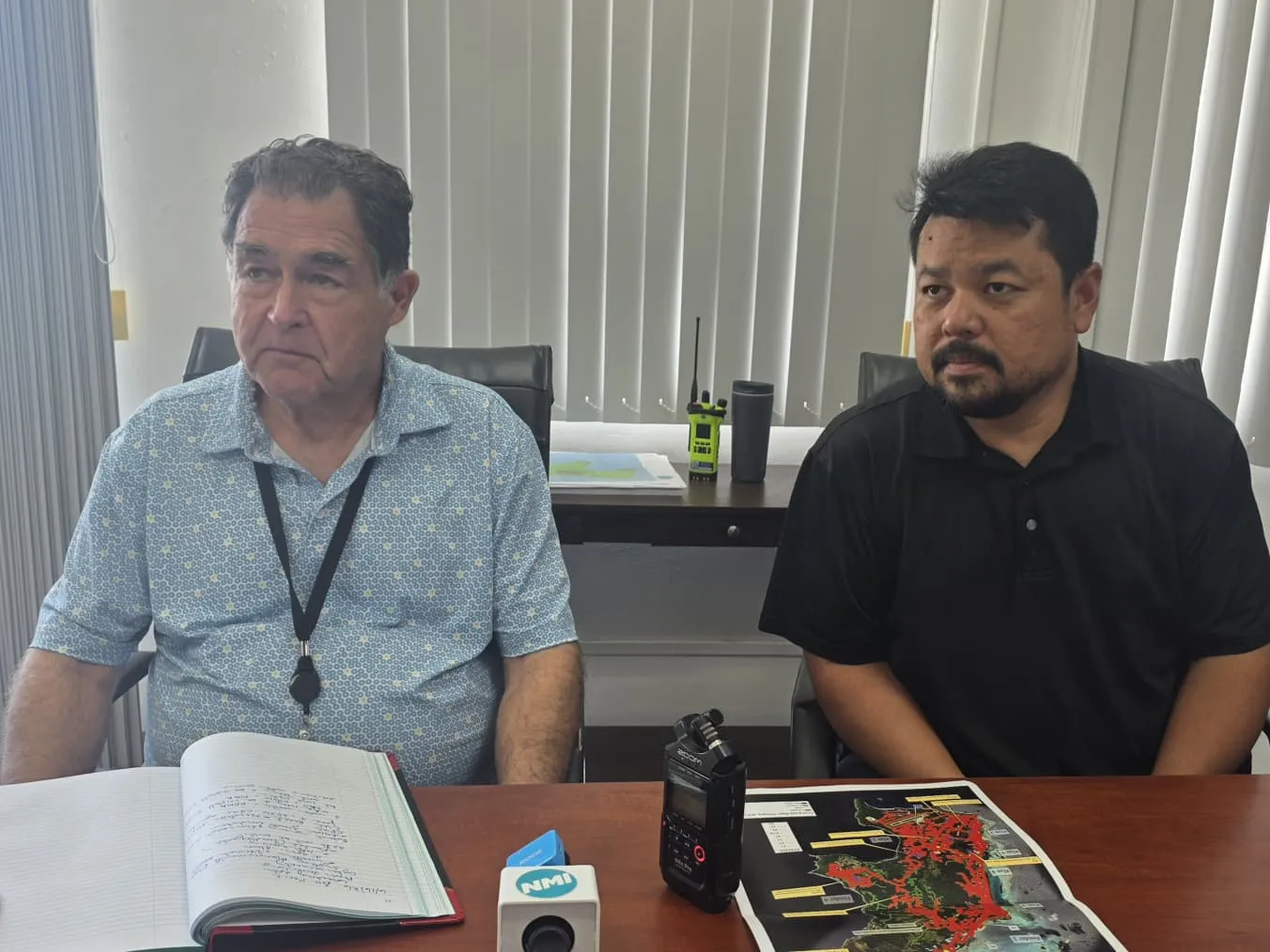


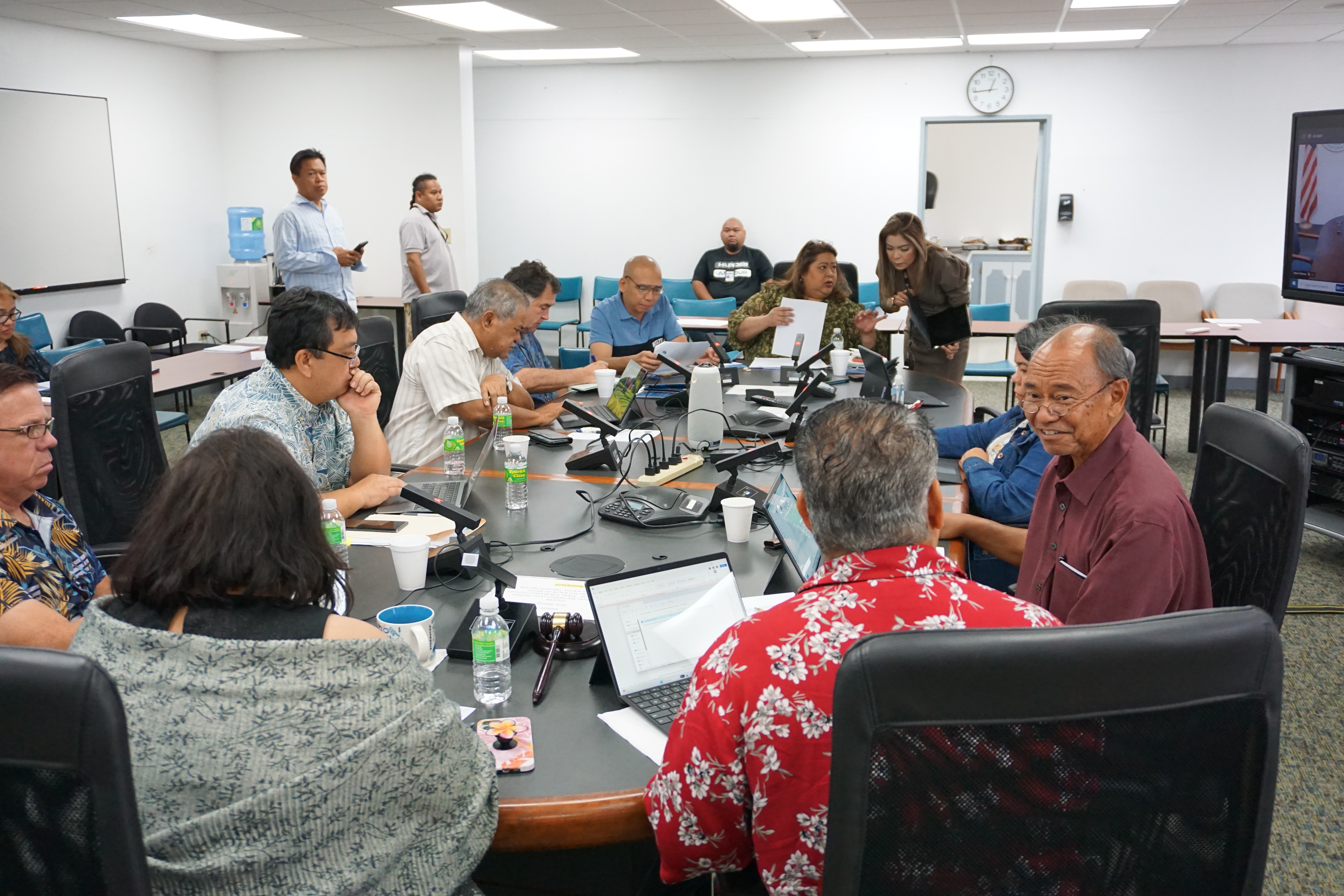
Commonwealth Utilities Corporation board member Simon Sanchez, right, speaks with a colleague, Allen Perez, during a break from a meeting Thursday.
“INSTEAD of suspending, or modifying the current net metering law, why not fix it all at once,” Commonwealth Utilities Corporation board member Simon Sanchez said on Thursday.
“We like the concept of fixing net metering, [but] we’re just concerned that the proposal to amend the current [law] may create more headaches than necessary and does not address the bigger problem,” he added. “It’s time to fix net metering for the CNMI so that we can move forward … but leave it in the hands of the two organizations that are expert on it, CUC, on the power side, and [the Commonwealth] Public Utilities Commission on the rate side,” Sanchez said.
It was CUC’s acting executive director, Betty Terlaje, who brought up the issue at CUC’s regular board meeting on Thursday.
She said the House Committee on Public Utilities, Transportation and Communication will hold a public hearing on a bill to suspend net metering on Feb. 2.
The bill was introduced by Rep. Vincent S. Aldan, who also chairs the House committee.
Terlaje said she was asked to testify regarding CUC’s position on the proposed suspension of the net metering law.
“It’s a four-year suspension,” she said. “I’m not sure why only four years…. I said it has always been CUC’s position that the net metering [law] was not written correctly. CUC was never asked for an input on the original net metering bill. When the bill was put to a vote, it passed and went through very quickly,” Terlaje added.
She said, “The way the bill was written is that … net metering customers can come in and apply, and they can install solar panels [for] up to 70% of their household’s usage, but the calculation is done by a solar company. In addition, a net metering customer cannot be charged any differently than a non-net metering customer in the same class. For example, there is no way you could actually charge a net metering customer for any standby cost that CUC would incur…. A net metering customer also gets full credit for what they produce … and that’s the law, and the only way to go around that is to repeal or modify it. We have been working with the Legislature, year after year, and about 15 years later, Rep. Aldan said he will suspend net metering while he also makes sure that we also don’t take away [anything] from the current net metering customers who have already invested in the program even though we are losing money from it.”
Terlaje added, “Basically if you guys are net metered customers, and you produce from your solar [panels] 1,000 kwh, but you only use 700 kwh, there is an excess of 300 kwh, so CUC has to pay for that 300 kwh. But CUC [can’t] charge any customer in the same class to recover the 300 kwh that we have to pay. [Regular] non-net metered customers [end up] paying for that because we take away from them [in terms of improvements on our power plants] to pay net metered customers…. The Legislature is saying that it’s not right, because it continues to hurt the customers, the same customers who are complaining and want a rate relief,” Terlaje said.
“We have not refunded any net metering customers, which the law requires us [to do]. [We’re supposed to] reconcile every 12 months and send a check to the customers. We have not done that since we implemented net metering,” she added.
CUC earlier said that it has 535 active customers under the net metering program, and 50 of those are commercial and government accounts while the rest are residential. Over 500 customers produce approximately around 4.8 megawatts of power, CUC added.
Sanchez said CUC should try to “fix all the problems.”
“Let’s model after other communities in the United States that have successfully dealt with these issues, such as Guam,” he said. “Let us just use the Guam model as a basis, and let’s see … which laws we can implement [in the] CNMI to solve the issues.”
Sanchez added, “The whole purpose of the net metering program was to allow consumers to be able to use what they generate to reduce the cost of their bill [and] to sell excess energy to other people…. If you save utility fuel, I will pay you the value of that fuel savings … but solar doesn’t pay for the grid, the generators that run at night that give them electricity — they don’t pay for that [and] they don’t pay for the people that operate the generators … so that’s where the issue is.”
Sanchez, a longtime Guam Consolidated Commission on Utilities member, said, “Rather than suspend, let’s come up with a better bill. Let’s work on a better bill now. Let CUC and PUTC figure out reimbursement rates. In the early days, no one cared about the penetration of solar on a particular circuit. Now, as we’ve learned, when you have too much on a circuit that circuit goes crazy. When you do large-scale solar, that vendor has to do a grid impact study. How much impact will your 60-megawatt solar farm have on the grid? They have to pay for the impact to make sure the grid can handle it,” Sanchez said.
“At the same time, it’s hard to expect [a residential ratepayer] to hire an engineer and do an impact study on one small house,” he added.
“I think they should replace the current law with a better law,” he reiterated.
