






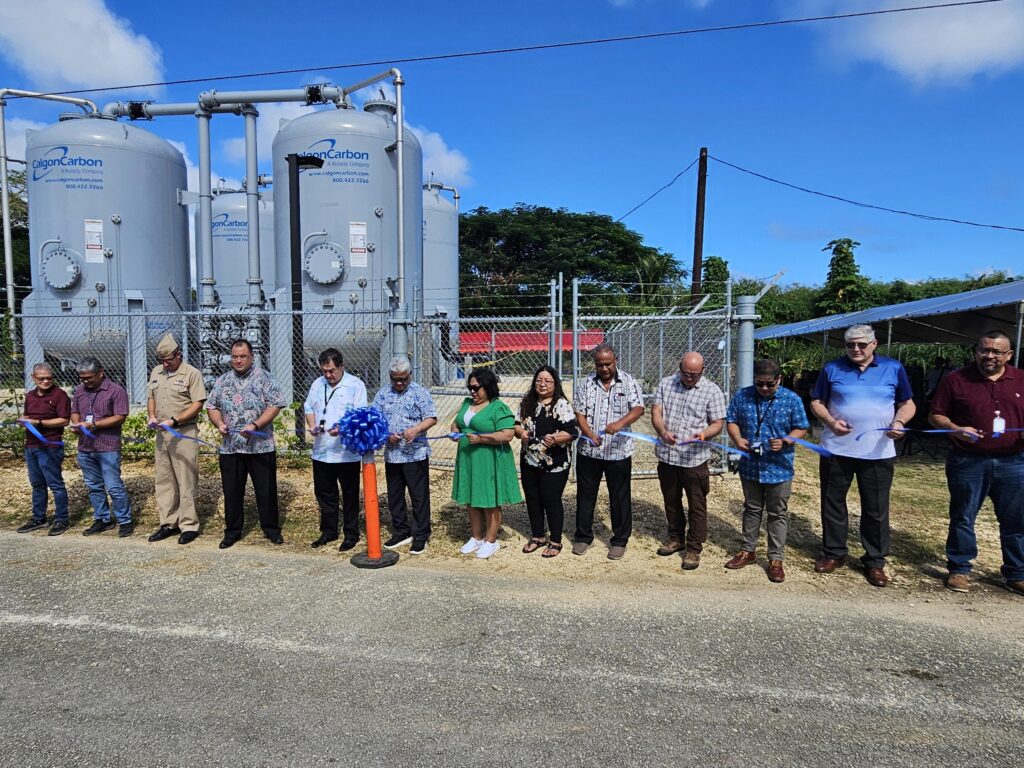
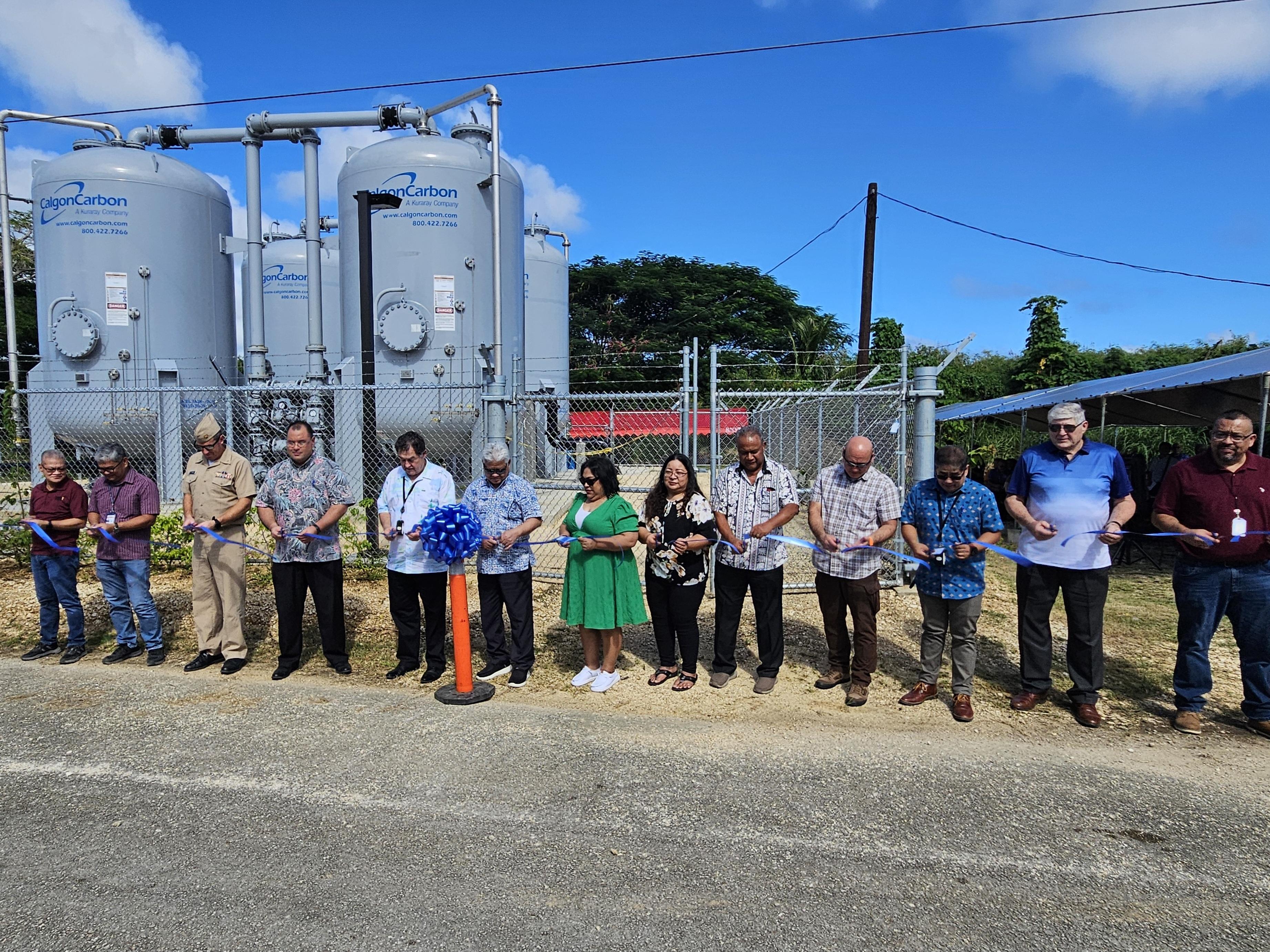
The Commonwealth Utilities Corp. holds a ribbon-cutting ceremony for the completion of the Isley Field and Obyan Wells Granular Activated Carbon or GAC Water Filtration System on Wednesday. In photo are Gov. Arnold Palacios, CUC Executive Director Kevin Watson, CUC Board Chair Janice Tenorio, CUC board member Miranda Manglona, Bureau of Environmental and Coastal Quality Safe Drinking Water Manager Travis Spaeth, CUC Water & Wastewater Engineering Manager Larry Manacop, Speaker Edmund Villagomez, Commonwealth Public Utilities Commission Chair James Sirok, Commonwealth Ports Authority Board Chair Ramon Tebuteb, other CUC officials, staffers and representatives of Coreplus Construction, the project contractor.
THE Commonwealth Utilities Corporation held a ribbon-cutting ceremony for the completion of the federally funded Isley Field and Obyan Wells Granular Activated Carbon or GAC Water Filtration System on Wednesday.
In his remarks, CUC Executive Director Kevin Watson said, “The filtration system is going to turn our water quality much purer. The installed GAC filters are designed to reduce contamination levels and eventually eliminate the public health risk [posed] by Perfluorooctanoic Acid or PFOA and Perfluorooctane sulfonate or PFOS contaminants in the ground water. This treatment system will filter out PFOA and PFOS from the contaminated wells, gradually lowering concentrations below the health advisory limit, and improving the water quality into the future.”
In 2015, elevated concentrations of PFOS and PFOA were discovered at some Isley Field and Obyan wells.
In May 2016, the U.S. Environmental Protection Agency issued nationwide primary drinking water regulations to establish legally enforceable levels for PFOS and PFOA.
PFOS and PFOA, which are mainly used for firefighting foam, are cancer-causing compounds.
According to Gov. Arnold I. Palacios, “PFAS is sometimes also known as a ‘forever’ agent. This very persistent chemical stays in our water, that’s why we have to invest so much into this infrastructure to provide safe drinking water.”
He added, “This project was funded by multiple [federal] sources, so we are proud of these agencies and very thankful. The infrastructure looks ‘spacey.’ It looks like a rocket, but it will provide us safe water for our community — it’s a very critical infrastructure.”
The governor also commended all those involved in the project for working “so hard to get it done.”
“These wells provide so many of our communities with a life-giving element, water, the most basic necessity in our existence…. It’s really a milestone to be here to finish this project, indeed. And we have so many people to thank for it. Thank you CUC!”
CUC Water & Wastewater Engineering Manager Larry Manacop said the project’s total funding amounted to $2,158,020.
Of that amount, he said, “$1,167,120 was for the GAC equipment, and $540,800 was for the construction cost.”
Paragon Corporation, doing business as Coreplus Construction, is the project contractor.
The U.S Department of Commerce and the Department of the Interior provided the funds.
CNMI Bureau of Environmental and Coastal Quality Safe Drinking Water Manager Travis Spaeth said, “We first identified PFOS in 2015, but no one really knew what the health ramifications were…. To mitigate it, CUC was shutting down wells, diverting water where they could, trying to reduce the effects, but it didn’t really work; the PFAS continued to spread.”
He added, “PFOS has now gone through multiple changes in the regulatory aspect, including in the CNMI. We now regulate PFOS with a Maximum Contaminant Level or MCL. We were the first territory, and one of the first [jurisdictions] to come up with an MCL for our [Commonwealth]. That being said, the future of regulated PFAS is not looking good. EPA’s new MCL is much lower. We’re going from 7th part per trillion to 4th part per trillion. That is like a drop in the runway. It is a very small trace amount…. This is going to be difficult for the utility moving forward, [but] this is one giant step in the right direction to do that,” Spaeth said, referring to the new water filtration system.
The construction for the GAC system began in Feb. 2024, and it has been active for two months now, Spaeth said.
“I think we expect to see results from our first test soon to see what the levels are — hopefully it does not detect [contaminants] coming out of this site,” he added.
