






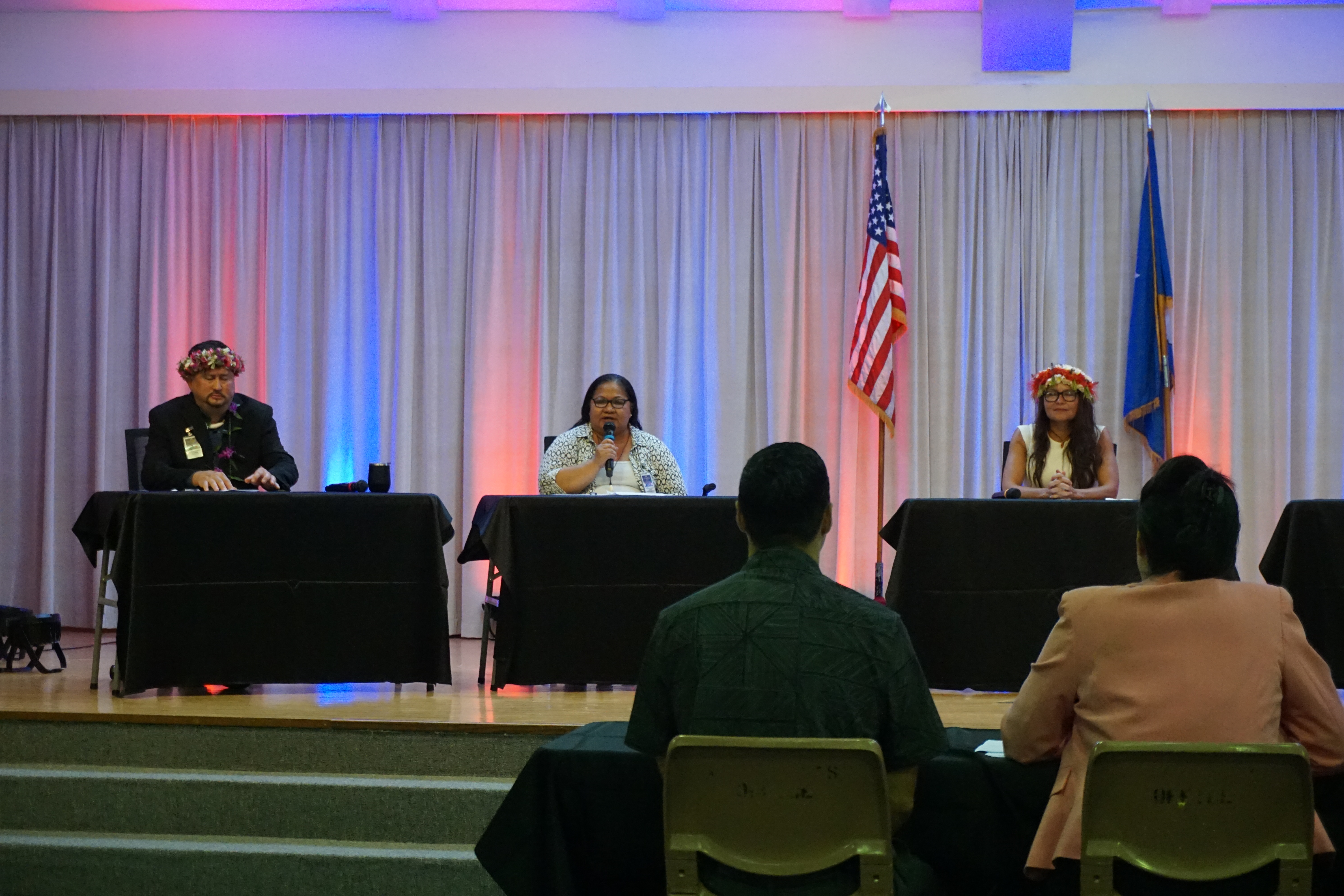
From left, Edwin Propst, Lianna Hofschneider, and Kimberlyn King-Hinds.

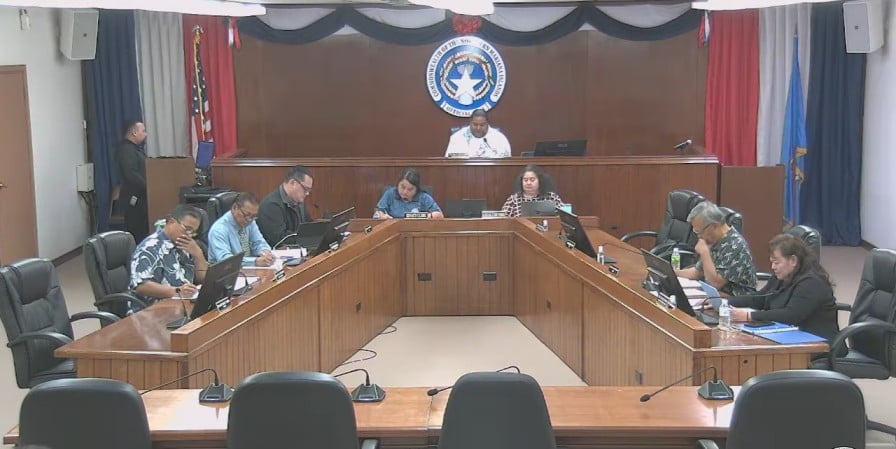
Fom left, Kimberlyn King-Hinds, Jim Rayphand and John Gonzales.
THE five candidates for U.S. delegate covered a wide variety of issues facing the Commonwealth during a debate hosted by the Saipan Chamber of Commerce on Tuesday evening, Sept. 17 at the multi-purpose center in Susupe.
Regarding immigration issues and the CNMI Economic Vitality & Security Travel Authorization or EVS-TAP Program, independent candidate Lianna Hofschneider believes the Commonwealth should work within EVS-TAP’s legal confines.
The EVS-TAP will allow pre-screened Chinese nationals to travel to the CNMI visa-free for up to 14 days, replacing the previous paper-based discretionary parole program. Chinese visitors must fill out an electronic version of Form I-736 under EVS-TAP and submit it online to Customs and Border Protection at least five days in advance of their arrival in the CNMI.
Hofschneider called EVS-TAP “important” and also highlighted that immigration is “federalized” in the CNMI.
U.S. Citizenship and Immigration Services “handles [immigration],” she said. “We should work with them and see what are the areas that we need to improve. Having said that, as a former immigration officer, I believe the CNMI does not have the capability of tracking once the visitor comes in and leaves. We see that in our community and we cannot kid ourselves. That’s not good for enforcement.”
Republican Kimberlyn King-Hinds said in her conversations with USCIS and U.S. Immigration and Customs Enforcement agents, she learned that “challenges” involving their ability to “actually enforce their federal mandates” are related to funding.
“Congress does not…give them enough funding to be able to run their operations and actually do their jobs,” she said. “They don’t have the resources. One of the first things that we need to advocate for is for Congress to live up to its obligation. It took over our labor and immigration but it didn’t come with money. And now they’re trying to make it seem as if this is a local matter, that this is our problem to address. This is not a CNMI problem, it’s a federal problem.”
She said she would advocate for U.S. Congress to provide the “necessary support” for the local branches of USCIS and ICE to do their jobs.
Jim Rayphand, an independent candidate, is “glad” that immigration is under federal authority.
“The decision on immigration is not ours and I’m happy about that,” he said. “The bureaucracy needs to be lessened and perhaps its funding again from a delegate standpoint.”
He said he supports EVS-TAP’s implementation.
“I think the benefit of it to my understanding…it was really the alternative to just sort of free flowing Chinese market to the CNMI, that these would be pre-checked travelers…. It doesn’t hurt [to implement it],” he said.
John Gonzales, another independent candidate, was open minded about EVS-TAP’s implementation.
“I trust that they have the competence and the infrastructure to carefully vet our visitors and laborers,” he said. “If [EVS-TAP] is an additional tier, then why not.”
He said if elected, he wants access to immigration data so he can make an informed decision to create a “more robust CNMI-only immigration policy.”
Gonzales said federal immigration policy as applied to the CNMI should meet “the peace and security needs of the United States, but more importantly our economic salvation and sustainability moving forward.”
Edwin Propst, a Democrat, said he would support U.S. Congressman Gregorio Kilili Camacho Sablan’s bill, H.R. 560 or the Northern Marianas Population Stabilization Act.
The act would grant CNMI resident status to certain non-U.S. nationals.
Propst said the bill would ensure “stability for our long-term workers and investors.”
He also wants to support a “Marianas visa” tailored to the CNMI and Guam’s immigrant needs. He said the “Marianas visa” should replace the CW-1 program.
Veteran issues
The delegate candidates were asked about issues veterans face in the CNMI due to the lack of a Veterans Affairs clinic here.
King-Hinds said a veterans center on island could be a long-term goal.
“The fact of the matter is [that it is] a hard goal. That’s a long way out,” she said. “Here are some things we can do now. Fifty-six percent of our veterans are being denied [because they are] not eligible to travel. They’re not given that benefit. We need to amend that so that more people can qualify.”
She said veterans can wait around 227 days to draw down their disability benefits, and she wants to change that.
Rayphand said nationwide, veterans “still struggle” for basic mental and physical healthcare.
He said locally, using military resources, the CNMI could boost its hospital, which in turn would “serve veterans and the rest of the citizens equally.” This can compensate for the lack of Veterans Affairs clinic here, he said.
“Our effort to improve the medical system in general should have a positive effect on our veteran population,” he said. “I don’t necessarily see that there has to be a separate veterans clinic per se.”
Gonzales said he has met with veterans during his door-to-door campaigning.
“Time and time again they tell me the issues they have is the lack of access to healthcare,” he said.
Gonzales wants to work with Hawaii, American Samoa, and Guam in order to use “numbers and the data to justify the need for taking care of our veterans.”
Propst’s plan if elected is to advocate for a “fully fledged veterans center” and a community-based outpatient clinic “so that Northern Marianas veterans can receive regular and specialized care without needing to travel.”
For her part, Hofschneider said the Commonwealth Healthcare Corp. could provide healthcare to veterans. But she also believes that there should be a veterans hospital in the CNMI, and that the veterans of Rota and Tinian must be taken care of on their respective islands.
“There’s no reason why, especially in Tinian and Rota, the veterans there they have more challenges,” she said.
Airfare
The final question of the night was about transportation. Candidates were asked to comment on “high” airfare; “inconvenient” overnight stays “due to limited airline options;” and if they have “more affordable and convenient travel solutions.”
Gonzales supports local exemption from cabotage laws, saying that cabotage does not work here.
“What American-owned airline or domestic carrier would invest here amid the high costs, the exorbitant costs further exacerbated by the worst inflation ever in modern history?” he asked.
He wants to entice airlines in Japan, Korea, the Philippines and other nations to reduce costs while ensuring “United States peace and security in the greater Indo-Pacific region.”
He said he wants essential air service provided to the CNMI.
Propst said he is a vocal critic of “high” airline prices. “I’ve been saying it for quite a while now, for several years mostly on Facebook, [about] the frustration when it comes to $600 round-trip airfare between Guam and Saipan. It’s outrageous,” he said.
He agreed with Gonzales that cabotage should be suspended in the CNMI. In addition, Propst said seaports could be upgraded to accommodate large vessels and develop an interisland ferry service.
King-Hinds said she has advocated for essential air service for the CNMI, but has faced “hard truths” about the issue with the federal government.
“There simply is no appetite in Congress right now to expand that service to the CNMI,” she said.
She said if Annex VI exemption is reinstated for the CNMI, Saipan could bring in more airlines. Reinstating the exemption would allow for the resumption of unrestricted scheduled air transportation between China and the CNMI.
“The more flights that land the less the cost is of landing here at the airport,” she said. “That’s just business. That’s how business works.”
Rayphand said he would support ongoing efforts involving cabotage exemption and essential air service.
He said the main goal should be to court domestic commercial and freight flights.
“It’s a nice idea to be able to bring in foreign carriers. We do have long time allies in the region. We could benefit from that as well. But absolutely we need to court more domestic airlines and that includes fair dealings at the airport level here,” he said. “There needs to be some way to bring some order and fair dealing in the matter in which we court the airlines.”
