





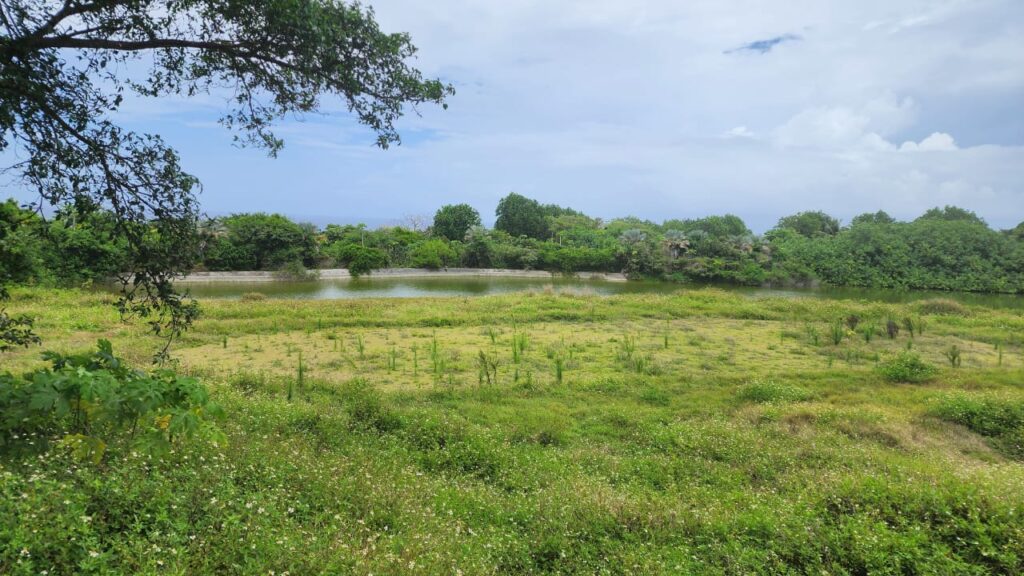
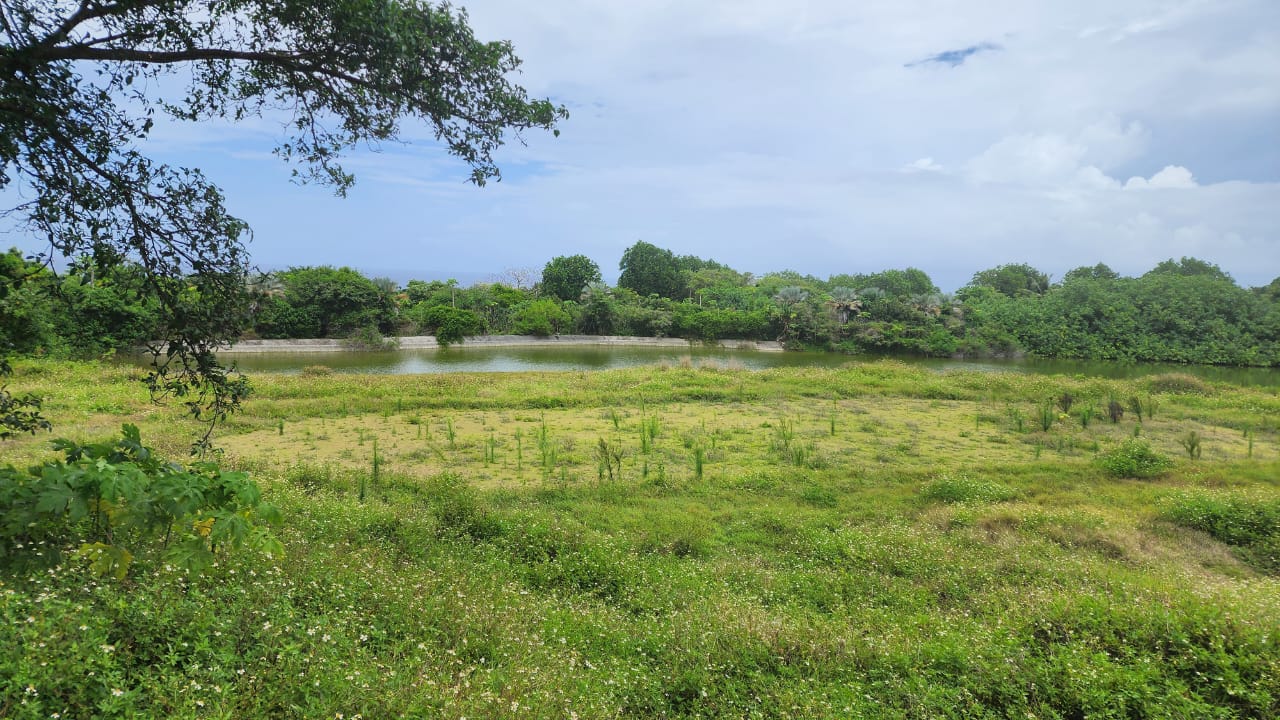
Palm trees and other vegetation are seen on Rota Resort’s unattended golf course.
ROTA Resort LLC’s lease termination appeal was dismissed with prejudice earlier this month after Department of Public Lands Hearing Officer Ramon Dela Cruz determined that the company was in violation of its lease agreement with DPL.
On March 8, 2023, DPL issued a notice of termination of Rota Resort’s lease, saying its owner, Hee Kyun Cho, had abandoned the property and failed to pay rent on the only hotel and golf course facility on Rota.
Rental payments are covered under section 6(A) of the lease agreement, while property abandonment is covered under Article 25.
Cho and Rota Resort appealed the termination on April 6. The case went before the DPL Administrative Hearing Office on Sept. 1 and 8.
Dela Cruz’s decision was issued on Dec. 5.
According to Dela Cruz, both Rota Resort and DPL acknowledge there were no rental payments from July 1, 2020 to Feb. 28, 2023.
He notes further that neither party disputes that Rota Resort ought to have paid $639,879.37 in rental payments for that time period.
He said Rota Resort was the recipient of a paycheck protection program loan in the amount of $186,155 in May of 2020. Despite telling DPL it would use those funds to pay rent, the department did not receive any money, Dela Cruz said.
He added that Rota Resort abandoned its hotel and golf course beginning July 2022.
“The hotel, golf course, and all other services were shut down, and DPL inspections in July and Sept. 2022 as well as Feb. 2023 revealed that the premises appeared to be in disrepair, with the grounds being overgrown,” Dela Cruz said. “The power at the resort had been turned off, most employees had been terminated, and some areas were vandalized and dilapidated.”
Dela Cruz said Rota Resort did not notify DPL in writing regarding the closure of the facility.
He cites Article 26 of the lease agreement, which states that a lessee will automatically be in default of its lease if “lessee shall fail to pay any installment or rent…within thirty days after the due date.” It also states that the lessee will be in default for abandoning the premises, which in this case is defined as failing to use the premises for operation of a hotel and golf resort for a consecutive period of 90 days without securing the written consent of DPL.
In his appeal, Cho cited Article 11 of the lease agreement, which covers excused performance delays. Cho’s argument is that the Covid-19 pandemic was a “force majeure” event.
“Force majeure is a provision in a contract that frees both parties from obligation if an extraordinary event directly prevents one or both parties from performing,” according to an online legal website.
Cho said the pandemic caused economic hardships, which prevented him from being able to fulfill his rental and property maintenance obligations. He said such obligations were excused under Article 11.
Dela Cruz disagreed, saying that Article 11 and a force majeure argument were more appropriate for construction deadlines, which by nature have a set, specific time frame to begin and end.
The force majeure feature of a contract allows the construction deadline to be extended if an “act of God” prevents the construction project from completing, Dela Cruz said.
Payment of rent on a regular basis is not the same as a construction deadline, Dela Cruz added.
He said a force majeure is an “affirmative defense” — meaning it was up to Cho to establish that a force majeure event was occurring in the first place. Dela Cruz said Cho did not do this.
Cho filed two CNMI executive actions from Feb. 2020 and April 2020 in support of his force majeure argument, but Dela Cruz said neither of those executive actions were enough to prevent Cho from paying rent.
“Appellant provided no quantitative support for its contention that these executive orders somehow caused its failure to pay rent,” Dela Cruz added.
He said Rota Resort was not excused from paying its rent, even under Article 11, and that it abandoned its property for more than 90 days.
He also said that DPL’s lease termination was not “arbitrary and capricious” as Cho had alleged in his appeal.
