





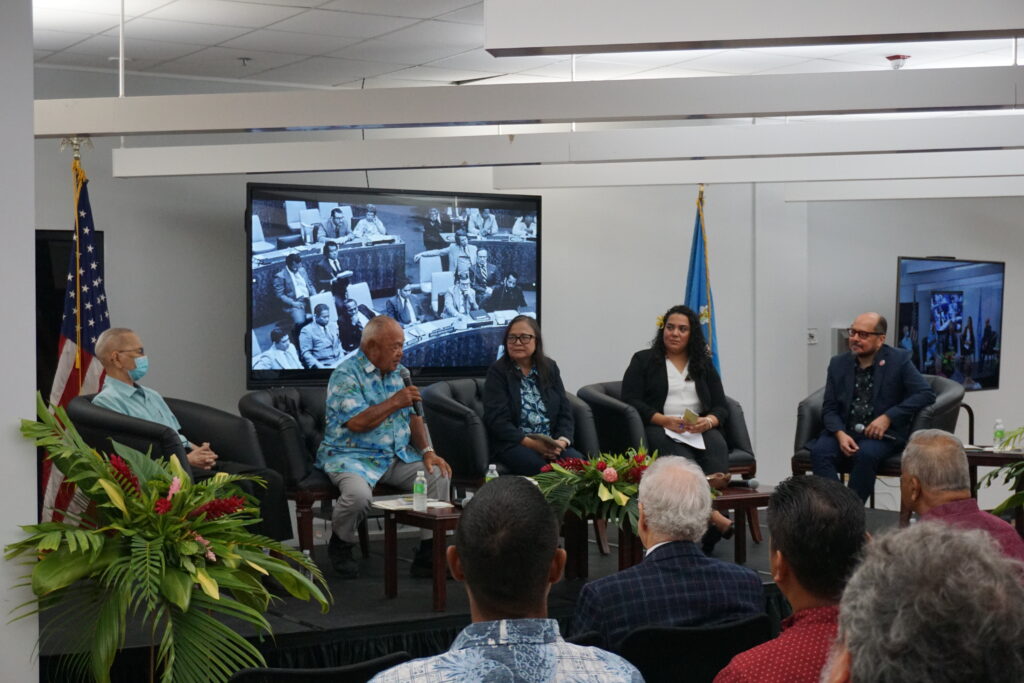
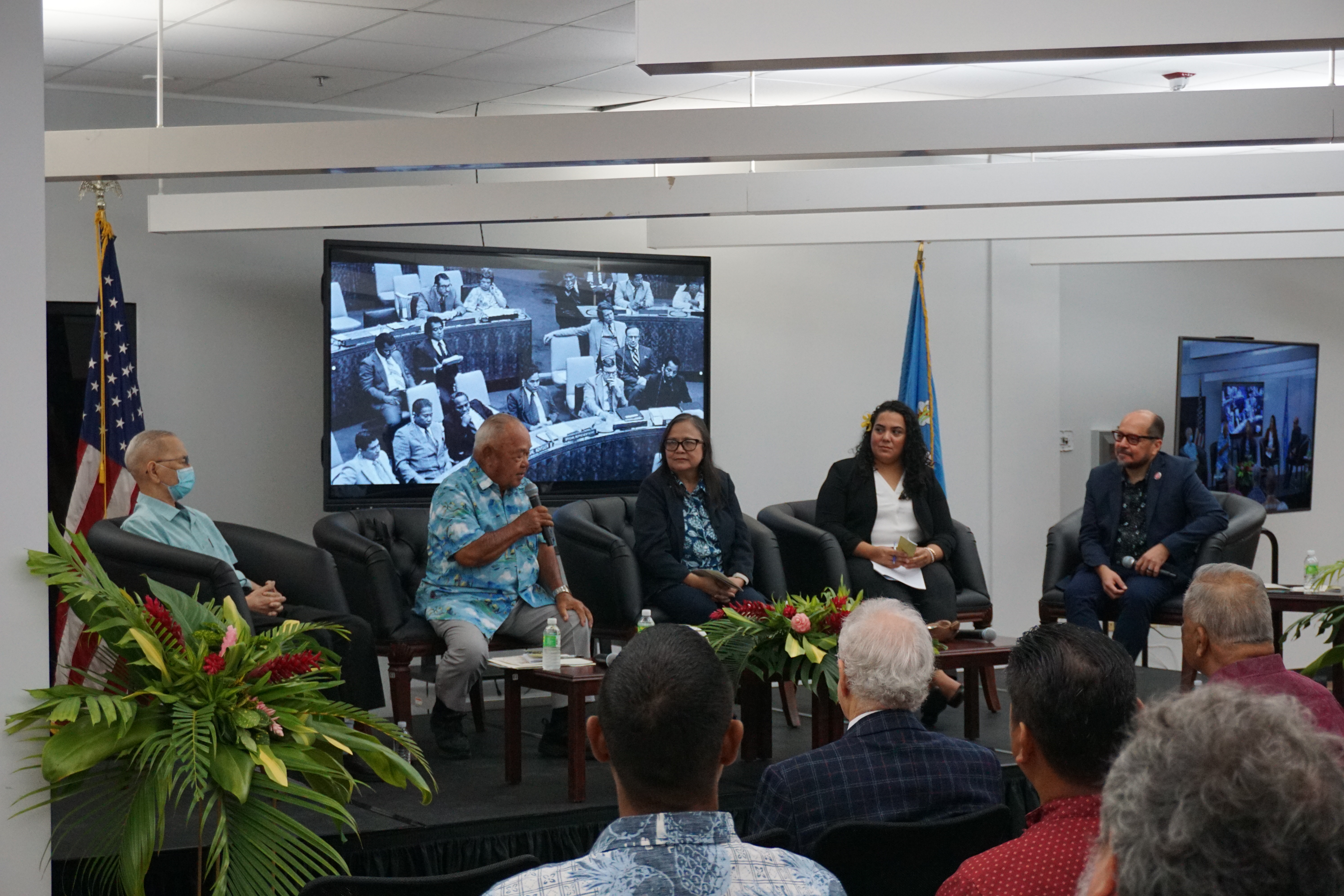
From left, former Covenant negotiators Manuel Sablan and Pedro A. Tenorio with Judge Lillian Tenorio, Assistant Attorney General Rellani Ogumoro and Northern Marianas College President Galvin Deleon Guerrero, Ed.D.
THE Covenant’s legacy has been “very … satisfactory” to the CNMI, former Lt. Gov. Pete A. Tenorio said on Thursday.
“I think overall, our people accepted the Covenant. They knew there were problems like in any other agreement. The Covenant is not a perfect document but it’s one that is very unique,” he added during a panel discussion organized by the local judiciary on Thursday.
Titled “Konbetsasion: Understanding the Covenant,” the panel discussion focused on the document that established the CNMI in political union with the United States.
On Monday, March 24, the CNMI will celebrate the 48th anniversary of the Covenant’s enactment into U.S. law.
Besides Tenorio, who was one of the islands’ Covenant negotiators, the panel on Thursday included another former Covenant negotiator, Manuel A. Sablan, who is currently the executive director of the Commonwealth Development Authority; Superior Court Judge Lillian Tenorio; and Assistant Attorney General Rellani Ogumoro.
The panel was moderated by Northern Marianas College President Dr. Galvin Deleon Guerrero.
Also attending the discussion were Gov. Arnold I. Palacios, Lt. Gov. David M. Apatang, legislators, NMC students, judicial staff, and other community members.
The panel discussion was livestreamed on YouTube. (https://shorturl.at/bkmx0)
Background
From 1972 to 1975, members of the Marianas Political Status Commission negotiated the terms of the Covenant with the representatives of the U.S. The Covenant marked the end of the NMI’s status as one of the districts of the U.S.-administered Trust Territory of the Pacific Islands.
In a June 1975 plebiscite, nearly 79% of local voters approved the Covenant, which was then approved by both houses of the U.S. Congress and signed into law by President Gerald Ford.
The Covenant provides for the formation of a self-governing Commonwealth, and specifies which provisions of the U.S. Constitution and federal laws are applicable to the CNMI.
Promises
During the discussion on Thursday, Deleon Guerrero asked the panelists if the “promises of the Covenant have been fulfilled.”
Tenorio noted that the neighboring U.S. territory of Guam has never negotiated its own political status with the United States, and does not have its own constitution.
“Through the Covenant we were able to develop our own Constitution and the U.S. cannot amend it unless we agree,” he said, referring to Articles I, II and III of the Covenant — the mutual consent provisions.
Section 105 of the Covenant reads: “In order to respect the right of self-government guaranteed by this Covenant, the United States agrees to limit the exercise of that authority so that the fundamental provisions of this Covenant, namely Articles I, II, and III and Sections 501 and 805, may be modified only with the consent of the Government of the United States and the Government of the Northern Mariana Islands.”
Like Tenorio, Ogumoro said the CNMI is unlike any other entity that is part of the United States political family because of the Covenant.
She said the Covenant “specifically limited the applicable federal laws and parts of the U.S. Constitution that would apply here. … Before it’s applied here we’ve got to see if it will work for us or if we want it before it’s just thrown our way, which is unlike anything else that you see across the United States.”
She said Section 805 of the Covenant restricts land ownership to those of Northern Marianas Descent — a provision backed by the United States Court of Appeals for the Ninth Circuit.
Ogumoro said this restriction is not something that would “pass constitutional muster” elsewhere in the United States.
“The 9th Circuit recognized that [Section 805] was a fundamental provision in our Covenant, and without this provision, we wouldn’t have a Commonwealth, we wouldn’t have this tie with the United States,” she said. “Therefore in order to not frustrate the purpose of the Covenant, they upheld [land ownership restriction] even though it’s technically unconstitutional if it were anywhere else.”
