




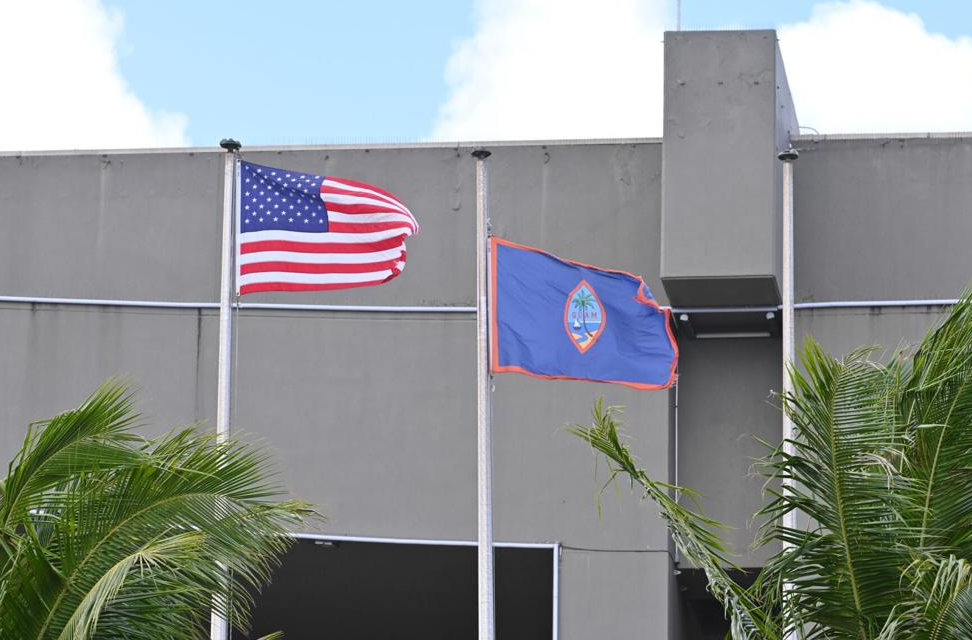

The Guam and U.S. flags wave in the breeze at the Guam International Airport in Tiyan.
HAGÅTÑA (The Guam Daily Post) — U.S. territories face data gaps primarily due to federal agencies not including them in many federal statistical products, and these gaps affect territorial government operations in various ways, with no inclusion in the U.S. Census Bureau’s American Community Survey cited as being significant, according to a new report out of the Government Accountability Office, an independent, nonpartisan agency under Congress.
The ACS provides detailed demographic statistics used in a large number of federal formula grant programs, the GAO report stated.
But territorial officials also reported other significant data gaps. For Guam specifically, officials indicated that not enough reportable data in the Island Areas Census for some of the island’s smaller communities prevent those communities from being included in other composite statistics, “thus understating the territory’s needs for sources,” according to the GAO report.
The Social Vulnerability Index was specifically cited as an example of those other “composite statistics.”
“The Social Vulnerability Index includes a range of census variables that help local officials identify communities that may need support before, during, or after natural disasters. The information it contains also helps agencies make decisions on allocating emergency preparedness funding,” the GAO report stated.
“Officials from the Department of the Interior provided additional examples of how data gaps can have adverse effects. For example, officials stated that in lieu of being comprehensively included in federal import and export statistics, territories are left to collect their own customs data, despite having limited capacity to do so,” the report added later.
There are various structural issues and other characteristics that contribute to data gaps for the territories, according to the GAO. These include inconsistencies in federal statutes regarding when to include territories, costs, geographic challenges and technical factors that can complicate data collection, such as language barriers.
“(Federal) agencies also cited reasons unique to their operations as contributing to data gaps. For example, the National Agricultural Statistics Service releases Census of Agriculture data for the territories other than Puerto Rico with a one-year lag relative to comparable data for the rest of the U.S. National Agricultural Statistics Service officials explained that, by spreading out the several territories’ data collections, the agency can take staff assigned to the Census of Agriculture and balance their workloads. This allows staff to focus on data collection and analysis,” the GAO report stated.
Agencies attributed some data gaps to limitations with source data, such as a lack of a robust and updated address list in the territories, which limits mail-based surveys, the Census Bureau indicated to GAO.
The U.S. Bureau of Labor Statistics reported to GAO that American Samoa, the Commonwealth of the Northern Mariana Islands and Guam are excluded from certain employment statistics, partly because none of those territories have a permanent unemployment insurance program generating statistics that BLS would need, according to the report.
Other factors might also explain why territorial data may sometimes not appear in data collection for federal statistics that they are otherwise eligible for, such as officials being accustomed to limiting the scope of statistical products to the 50 states and being unaware that the territories could also be included, the GAO report stated.
“Territories have taken steps to mitigate data gaps through local data collection. Federal agencies also provide some forms of technical assistance to support statistical efforts in the territories. In particular, since fiscal year 2019, the Department of the Interior has provided over $60 million through a technical assistance program, some of which is to be used to improve statistical collections,” a key takeaway in the report stated.
“Treatment of the territories differs across agencies in the federal statistical system, and efforts to collect and report data on the territories are limited and uncoordinated. We recommend that the Office of Management and Budget develop a coordinated, government-wide approach for federal statistical agencies to use, in consultation with territories and stakeholders, to examine the costs, benefits, and feasibility of including territories in statistical products and, as appropriate, identify ways to address any data gaps,” another key takeaway added.
