



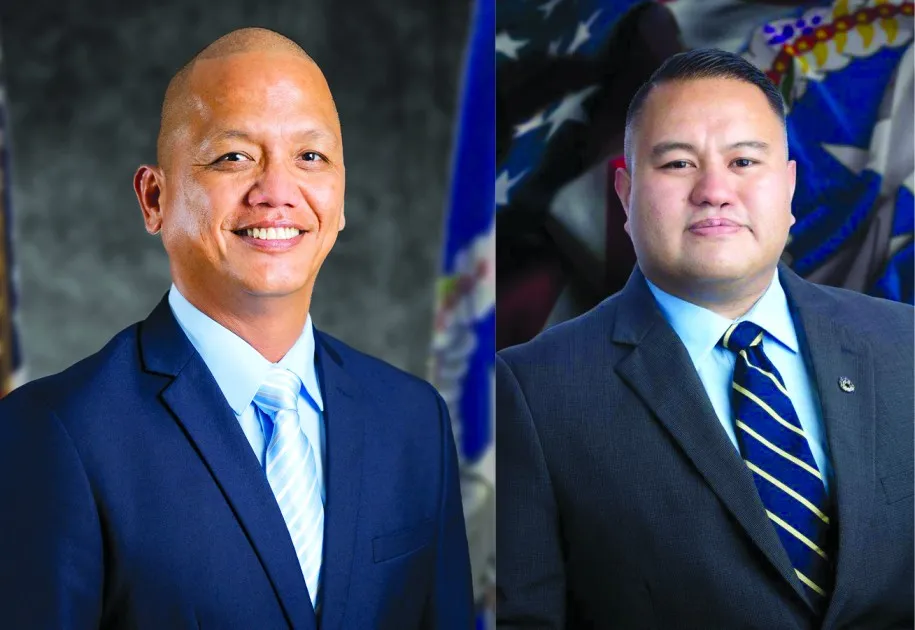




SOME local business leaders want to see the revival of the China tourism market, but Gov. Arnold I. Palacios on Tuesday said he prefers to strengthen the CNMI’s ties with its federal partners, including the U.S. military.
“If you looked at my different speeches to the U.S. Senate, and the recent U.S. congressional hearing in Guam, I pointed out that we are always going to be vulnerable because of the geo-political situation that we are in,” the governor said.
He also noted that a $150 million divert airfield and the CNMI Joint Military Training on Tinian will be “rolling out soon, and we need to put those in our consciousness.”
“We cannot continue to be looking at things just for instant gratification,” he said adding that the CNMI must create a “really sustainable economy.”
“I mean, yeah, we opened up to foreign investments because the U.S. advocated globalization, especially in the Asia-Pacific area. But nobody told us what the geo-political situation would be in 2020 and 2021,” Palacios said, referring to the deteriorating ties between the U.S. and China.
“So we are getting caught in the crosscurrent,” he added. “Do I feel a lot of pressure? Believe it or not, I feel that. I feel that from the [business] community that [wants to see more Chinese tourists]. But I can assure you that this is not just in my control. It is about the national interest and national security,” he said.
Palacios has announced that his administration would pivot away from “the Commonwealth’s overreliance on Chinese investment, and seek to strengthen our relationships with our federal partners and allies in the region.”
He said he “worried about the instability of the Chinese markets in light of shifting geo-political currents” and about “the Commonwealth’s potential exposure to national security concerns.”
China market
In a letter on Monday, Saipan Chamber of Commerce President Joe C. Guerrero urged Commonwealth Ports Authority Board Chairwoman Kimberlyn King-Hinds “to consider engaging with the federal government to find avenues to work within the existing requirements for the resumption of air service between the NMI and China.”
He is hoping that the U.S government “will recognize [our] severe economic condition [and] unique political and geographic position….”
He said the CNMI hopes to “join…the nation in obtaining a full resumption of tourism revenue through strategic and beneficial commercial engagements that are at the forefront of American policy in the region.”
Noting that Chinese tourism made up 44% of the arrivals prior to the Covid-19 pandemic, Guerrero said “we must recognize the vulnerable position the NMI economy is presently in, with nearly all economic activity being reliant on a single source market,” referring to South Korea.
He said the central problem “is the absence of another sustainable tourism market, such as the China market…. [T]he structure of the NMI’s tourism economy has shifted from a diversified mix of three primary source markets to only one.”
In short, he said, “the present reality is that all of our eggs are in one basket — we do not have enough eggs to survive, and our community continues to suffer. Without additional source markets and/or handouts from the federal government, more businesses will close, U.S. worker jobs will be lost, and many will unnecessarily suffer the consequences, most especially our most vulnerable populations, our manamko’ and those living in poverty.”
In 2019, prior to the pandemic, there were 185,536 arrivals from China. This figure plummeted to 18,550 in 2020; 12 in 2021; and 186 in 2022.
In April 2023, arrivals from China totaled 164; in May, 392; in June, 503; and in July, 1,075.
