





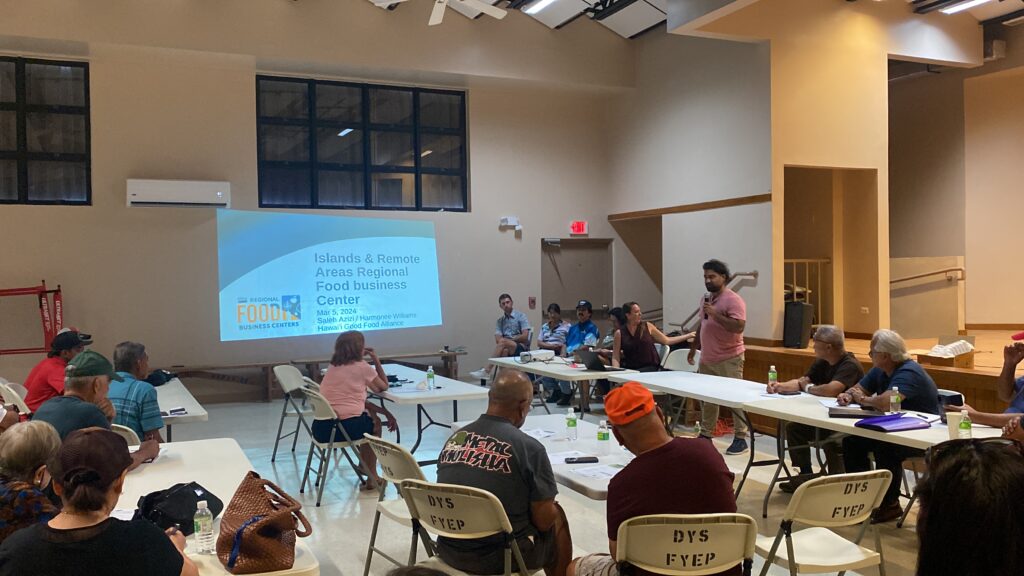
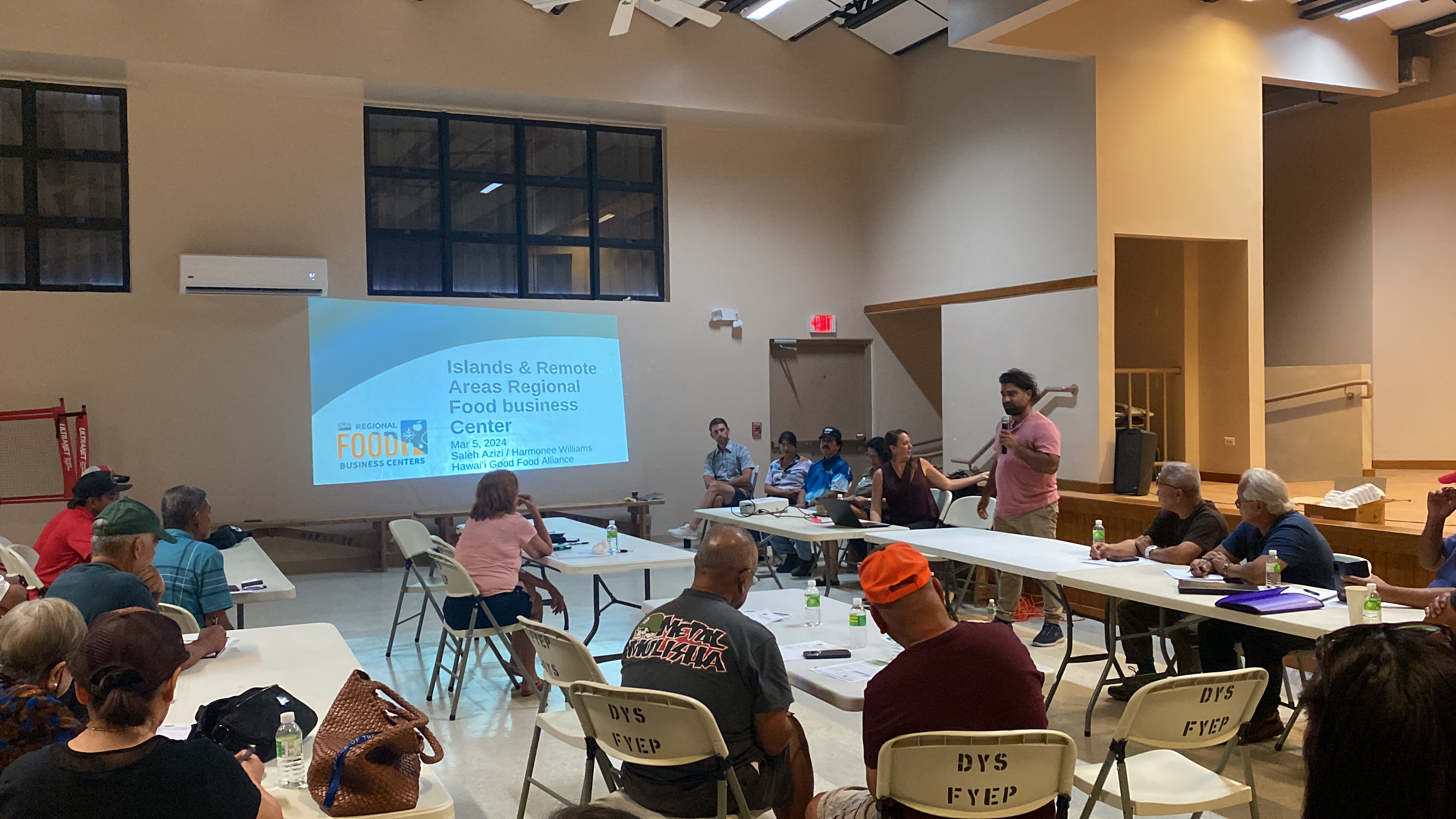
Saleh Azizi, standing, speaks to local farmers at a meeting on March 7 in Kagman.
ON Thursday, March 7, representatives from the Hawai’i Good Food Alliance and Guahan Sustainable Culture met with local farmers at the Kagman Community Center to conduct needs assessment research ahead of plans to implement the USDA’s Regional Food Business Center program in the CNMI.
According to Project Director Saleh Azizi, the program will be implemented in July.
He said the Biden administration has released around $400 million in funding that can be available for the nation’s farmers. The funds will help farmers address obstacles they face in the middle of the supply chain. When the program funds are available, the CNMI can apply for grants that help with “post-harvest practices and marketing,” Azizi said.
He added that the funds will support projects to ensure that “the dots are connected along the value chain” by “connecting production to consumption.”
He said the program funds will answer such questions as “How do we move the needle from here, especially in relation to post-harvest practices and marketing? How do we get the produce onto the shelves?”
Glenn Manglona, the president of the Kagman Agriculture Farms and Producers Association, said, “If you’re a farmer, what are your challenges in getting to the market? That would be placed in the plan to request for federal funding. If I’m a producer and I’m having a hard time reaching the market in Guam for example, I can get a grant for cold storage or transportation. The grants are targeted towards the distribution and aggregation to reach the market.”
Azizi said based on a needs assessment meeting on Tinian conducted on March 6, one potential project that could hypothetically be supported by USDA Regional Food Business Center funds is a butchery for the local slaughterhouse.
“Tinian has a USDA slaughter facility, so we already have an infrastructure piece in the middle [of the supply chain]. A slaughter facility is post-harvest,” Azizi said. “They take the cattle there, they break down the cattle. But then [farmers] said what’s missing is someone who further breaks down the cattle…. That’s an example that could be funded through a project like this.”
He said the projects would be at the direction of the local organizations that applied for the funds.
At the meeting in Kagman, some farmers said their needs include irrigation, seed health, and soil nutrition, but these are areas that cannot be funded by the Regional Food Business Center program.
However, Azizi said it’s still “very helpful” to share local issues at this level because he and representatives from Guahan Sustainable Culture and Hawai’i Food Alliance, which handle the technical activities of the program, can share the information with federal grantors.
“We’re utilizing all the information we get,” Azizi said. “We’re going to share that with the USDA, and…the USDA [will] get to hear that water is an issue for farmers…. All of the information is important.”
