







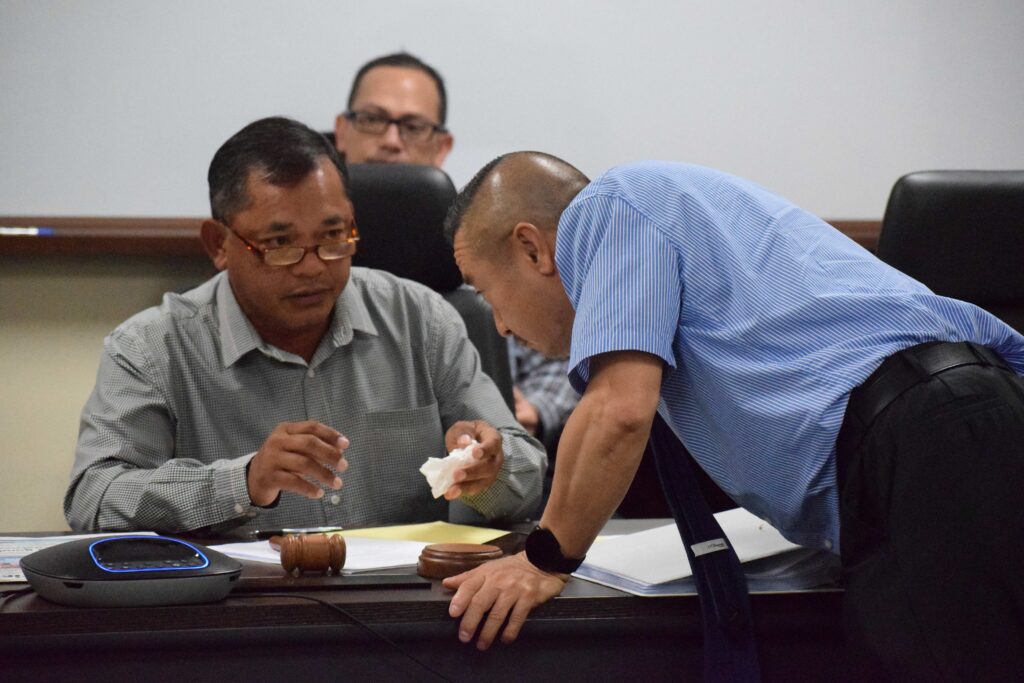
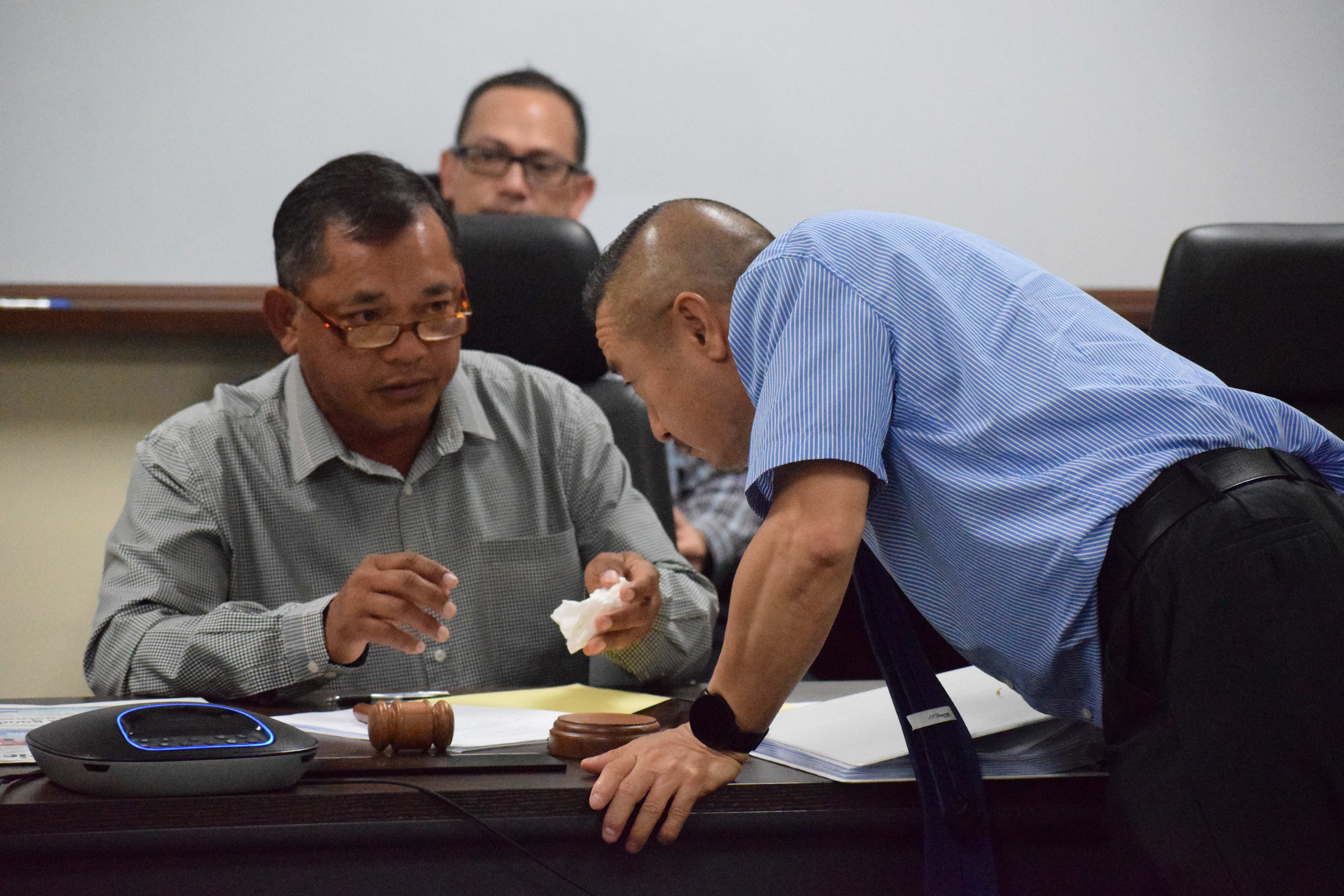
Commonwealth Casino Commission Vice Chair Ralph S. Demapan confers with Executive Director Andrew Yeom as Assistant Attorney General Carl Dela Cruz looks on during a revocation hearing in the commission’s conference room Wednesday morning.

Assistant Attorney General Keisha Blaise, right, asks Commonwealth Casino Commission Executive Director Andrew Yeom, back to the camera, a question during a revocation hearing on Imperial Pacific International’s exclusive casino license in the commission’s conference room in Gualo Rai on Wednesday.
IMPERIAL Pacific International’s legal counsel on Wednesday asked members of the Commonwealth Casino Commission to disqualify themselves from their tribunal because they can’t be impartial decision-makers.
Attorney Michael Chen, who was in California, appeared during the revocation hearing at the CCC office in Gualo Rai via Skype.
He made the motion after cross-examining the commission’s executive director, Andrew Yeom, on, among other things, the annual $3.15 million regulatory fee that IPI has failed to pay since 2020.
The commission’s vice chair, Ralph S. Demapan, presided over the hearing with fellow Commissioners Ramon Dela Cruz, Mario Taitano and Martin Mendiola as hearing officers. Their legal counsel was Assistant Attorney General Carl Dela Cruz while Assistant AG Keisha Blaise served as Yeom’s counsel.
In his cross-examination of Yeom, Chen asked, “When was the last time IPI made payment to CCC?”
Yeom replied, “Which payment?”
Chen: “Anything. When was the last time IPI paid anything to CCC?”
Yeom: “I believe that was the regulatory fee [that was] paid back in 2019.”
Commissioner Ramon Dela Cruz: “Yeah. That was in 2019.”
Chen: “Are you responsible for the expenditures of CCC?”
Yeom: “Yes.”
Chen: “So when IPI paid the last time, the regulatory fee in 2019, what was the…balance in CCC’s account?”
Yeom: “In 2019, I was not the executive director, so I don’t recollect the figure of the balance.”
Chen: “When were you appointed executive director?”
Yeom: “August 2021.”
Chen: “By the time you were appointed, how much money did CCC have in its bank account?”
Assistant AG Blaise: “Objection. Are you now questioning on [the] regulatory fee because I did not direct my client on [the] regulatory fee complaint.”
Chen: “This is about bias.” He then asked Yeom: “When you…were hired as executive director, how much money was in CCC’s account?”
Yeom: “I do not recollect.”
Chen: “Since you [became] executive director, did CCC run out of money?”
Yeom: “Starting in 2021 we were struggling already. So we had to cut employees. More than 75% of our staff was cut…because [we were] short in budget — we went under.”
Chen: “Were you personally affected financially because IPI couldn’t make the payment?”
Blaise: “Objection.”
Yeom: “Personally, I don’t think that is an important question for me to answer. All this has nothing to do with my personal [financial] status.”
Chen: “As the director, do you pay the commissioners?”
Yeom: “What are you talking about? Do the commission pay the commissioners?”
Chen: “Yeah. Do you pay them out of the commission funds? Do you pay the commissioners?”
Yeom: “Yes. From the bank account. Yes.”
Chen: “Did you have trouble because IPI did not…pay…the regulatory fee? Did you have trouble making those payments to commissioners?”
Yeom: “The commissioners, as of today, and all throughout 2023, [have] been working on a voluntary basis because of non-payment of the regulatory fee.”
Chen: “Were they happy about it?”
Blaise: “Objection. Speculation.”
Chen: “Let me re-phrase. Did they express dissatisfaction working as volunteers?”
Blaise: “Objection, hearsay.”
Chen: “I think this goes to a state of mind. It’s not hearsay.”
Yeom: “I think that is a question that should not be directed to me. You should ask the commissioners that question.”
Chen: “They are not on the witness list, and they are serving as hearing officers.”
He later added, “I’m going to make a bold or rather aggressive motion. I know the commissioners will find this rude or are not going to grant it, [but] I am going to ask all the commissioners to disqualify themselves because of the existing bias. I’m sorry to offend the commissioners but I have to make this motion on the record.”
Blaise asked Chen, “Is that as to the entire hearing?”
“Yes,” Chen replied.
Demapan then asked Chen, “Does that conclude your examination with Yeom?”
Chen said, “Yeah, for the first part of the cross examination with respect to Complaint No. 002. I do ask that my motion be reflected on the record.”
Complaint No. 2021-002 pertains to IPI’s failure to maintain reserve funds for its employees while Complaint No. 2021-003 pertains to IPI’s failure to pay the $3.15 million annual regulatory fee.
Demapan asked his fellow hearing officers if they had questions for Yeom. None, they said.
Chen reiterated that hearing officers have to be impartial. He said he made the motion because there’s bias. “They couldn’t act as impartial decision-makers based upon the testimony given by the executive director. I understand that this is offensive, but for my client’s interest, I have to make that motion and please do not be offended personally,” he said.
Blaise said, “I would like to object to Mr. Chen’s motion.”
“I do not believe that the commissioners are biased,” she added. “We just spoke about Complaint No. 002, which concerns IPI’s failure to comply with Commission Order 2020-003, which requires IPI to maintain a bankroll formula. I do not [see] where that bias would come from as the funds were supposed to be created to ensure that IPI’s employees were paid. The commissioners would not receive a dime of that money so I don’t know where that bias would come from,” Blaise said.
Chen said it’s not about the issue of IPI maintaining minimum funds for its employees. He said it’s about the commissioners having a personal interest in IPI. He noted that requiring a hearing officer to be impartial is “part of the U.S. Constitution as well as the NMI Constitution.”
Chen added, “I know that the commissioners themselves can make the decision to disqualify or not disqualify themselves, but I just have to make that motion for the record.”
The commissioners said they will not respond to the motion of disqualification.
Demapan then called for a recess until 11 a.m. today, Thursday, when the hearing resumes in the governor’s conference room on Capital Hill.
