






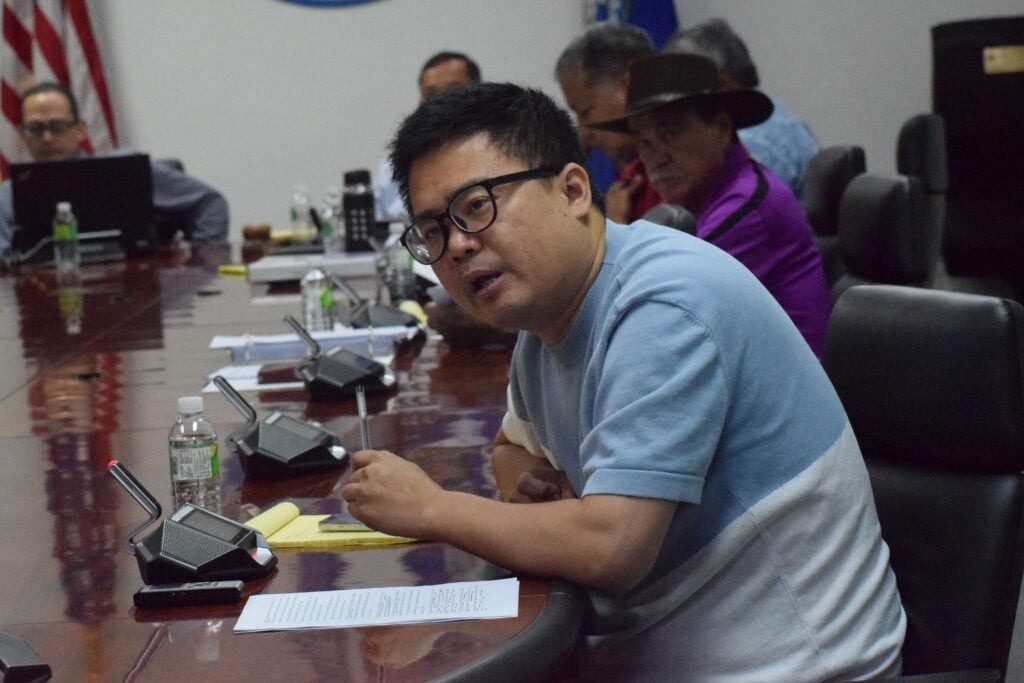
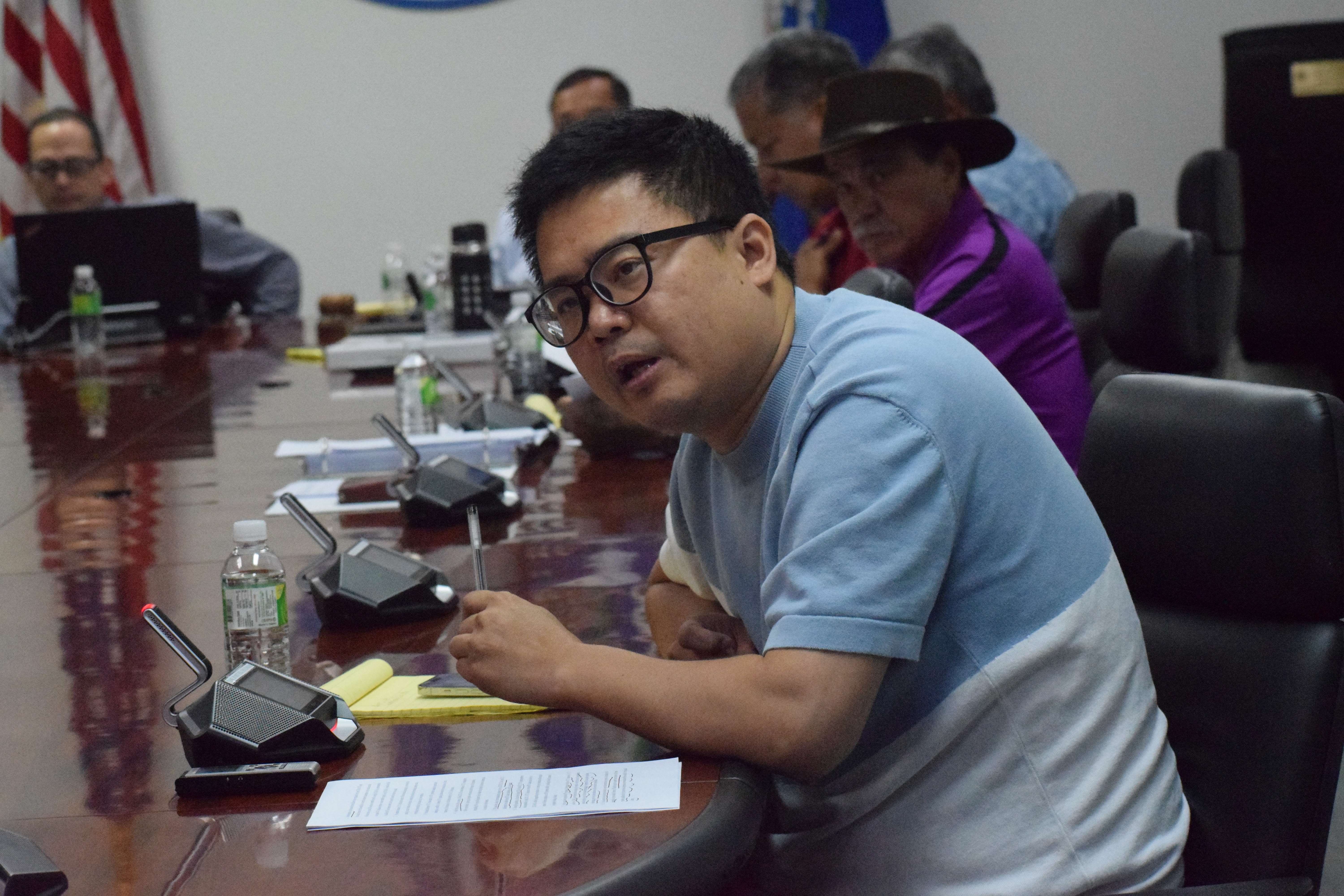
Imperial Pacific International Director How Yo Chi speaks during the revocation hearing on Friday at the administration building on Capital Hill.
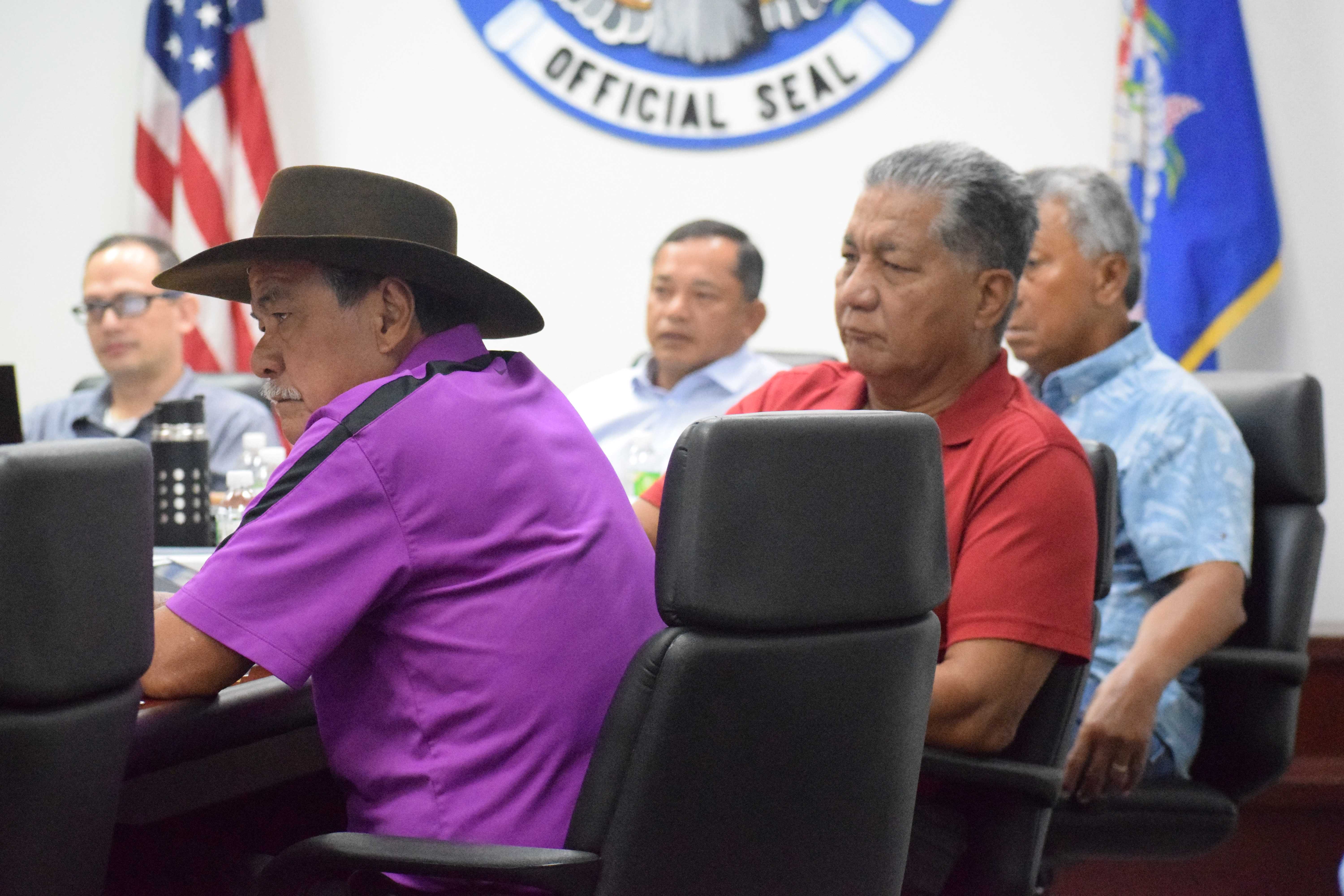
Commissioners Ramon Dela Cruz, Ralph Demapan, Martin Mendiola and Mario Taitano, and their counsel, Carl Dela Cruz, left, listen during the revocation hearing at the administration building on Capital Hill.
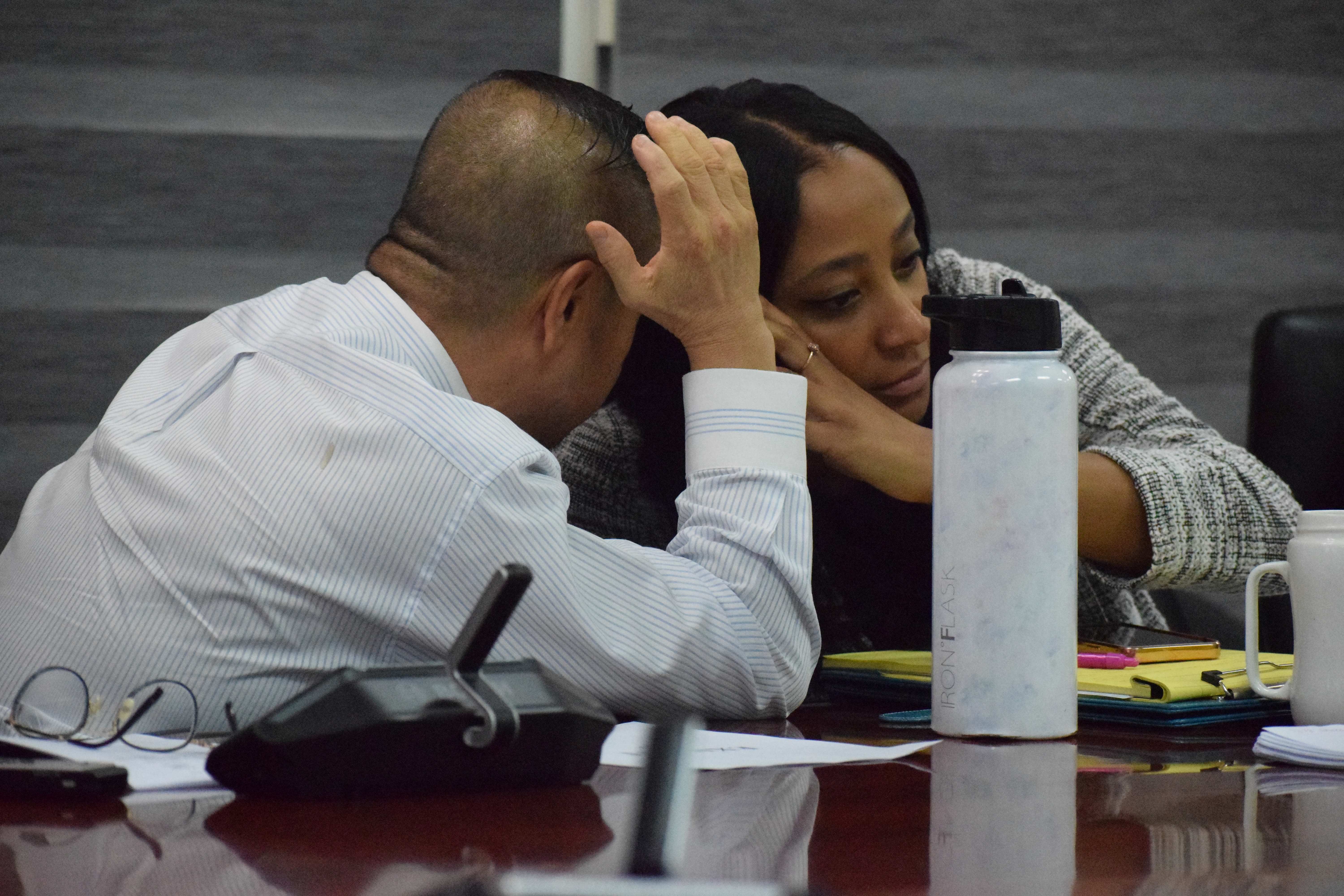
Commonwealth Casino Commission Executive Director Andrew Yeom confers with his legal counsel, Assistant Attorney General Keisha Blaise.
IMPERIAL Pacific International’s proposed settlement terms include “leaving the island peacefully,” giving up the exclusivity of its gaming license, transferring the casino license to a new investor, and the payment of $31 million for its arrears and $16 million for the lifting of its license suspension, IPI Director Howyo Chi said.
But Gov. Arnold I. Palacios rejected the offer, Chi added during the conclusion Friday of the two-day revocation hearing at the administration building on Capital Hill.
“IPI is looking for a way to settle this amicably,” Chi said. “It’s not our intention to go through this messy revocation process that could drag on for years to come.”
The Commonwealth Casino Commission, he added, “is amenable to our offer to leave the island and transfer the license. We are just frustrated that the governor appears to have stuck to this messy litigation. We want to settle this as swiftly and peacefully as possible,” Chi reiterated.
The hearing pertained to CCC’s enforcement actions against IPI for its non-payment of the annual exclusive casino license and regulatory fees. Since the onset of the Covid-19 pandemic in 2020, CCC said IPI has failed to pay its obligations that have now amounted to over $62 million in annual exclusive casino license fees due to the CNMI government, and over $17.62 million in regulatory fees due to the commission, plus fines and penalties, for a total of $79.63 million.
Adjourned
With acting CCC Chair Ralph Demapan as presiding officer, and Commissioners Mario Taitano, Martin Mendiola and Ramon Dela Cruz as hearing officers, the revocation hearing adjourned at around 6 p.m. on Friday.
The second day of the hearing was held in the Office of the Attorney General’s conference room because there was a scheduled event in the governor’s conference room where the first day of the hearing was held on Thursday. The office of the casino commission in Gualo Rai was the original venue of the hearing, but it had to be changed due to the unstable internet connection in the conference room.
Within 30 days, the commission will hold a public hearing to let the people voice their opinion before CCC decides whether or not to revoke IPI’s exclusive license.
After hearing both parties’ closing arguments on Friday, the commission’s legal counsel, Carl Dela Cruz, said IPI’s motion for the disqualification of the commissioners will be addressed in a written decision “that is going to be forthcoming.”
He also noted that several objections were made by both parties, and the record will reflect them.
He said the commission did not rule against the objections and allowed the arguments to proceed because it wanted to give both parties a “lot of flexibility to give their arguments since this is an administrative hearing — it’s more informal. So the rules of civil procedures don’t apply here.”
Failure to comply
Assistant Attorney General Keisha Blaise, who represented the commission’s executive director Andrew Yeom, reiterated in her closing argument that IPI failed to comply with the commission’s orders in 2021 to pay the annual regulatory fee and maintain a bank account for payroll.
IPI’s legal counsel Michael Chen, who was in California and appeared via videoconference, said whether or not to take away IPI’s casino license “is more than just a legal issue.”
“If we come together as a community looking at the problem we have — if we are looking for a solution … rather than saying, ‘Oh, it’s all your problem,’ or, ‘It’s not my business’ — I think that is a wrong approach. … We can make this argument or that argument, but eventually, folks like you in the island have to bear with it,” Chen said.
“You can kick IPI out, but is this really what you think will benefit everybody? I don’t really think so,” he added.
He said there are ways to make IPI do a little bit more, and he thinks IPI is willing to do it. He encouraged the commission to make a decision that will be a “proper remedy.”
Settlement terms
IPI submitted its proposed settlement terms to the commission as an exhibit under seal, and discussed it in private due to its confidential nature.
The legal counsel of the commission’s executive director, AAG Blaise, did not object to the motion to submit the settlement terms under seal, but she reiterated her objection to the relevance of the settlement terms to the revocation hearing.
The hearing officers’ legal counsel, Dela Cruz, said they are inclined to allow the IPI counsel to proceed and discuss the proposed settlement agreement, although it did not mean that the tribunal agreed whether it was relevant or irrelevant.
On Friday, the hearing officers allowed IPI and its counsel to talk about the proposed settlement terms.
Chen then conducted a direct examination of Chi, the IPI director, who said the settlement agreement was “negotiated back and forth” until IPI and the casino commission came up with the final number, which was $31 million for the arrears and $16 million for lifting the suspension of the casino license.
Chi said there was no response to their proposal. “I guess it was accepted by one party but rejected or not responded to by another party,” he added.
Chen asked, “Another party? What do you mean by that?”
Chi answered, “The governor — the governor did not accept the terms.”
He added that the governor “sort of weighed it around and said that in three weeks when he returned to the island, he would make a decision. But when the governor was back last week, the governor, through his legal counsel, was basically saying, ‘We reject your offer.’ So that is where we are. … We are trying to figure out what is acceptable to the governor, but the governor did not provide a counter-offer or a proposal to us.”
Chen asked Chi if it was frustrating not to know who he was negotiating with. Chi said yes.
“When we were negotiating strictly with CCC, without the governor’s counsel, without the governor’s presence, we had a framework developed that was agreeable between CCC and IPI. CCC was supposed to present it to the governor, but we never got an answer from the governor until one day he came in and said that he would like to see all the proposals and make his own decision,” Chi said.
He added that “it is quite frustrating that we keep negotiating and not able to get something in return — something that is agreeable. … So far we have not been able to get that.”
Chen said IPI’s proposed settlement terms are “fairly comprehensive but the major obstacle is, you are negotiating with more than one party and also one party is kind of shadowing, and you don’t know who you are talking to, and … what they want.”
Chi agreed.
He also said that part of the proposed settlement agreement would require IPI to give up its exclusive license without challenging its revocation, if it fails to make payments to the CNMI.
Chen asked, “IPI agreed to that?”
Chi answered, “Yeah, I think IPI would agree to that.” However, he said, “we did not get to that point yet because we could not get the agreement on the amount. We have thought it through that if it is going to be in the settlement terms, then obviously there are certain terms that are going to be incorporated as well to protect both sides.”
Chen asked, “About the exclusivity?”
Chi replied, “Yes, that has been discussed. And that is what both sides have agreed on. We don’t have an issue on that.”
Chen noted that IPI has entered into a memorandum of agreement with Kyosei Bank Group, an investment company that would take over IPI’s assets.
Chi said the original term was a 50-50 sharing of the casino, but as the issue of license revocation unfolded over the last two weeks, the share of investment was changed to 100-0, meaning, Kyosei will get a 100% share and IPI 0%.
Chen asked if it’s okay with Kyosei that the license would no longer be exclusive, Chi said, “Yes. They, the Kyosei Bank Group, would be willing to open up the license so we will have to agree to an amendment to Public Law 18-56 [the Saipan casino legalization law] to change [the license] from exclusive to non-exclusive.”
The settlement agreement and the MOU between IPI and Kyosei will allow the CNMI Legislature to amend the casino law, Chi said.
Variety was unable to get a comment from the governor.
