




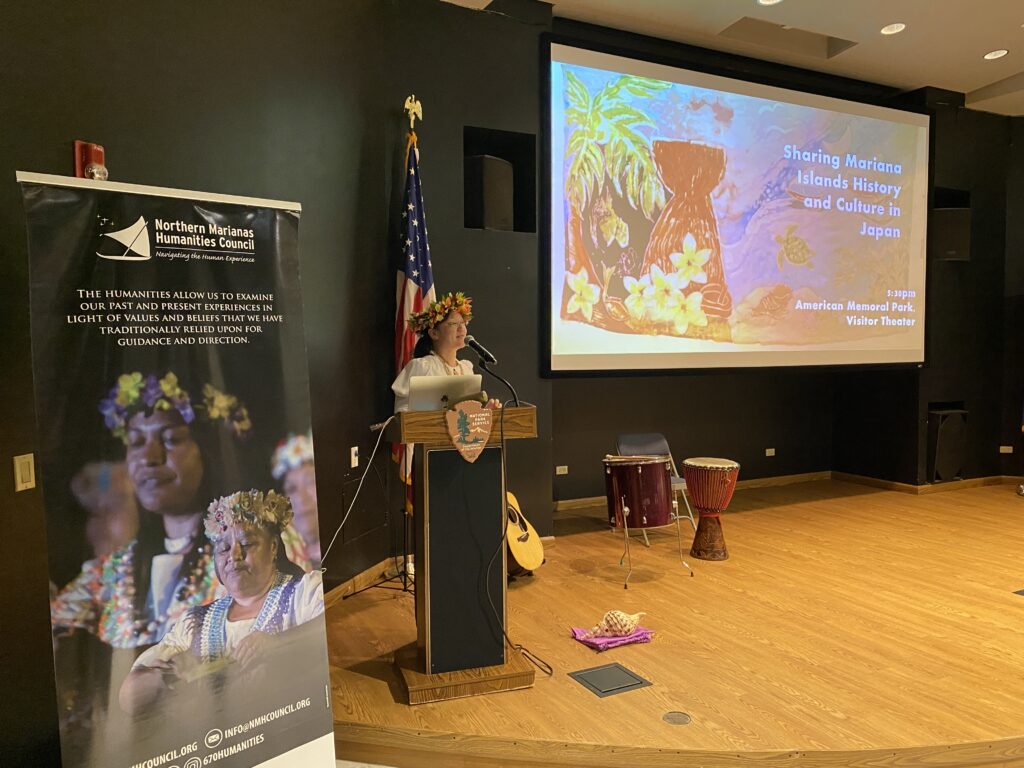
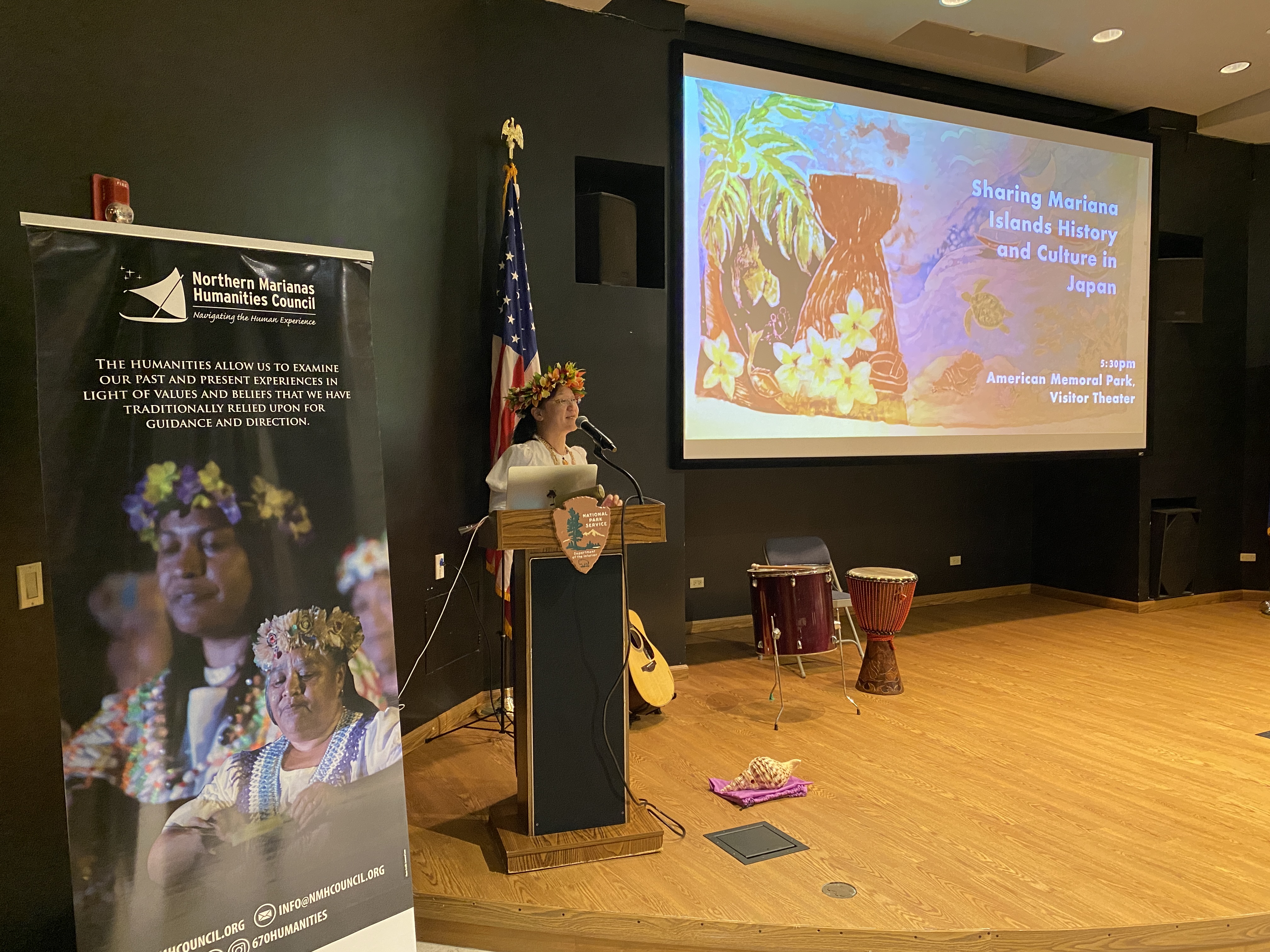
Professor Kyoko Nakayama conducts a lecture on at the Visitor Center of American Memorial Park as part of the Northern Marianas Humanities Council’s Community Lecture Series on Aug. 7, 2024.
AT the Northern Marianas Humanities Council’s Community Lecture Series on Aug. 7 at American Memorial Park’s Visitor Center, Teikyo University Professor Kyoko Nakayama explained how her passion for history and research led her to discover Chamorro culture and dance.
Nakayama is a fa’fa’nague or Chamorro dance instructor and heads Guma Famagu’on Tano’ Yan I Tasi in Tokyo. She is a student of Frank Rabon of Guam and has been recognized by the Guam Legislature for her teaching and numerous performances around the island.
At last week’s lecture, Nakayama spoke about how her thirst for knowledge translated into an enduring interest in Chamorro dance.
She said from 2005 to 2010 she took part in various workshops in Hawaii that brought together social studies teachers from Japan and the United States. During a discussion in one of these workshops, they learned how to teach the Pearl Harbor attack from the Japanese and American perspectives.
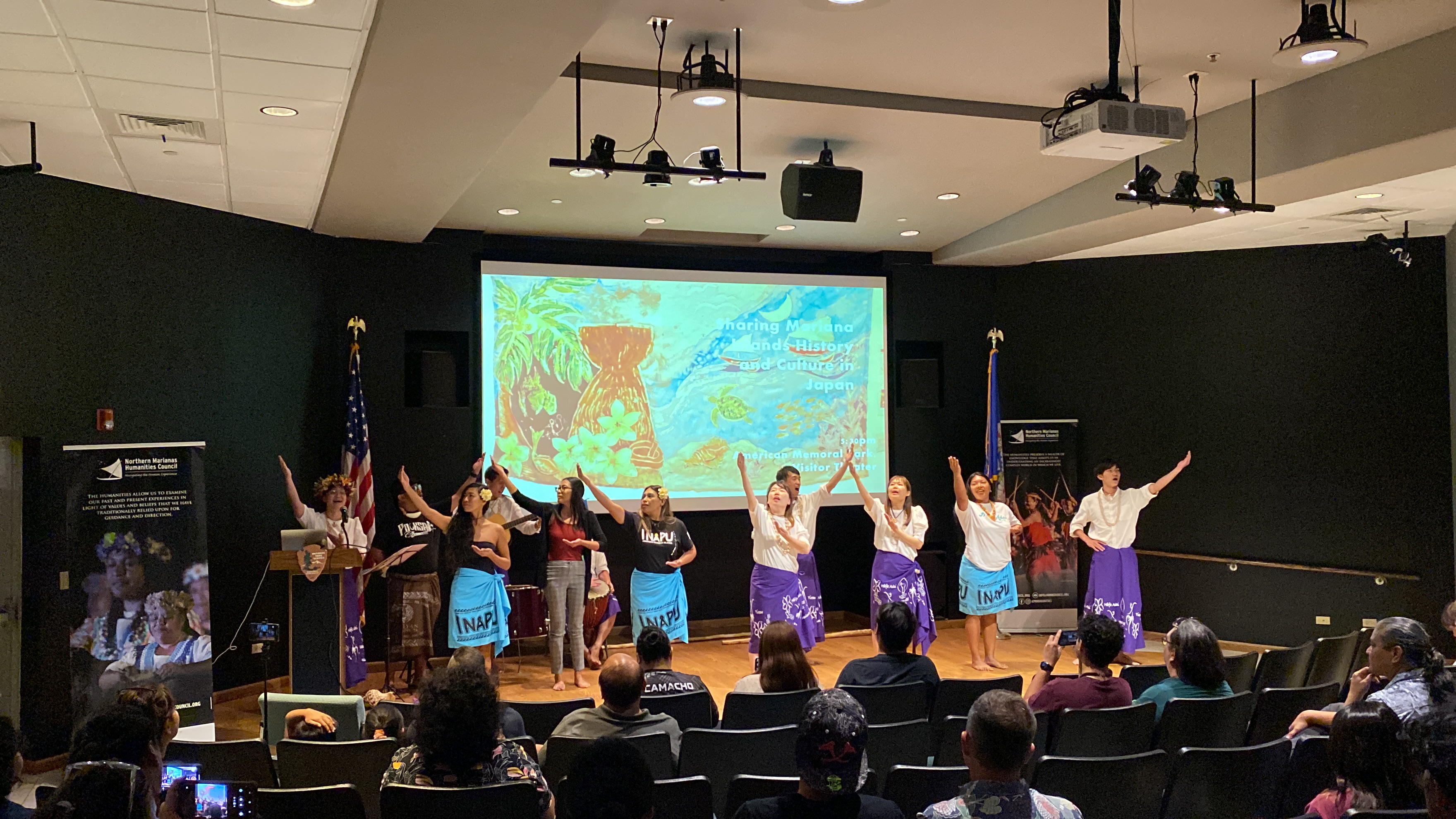
Local dancers and Nakayama’s students perform on stage.
There was also some mention of Guam, and Nakayama said she learned that the island was attacked by the Japanese on the same day as Hawaii. She became interested in the Guam attack and sought out resources about how the people were affected. However, she noticed that in her Japanese sources, there were few mentions about the indigenous people of the Marianas during World War II.
“I checked the English site and there’s so much information,” she said. “I said, oh my gosh, Japanese people don’t understand what happened in Guam and the Marianas. I started to know who is Chamorro, what is Chamorro culture, and what did the Japanese government [do] in Guam and in the Marianas.”
With a newfound interest in the Chamorro culture, Nakayama took a trip to Guam in 2008. She scheduled observations in a Guam Department of Education classroom and was first introduced to a curriculum that incorporated Chamorro dance.
She would later return to Tokyo and begin formal lessons in Chamorro dance from Frank Rabon in the Guam Visitors Bureau’s Chamorro dance program.
She realized that for Japanese people in their 90s, like her father, the Marianas are remembered as “Nanyo” or the South Sea, but they do not know that there is a place called “Mariana Islands.”
Other senior citizens can recognize the word Saipan because it is synonymous with Banzai Cliff.
“Saipan has a strong impression of the Banzai Cliff image that is repeatedly broadcast in August, the anniversary of the end of the war in Japan,” Nakayama said.
Others know Guam as a “more reasonable resort” than Hawaii, and Saipan as a “cheap, close resort,” but many do not know about Rota or Tinian, she added.
Among Japanese Millennials and those younger, she said, there is “little awareness” or “no awareness” about the Marianas, the Chamorro people, or Japan’s connection to the islands.
Young people in their 20s and teens show a “lack of interest in foreign countries and travel due to the Covid-19 [pandemic] and economic recession,” she added.
As a teacher and researcher, it bothered her that most Japanese are unaware about Chamorros or the connection between Japan and the Marianas.
Nakayama said Japan suffers from “mass amnesia” about its involvement in the war.
“The educational system avoided mentioning ‘war’ out of remorse for imperialism,” she said. “Teachers don’t teach what imperial Japan did in Asia and Pacific much.”
But as a professor, she said she wouldn’t let that occur in her classroom.
“I’m an educator so I feel pain very much,” she said. “So [it’s] one of the reasons why I share Mariana history in [my classroom].”
She uses Chamorro dance as one way to incorporate the Chamorro language into her lessons. She also teaches about ancient Chamorro pictographs and the latte stone. She said she sees parallels in Japanese culture and Chamorro beliefs regarding taotao mo’na, inafa’maolek, chenchule, and balutan.
Because she is an education professor, Nakayama sees Chamorro dance and culture as an opportunity for her students to empathize with people outside of the Japanese culture.
In an Aug, 7 interview, she said her goal is to help students “know the value of learning other cultures.”
She also realizes that dance performances are an effective way to approach difficult topics of discussion.
“It is difficult to find an audience for a difficult lecture, but dance music performance at a festival can attract many people and increase learning opportunities,” she said. “So sometimes I have this kind of lecture in Japan about Marianas history and culture, but some people don’t like to attend the lecture. But at a shopping center when we have a performance everybody stops to stare at us.”
She said her new challenge will be to learn Carolinian dance. She plans to join the CNMI’s Domatsuri dance team when they participate in the Nippon Domannaka Festival.
At the lecture’s conclusion, she and her students performed a Chamorro dance.
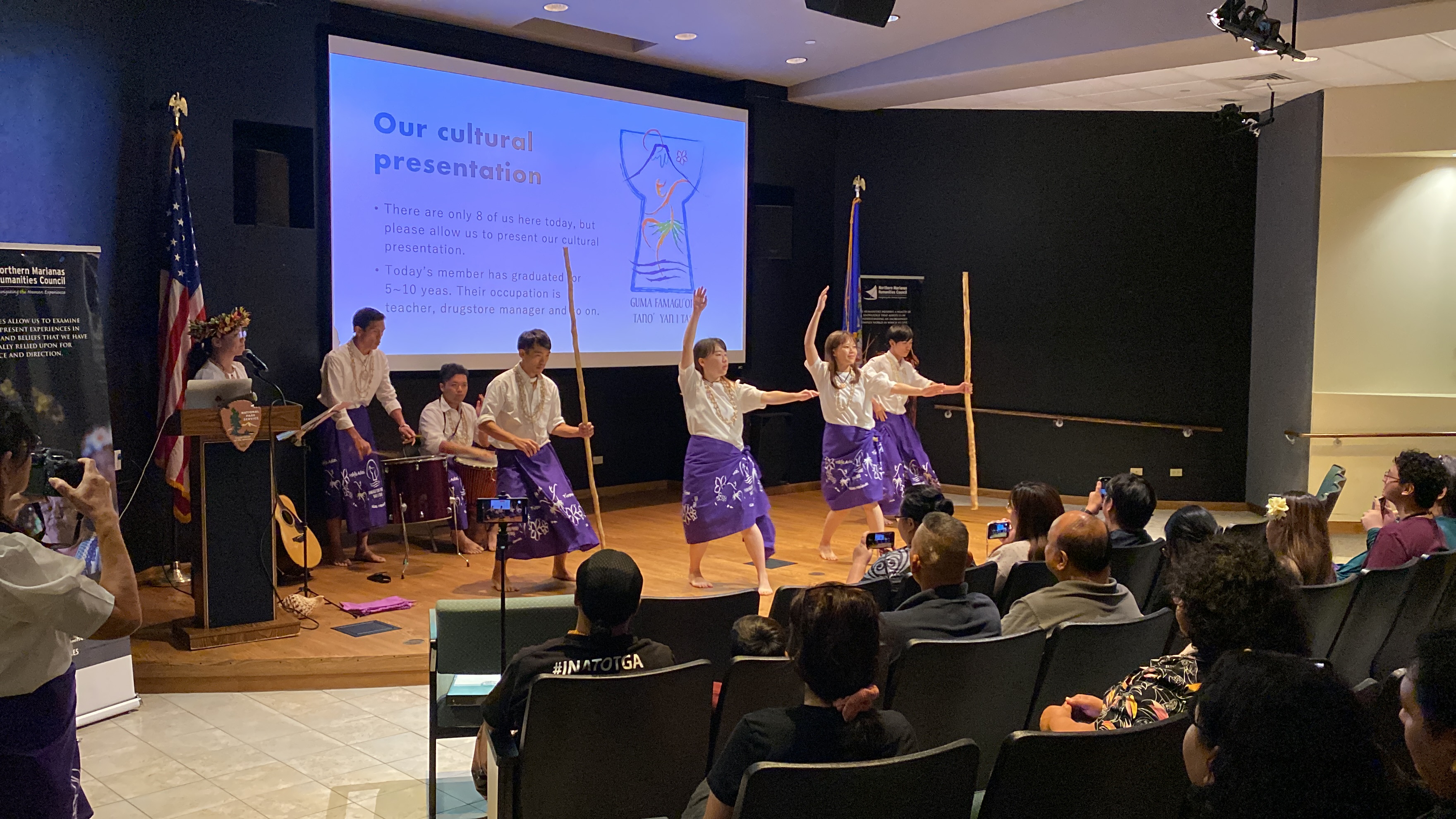
Professor Kyoko Nakayama’s students perform a Chamorro dance.
