






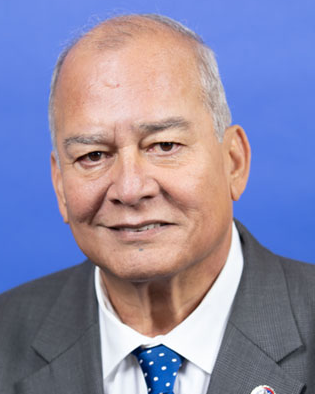

Gregorio Kilili Camacho Sablan
A TRUMP administration plan to tighten control of tourism between the CNMI and China is being put in place, U.S. Congressman Gregorio Kilili Camacho Sablan stated in his e-newsletter, citing an announcement Thursday by the Department of Homeland Security.
“The use of discretionary parole to allow entry will be replaced by a new electronic prescreening system called EVS-TAP, Economic Vitality & Security Travel Authorization Program,” Kilili said.
“The Trump plan agreed in 2019 consultations with then-Gov. Ralph Torres was never implemented, but the Saipan Chamber of Commerce and the Hotel Association of the Northern Mariana Islands urged me last year to advocate for the new system. And I did, writing to Homeland Security Secretary Alejandro Mayorkas in December asking him to move forward,” Kilili added.
“Under the current parole system, tourists from China present paper documents on arrival in the Marianas. Customs and Border Protection officers only have a few minutes to decide to allow entry,” Kilili said.
“EVS-TAP will require electronic submission at least five days before travel, giving CBP time to check the traveler against security watchlists and various law enforcement databases. An electronic ‘Board’ or ‘No Board’ will then be issued to the airline. CBP may still refuse entry on arrival. Travelers waive their right to contest deportation or removal and will not be referred to an immigration judge. In addition to improved security, the electronic EVS-TAP will speed up arrival wait-times and reduce costs for CBP,” Kilili added.
Early in December 2023, a joint letter from four U.S. senators and 28 U.S. House members strongly urged DHS to implement the B-1/B-2 visa requirement for Chinese traveling to the CNMI.
They said the current policy under the parole program made the CNMI “vulnerable to a plethora of problems including drug trafficking, illegal immigration, and organized crime.”
For their part, the Saipan Chamber of Commerce and HANMI said the implementation of EVS-TAP would enhance security measures while ensuring the orderly entry of Chinese nationals for tourism purposes.
Prior to the pandemic, China was the CNMI’s second largest tourism market.
In his letter to DHS, Kilili said the rationale for EVS-TAP was “well documented” in the 902 Consultations report, and that then-DHS Secretary Janet Napolitano “had recognized the importance of maintaining a flow of tourism from China to the Northern Mariana Islands.”
Kilili said tourism to the islands has not yet recovered from the Covid-19 restrictions, and that “in the long run our islands must reestablish what has traditionally been the mainstay of our economy.”
The CNMI Senate has also expressed support for the implementation of EVS-TAP.
