







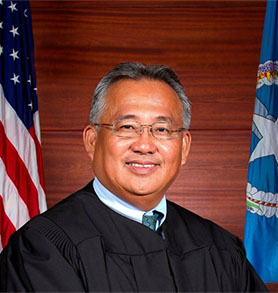
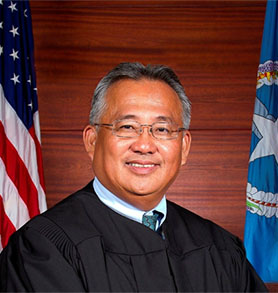
Robert Naraja
ATTORNEY Keith Chambers has respectfully asked Superior Court Presiding Judge Robert C. Naraja to recuse himself from the contempt of Legislature case against Shayne B. Villanueva because the judge has publicly endorsed the reelection campaign of Rep. Ralph Naraja Yumul, his nephew.
“Public endorsement of a political candidate and engaging in political activity in favor of a political candidate would make it appear that the court is not impartial,” Chambers said.
Yumul is a potential witness in the bench trial rescheduled for Dec. 3, 2024. It was originally set for Nov. 6, 2024.
Assistant Attorney General James Kingman, the prosecutor, opposed the defendant’s motion and asked the court to deny it.
Yumul chairs the House Special Committee on Federal Assistance and Disaster-Related Funding before which Villanueva appeared on March 5, 2024.
Villanueva was charged with contempt of Legislature after he invoked his Fifth Amendment right when asked by the House committee questions about BOOST.
BOOST stands for “Building Optimism, Opportunities and Stability Together,” a $17 million federally funded program.
Villanueva is the owner of Roil Soil Marketing, which the administration of then-Gov. Ralph DLG Torres contracted to help implement BOOST in 2022.
Earlier, Chambers raised concerns about impartiality because of the familial relationship between the judge and his nephew, Yumul. Yumul’s mother is the judge’s sister.
Subsequently, Judge Naraja ordered the parties to file a brief on whether he has to recuse himself from the case.
In a 13-page memorandum, Chambers noted that Yumul ran for reelection this year.
“On June 27, 2024, it was observed that a large sign was placed on [Judge Naraja’s] property on Middle Road with the following text: Please RE-ELECT Yumul RALPH House of Representatives Precinct 3.”
“The sign remained on the property from approximately late June until the time of this writing,” Chambers said.
On Nov. 5, Yumul won his bid for reelection.
Chambers said at the time of his writing the brief, a smaller sign with the words “Thank You” had been placed on the face of the sign.
“By allowing the sign to be put on the property it appears that PJ Naraja is participating in Representative Yumul’s campaign, is endorsing Representative Yumul’s candidacy, and is partaking in political activity on behalf of Representative Yumul,” Chambers said.
He added that “the ‘Thank You’ sign can be seen as a gratitude to the public for having reelected Representative Yumul. Publicly endorsing a [candidate’s] reelection campaign is a sign that the endorser openly approves of and agrees with the candidate’s political decisions that were made within their previous term. Here, one of Representative Yumul’s political decisions was voting to find Mr. Villanueva in contempt. Therefore, by openly endorsing Representative Yumul, a reasonable person ‘would conclude that [Judge Naraja’s] impartiality could be questioned here in that there is an appearance that Mr. Villanueva’s contempt charge has been prejudged.”
“With a high-profile case such as this, Representative Yumul has a lot at stake in this case’s outcome and the appearance of the sign on the property would cause a reasonable person to conclude that Judge Naraja could be constrained to concluding this matter in a manner that would not cause a political setback for Representative Yumul,” Chambers said. “Therefore, the existence of the sign on the property in and of itself gives the appearance that Judge Naraja would not be impartial but rather be predisposed to issue a ruling that would be favorable to the Commonwealth and, therefore, Representative Yumul.”
Chambers said: “This is not a situation in which Representative Yumul is being subpoenaed to testify as a disinterested witness in a case that does not turn on activity that he personally performed. This is a case in which Representative Yumul’s political conduct will be called into question and, as such, is a case in which [he] has a vested interest in the Commonwealth obtaining a favorable outcome. This case is also different from those in which a party moved to recuse a judge for political actions taken by the judge before they assumed the bench. It is not unusual for a judge both here and on the mainland to have partaken in politics before they became a judge or justice. If this was a matter in which the judge expresses a political opinion prior to ascending to the bench, this would be a different analysis.”
Chambers added: “At trial, facts concerning the [House] committee’s jurisdiction, the authority of the committee to conduct its investigation, whether the questions at issue here were within the scope of the authority granted to the committee, and whether the questions at issue were relevant to the … inquiry, are facts that need to be fleshed out. The individual best suited to provide these facts is the chair of the committee, Representative Yumul.”
But according to Kingman, Yumul “stands in a third-degree relationship to the judge under the civil law calculation method. The path moves from the judge upward to his parents (one degree), then downward to his sister (second degree), and finally to her son (third degree).”
“This calculation shows that the relationship does not meet the Commonwealth’s second-degree threshold. Automatic recusal is not required,” Kingman added.
He said Yumul is a witness under subpoena by the defendant.
“Without a show of proof about the testimony anticipated from Yumul that differs from his procedural role, the Commonwealth must also assume that the witness will simply provide duplicative, cumulative evidence that removes him from the ‘material witness’ determination from federal case law,” Kingman added.
Judge Naraja will hear the parties’ arguments on Nov. 18, and has set a motion hearing for Dec. 2.
