







By Bryan Manabat
[email protected]
Variety News Staff
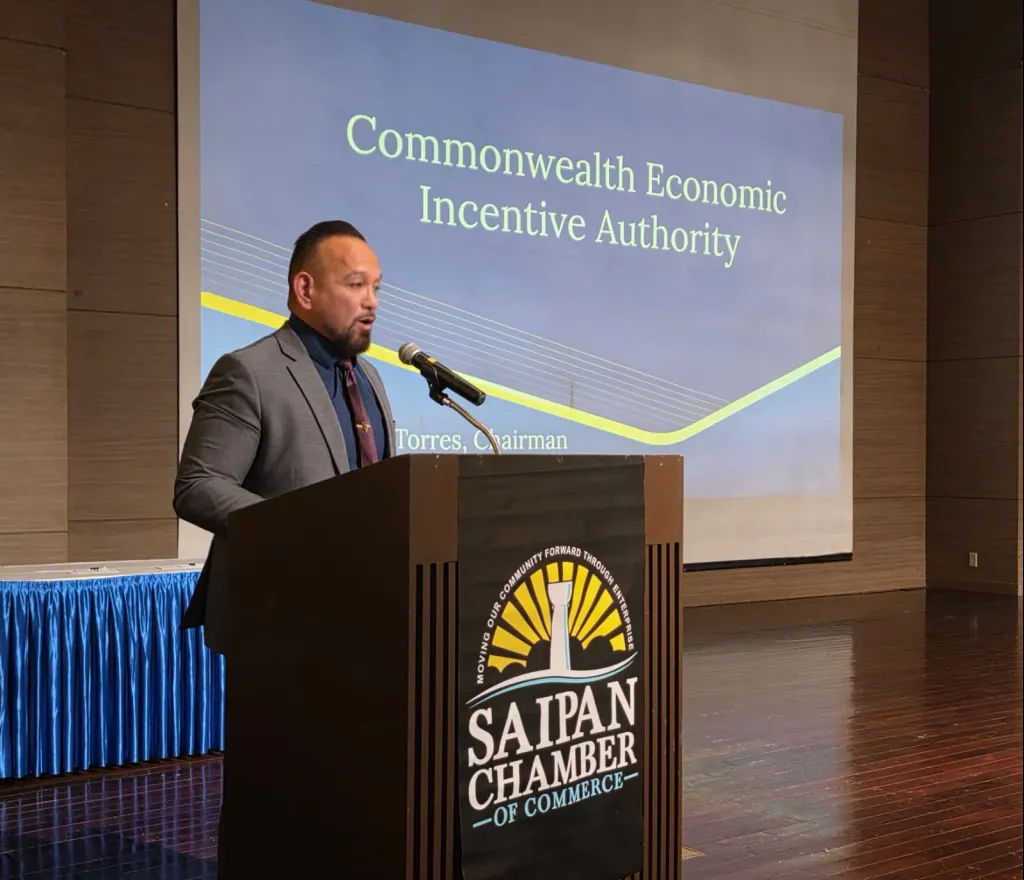
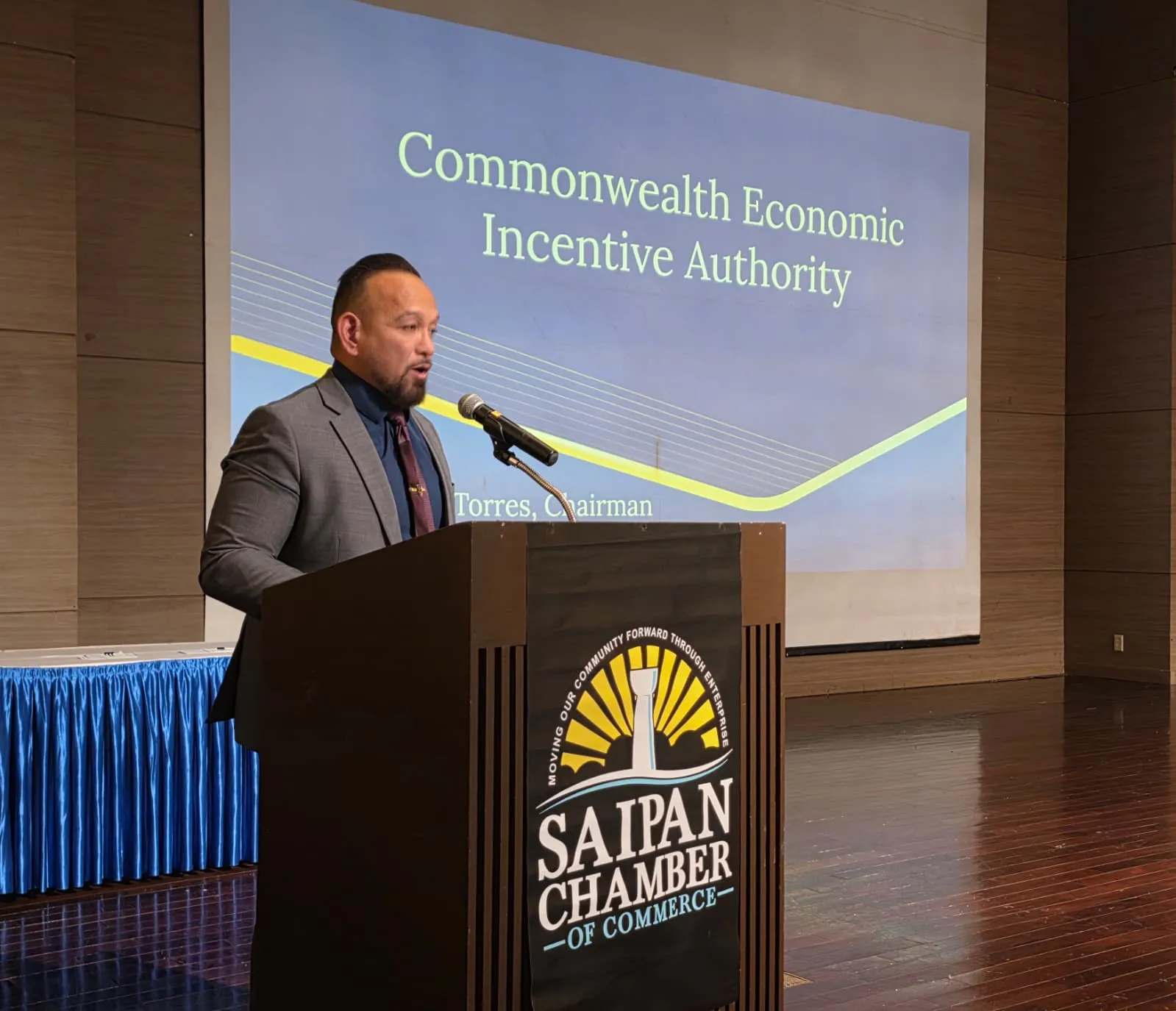
“CEIA is the tide that lifts all boats,” said Commonwealth Economic Incentive Authority Chairman Anthony Torres as he addressed the Saipan Chamber of Commerce recently, outlining an ambitious vision to transform the CNMI’s long-term economic future through aggressive global marketing, streamlined incentives, and a renewed push for diversification.
Speaking to business leaders, Torres, who is also the commissioner of the Department of Corrections, said his mission is deeply personal.
“This isn’t just another meeting or presentation for me. It’s personal,” he said. “Like many of you, I’ve watched our community weather tough times and typhoons, economic ups and downs, and a pandemic — and still come out fighting.”
Torres said CEIA’s work is rooted in what he called an “infinite mindset,” one focused on building a stronger economic foundation for future generations.
“I envision a Commonwealth where the vast majority of our people live in prosperity with a strong, diversified economy,” he said. “My goal as chairman is to drive CEIA’s aggressive marketing mandate and promote our economic incentive districts by attracting desirable international businesses for economic diversification, job creation, and growth.”
Torres emphasized that CEIA is not a new idea, but rather the revival of a long-standing economic strategy. He traced its origins to Public Law 12-20, the Northern Mariana Islands Free Trade Zone Act, which was enacted in 2000 following the collapse of the garment industry and the federalization of U.S. immigration, both of which reshaped the local labor market.
“Our leaders saw the future clearly,” Torres said. “We needed high-skill, low-impact, high-wage industries — technology, software, financial tech, and intellectual property — that don’t clog our roads, don’t hurt our reefs, and pay salaries our people can build a future on.”
In 2025, the Legislature renamed and revitalized the authority through Public Law 24-5, creating the Commonwealth Economic Incentive Authority. Gov. David M. Apatang appointed the board in August 2025, with Torres selected as chairman alongside Vice Chair Tina Azarvand, Dave Burger, Remy Mafnas, and Noel Calvo of Rota.
A new framework
Torres urged the business community to move away from the old “free trade zone” terminology.
“Do me a favor and forget that name,” he said. “It is now called an economic incentive district, or an EID.”
Within these districts, qualifying businesses may receive up to 20 years of tax rebates or exemptions on gross revenue tax, excise taxes, and other fees, with some rates dropping as low as 3-7%. Additional benefits include uncapped H-1B visas for specialized talent, faster permitting, and streamlined processes designed to reduce red tape.
“This isn’t about handouts,” Torres said. “It’s about matching incentives to the real value a business creates — jobs for our people, investment in our infrastructure, and long-term growth for our families.”
Momentum is already building, he added. Gov. Apatang recently signed House Bill 24-34, establishing the Saipan Economic Incentive District in Garapan and opening underused public land for responsible development.
Fair question
Torres acknowledged skepticism from some local business owners who question how CEIA’s efforts will benefit them in the near term.
“Fair question,” he said. “CEIA isn’t here to compete with you. It’s here to be the tide that lifts all boats.”
He said many existing businesses could qualify for incentives if they expand operations, invest at least $1 million, hire additional local workers, or introduce new services. CEIA is also developing a simplified application process supported by third-party compliance assistance.
Beyond incentives, Torres said CEIA aims to partner with local businesses through joint marketing initiatives, investor outreach, workshops, and global promotion of local success stories.
Building a future
Torres also addressed the long-standing challenge of young residents leaving the CNMI in search of better opportunities elsewhere.
“Too many of our young people have had to leave for better opportunities and are not coming back home,” he said. “I say this because I was once that kid who had no aspirations of moving back home.”
He said CEIA’s strategy seeks to reverse that trend by attracting future-ready industries that offer high-paying careers, including renewable energy, digital services and artificial intelligence development, financial technology and blockchain, cybersecurity, and intellectual property and licensing firms.
Many of these fields, he noted, offer salaries ranging from $150,000 to $300,000.
A call to action
Torres closed with a direct appeal to the business community.
“Saving this economy won’t be done through incremental improvement alone. We must also look for massive, calculated shifts,” he said. “Let’s team up. Reach out if you’re interested in exploring incentives for your business. Share your ideas with us.”
He encouraged business owners to attend CEIA board meetings, co-host events, or simply “grab coffee and talk story.”
“Together, we can make Saipan — and all our islands, Rota, Tinian, and the Northern Islands — a place where dreams can grow and thrive,” Torres said.
Bryan Manabat was a liberal arts student of Northern Marianas College where he also studied criminal justice. He is the recipient of the NMI Humanities Award as an Outstanding Teacher (Non-Classroom) in 2013, and has worked for the CNMI Motheread/Fatheread Literacy Program as lead facilitator.
