




IMABARI, Ehime (Mainichi Japan) — A project called the “Marianas Kyushoku Project” has been underway since the 2024 academic year, with students at Ehime University playing a central role. The idea is to keep up exchanges with Saipan in the U.S. territory of the Northern Mariana Islands while joining hands to improve school meals, a local issue there. What problems exist with children’s school meals, and how can they be changed?
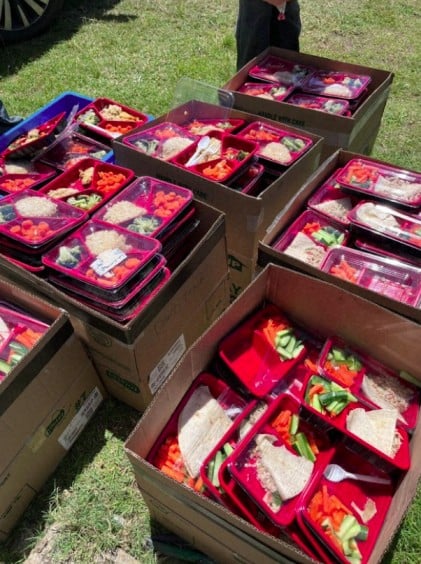
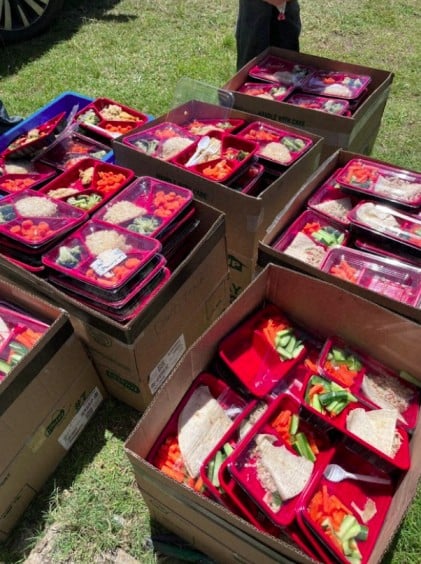
“It made me think, ‘What a waste.’ We grew up being told in elementary and junior high school to ‘eat everything on your plate,’ so it felt like a huge gap.” That is how Sakurako Inoue, 21, a fourth-year engineering student at Ehime University who has visited Saipan four times through the project, described the wasted food. Elementary and middle schools in Saipan and the other islands in the region serve both breakfast and lunch, but leftovers have long been seen as a problem, to the point that “about 80% of students leave some of their school meals uneaten.”
For more than 10 years, students at Ehime University and 16 other universities in Japan have continued cross-cultural training programs in Saipan and South Korea. In the course of learning about communication and leadership while engaging with people from different linguistic, historical and cultural backgrounds, the students became aware of the reality of school meals in Saipan and launched the project. “How can we make school meals delicious and enjoyable for children?” The students now travel there twice a year to study school meal conditions and exchange views on improvements with the public school system, which is the equivalent of a board of education, as well as with schools and nutrition program officials.
In a survey the project conducted in March 2025 with the cooperation of a middle school, about 103 kilograms of leftovers were discarded in a single day — roughly 65% of the estimated 158 kilograms of food served. By ingredient, some 92% of the carrots, approximately 62% of the broccoli and about 53% of the rice were left uneaten. The amount of time students actually spent seated in the cafeteria for lunch was also found to be extremely short compared to Japan: 46.4% sat for no more than five minutes, 45% for more than five but no more than 10 minutes and 8.6% for more than 10 but no more than 15 minutes.
In another survey conducted from October through December 2024 at four elementary and middle schools in Saipan, 73% of children answered “yes” when asked whether they try to finish their school meals, suggesting they do want to eat it all. At the same time, when asked whether it concerns them to leave food behind, a combined 29% answered it does not bother them or not bother them much, indicating a tendency not to worry much about leftovers themselves.
High leftover rates, short meal times, little resistance to uneaten food…with those realities in mind, the project has continued discussions with local officials from the standpoint that “what feels normal to us is not necessarily ‘normal.’ We want to accept differences in systems and values and think about what can actually be put into practice.”
One idea they are developing is a “model week” for school meals. Children have a habit of eating snacks during a short break before meals, but the plan is to try having them pause that habit and use a rotating duty system for serving and cleanup. Along with changes to the menu, the goal for the 2026 academic year is to move reform forward little by little through such a “model week.”
In this summer, Ehime University will also launch a practical education course focused on tackling these issues. According to lecturer Shinya Murata, who supervises the project and specializes in leadership theory, the new course “Global Leadership IV” will consist of eight sessions. It aims to first deepen students’ basic understanding of the Northern Mariana Islands and then help them acquire the ability to “communicate in a variety of situations” and “collaborate with diverse people to achieve goals.”
