






Text and photo
by Bryan Manabat
[email protected]
Variety News Staff
THE Commonwealth Utilities Corporation’s request for an advance disaster payment from the Federal Emergency Management Agency has been denied, heightening the utility’s cash-flow strain as it works to rebuild power and water systems damaged by Super Typhoon Sinlaku.
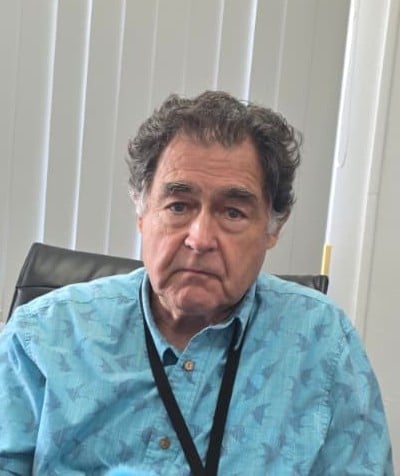
CUC Executive Director Kevin Watson confirmed the denial during a June 5 press briefing at his office, saying the advance was intended to help accelerate what is expected to be about $75 million in restoration work across Saipan and Tinian. The underlying reimbursement claim remains active, but FEMA will not provide upfront funding.
“Initially we were hopeful that we might get 50 percent, and FEMA… they were optimistic about that,” Watson said. “But just recently we came to realize that it had been denied. FEMA evidently didn’t have the funds available in its budget to be able to front that to us.”
The denial means CUC must spend its own money first and then wait for reimbursement through FEMA’s standard process — a months-long cycle that requires precise documentation. Watson emphasized that only the advance payment was denied and that the full $75 million reimbursement request remains under review.
He added that FEMA has deployed specialists to Saipan to train CUC staff on properly completing reimbursement applications. “It’s very important that every application or every document is filled out properly,” Watson said. “Just one mistake could derail the whole process for that particular application.”
Without the advance, CUC is relying on remaining reserves and is seeking legislative approval for a $40 million line of credit from local banks to keep restoration work moving. Watson said the utility entered the typhoon with about $13 million in reserves but was already under pressure from high fuel costs before the storm.
“Now it’s purchasing diesel fuel and restoration,” he said, noting that CUC must cover both ongoing generation costs and the extraordinary expense of replacing poles, conductors, transformers, and laterals.
Watson stressed that the line of credit cannot proceed without approval from both the House and Senate. The proposal sets a $40 million ceiling, but CUC would draw only what it needs to minimize interest costs.
“We wouldn’t just borrow the $40 million,” he said. “You may only need $1 million, so you don’t draw the whole $40 million down… you only take the bare minimum that you can get by with and keep that interest payment lower.”
Vendors, he acknowledged, are aware of CUC’s tight cash position and may be reluctant to extend favorable payment terms. Access to bridge financing, he said, is essential for securing contracts and long-lead materials such as transformers.
“That could be a challenge,” Watson said, adding that much of the restoration timeline now depends on how quickly policymakers act on CUC’s financing request.
The CUC Board of Directors will meet June 11 at 9:30 a.m. to discuss the FEMA advance payment denial, the fuel adjustment charge, and other typhoon-related policy matters.
Bryan Manabat was a liberal arts student of Northern Marianas College where he also studied criminal justice. He is the recipient of the NMI Humanities Award as an Outstanding Teacher (Non-Classroom) in 2013, and has worked for the CNMI Motheread/Fatheread Literacy Program as lead facilitator.
