



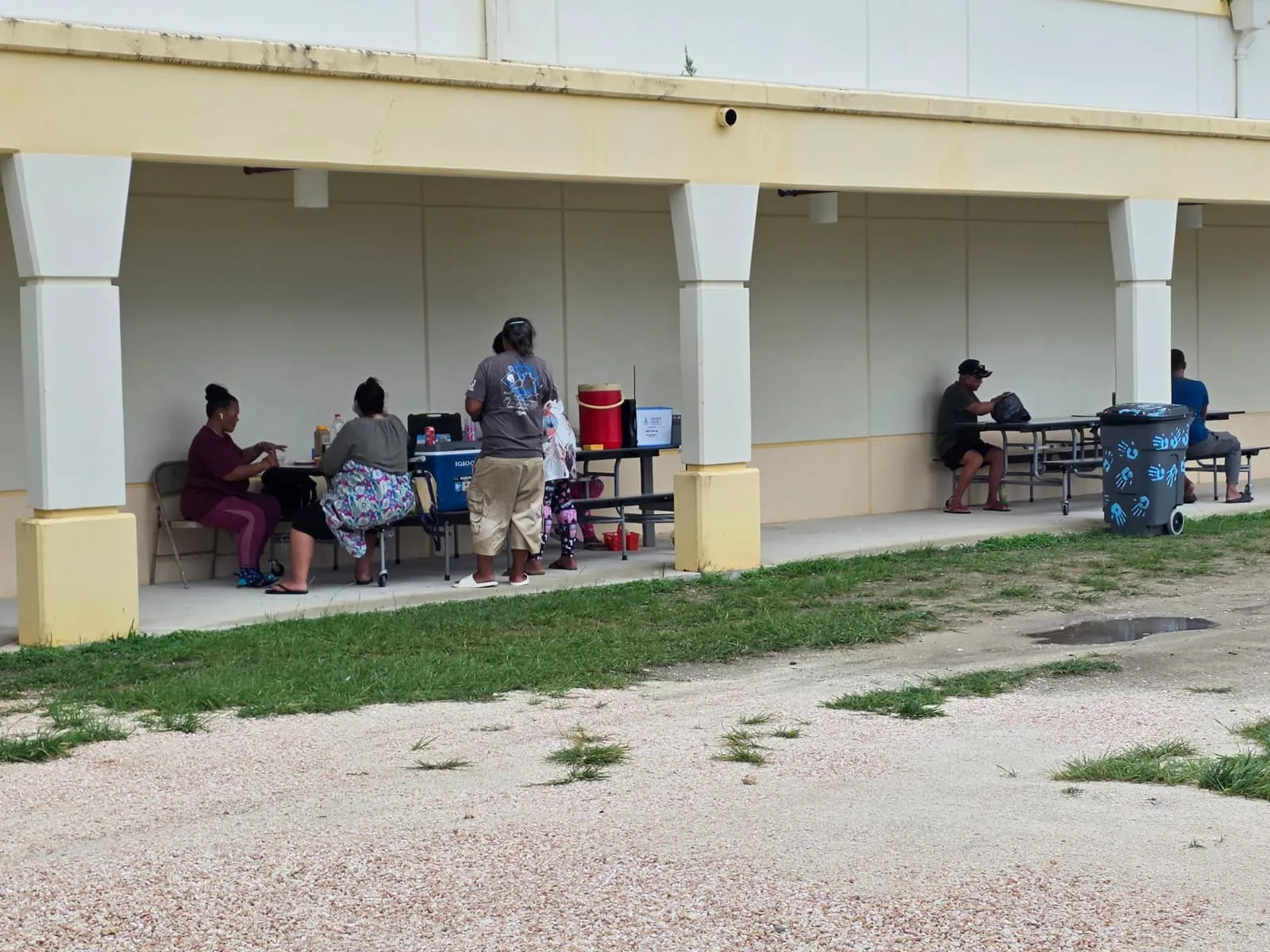




A new report from the Ministry of Education released Tuesday said both the public elementary and high schools on Kwajalein were forced to turn away students for the current school year for lack of classrooms.
Both United States and Marshall Islands government officials say that the bottleneck holding up construction of new classrooms at Kwajalein Atoll is the lack of land leases for these schools to expand and build new facilities. A Compact of Free Association between the two countries that went into effect in 2003 guarantees more than $11 million annually in funding for infrastructure development.
“In Ebeye and Kwajalein the lack of adequate classrooms is directly attributable to the absence of valid land lease agreements for the two schools,” said U.S. Deputy Chief of Mission Eric Watnik. “Compact infrastructure funding was allocated in past years for both schools, but it had to be re-directed to other projects when the land lease issue went unresolved. The United States will provide Compact infrastructure funding for both schools once there are valid land lease agreements.”
Acting Secretary of Education Allison Nashion said, “the Marshall Islands government’s initial plan to use infrastructure funds to build new public high school in (Kwajalein) has not materialized due to the ongoing issue with the land lease for lands on Kwajalein. As a result, Kwajalein Atoll High School continues to utilize buildings funded and constructed by funds Marshall Islands received under the Asian Development Bank basic education loan. The public elementary school on Ebeye is in the same scenario.”
The land lease problem is tied to a bigger issue of the ongoing dispute between Kwajalein landowners and the Marshall Islands and U.S. governments over long-term use by the U.S. of the Kwajalein missile testing range, America¹s prime long-range intercontinental ballistic missile test facility that uses this atoll as a target for missile launched from California. Since 2003, when the U.S. and Marshall Islands government signed an agreement to extend U.S. use of the missile range to 2066, landowners who must approve the deal for it to be valid have refused, saying U.S. rental payments are too low.
Landowners sought $19 million annually for use of the testing range, while the agreement signed by the U.S. and Marshall Islands officials provides $15 million annually that is adjusted upward for inflation. An escrow account collecting the difference in the existing and new agreement rent levels has now accumulated more than $30 million awaiting landowner acceptance of the lease before it can be released. Ongoing negotiations for the past seven years have been unable to resolve differences to reach a deal acceptable to all parties.
The existing land use agreement for the U.S. Army-operated missile range expires in 2016, putting long-term U.S. presence at Kwajalein in question.
With the missile range land use agreement in limbo, land leases for the school properties have gone unresolved, so “many students were turned away due to lack of space,” a report from the Ministry of Education on Ebeye Elementary School said.
The high school is facing the same problem. “For this year, the enrollment has gone above 400 students and because of the shortage of teachers and the limited number of classrooms we had to turn away many students,” the Ministry of Education’s report said.
This year’s over-crowding in the public schools has been heightened because “more students from the private schools on Ebeye sought entry to the public schools, both secondary and elementary,” Nashion said.
The public schools face the challenge of trying to maintain the student-teacher ratio at 30 to 1 “but were pressured by many parents” to take more students.
