




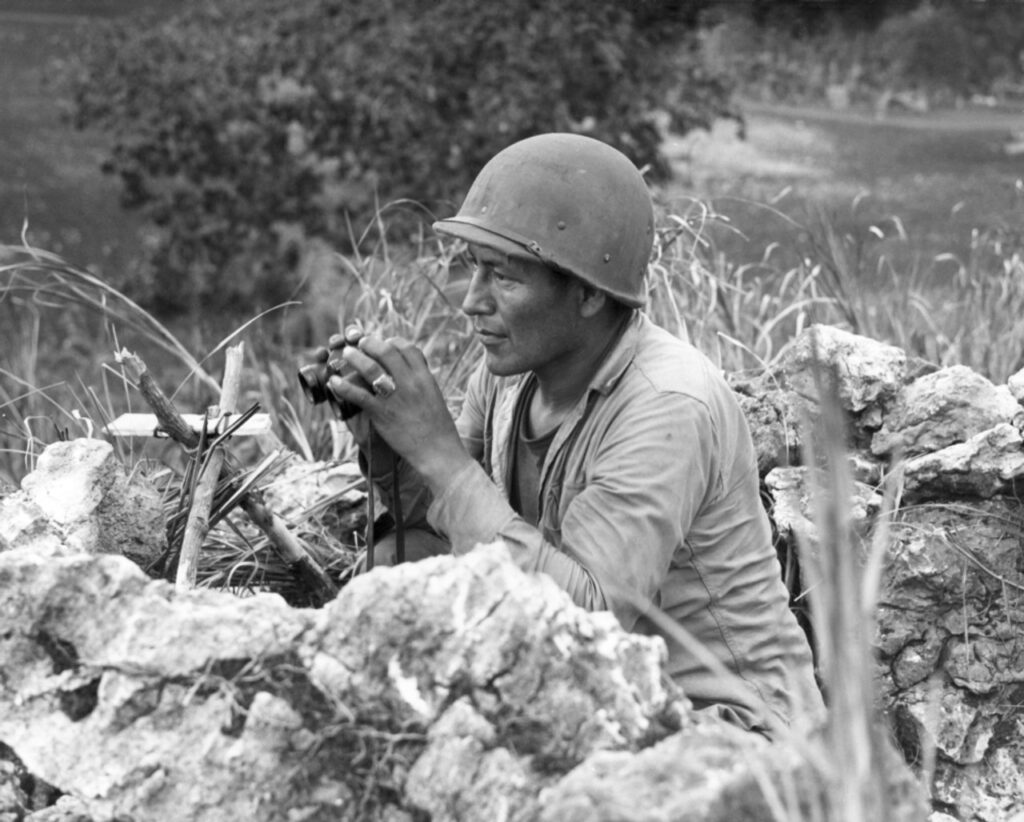
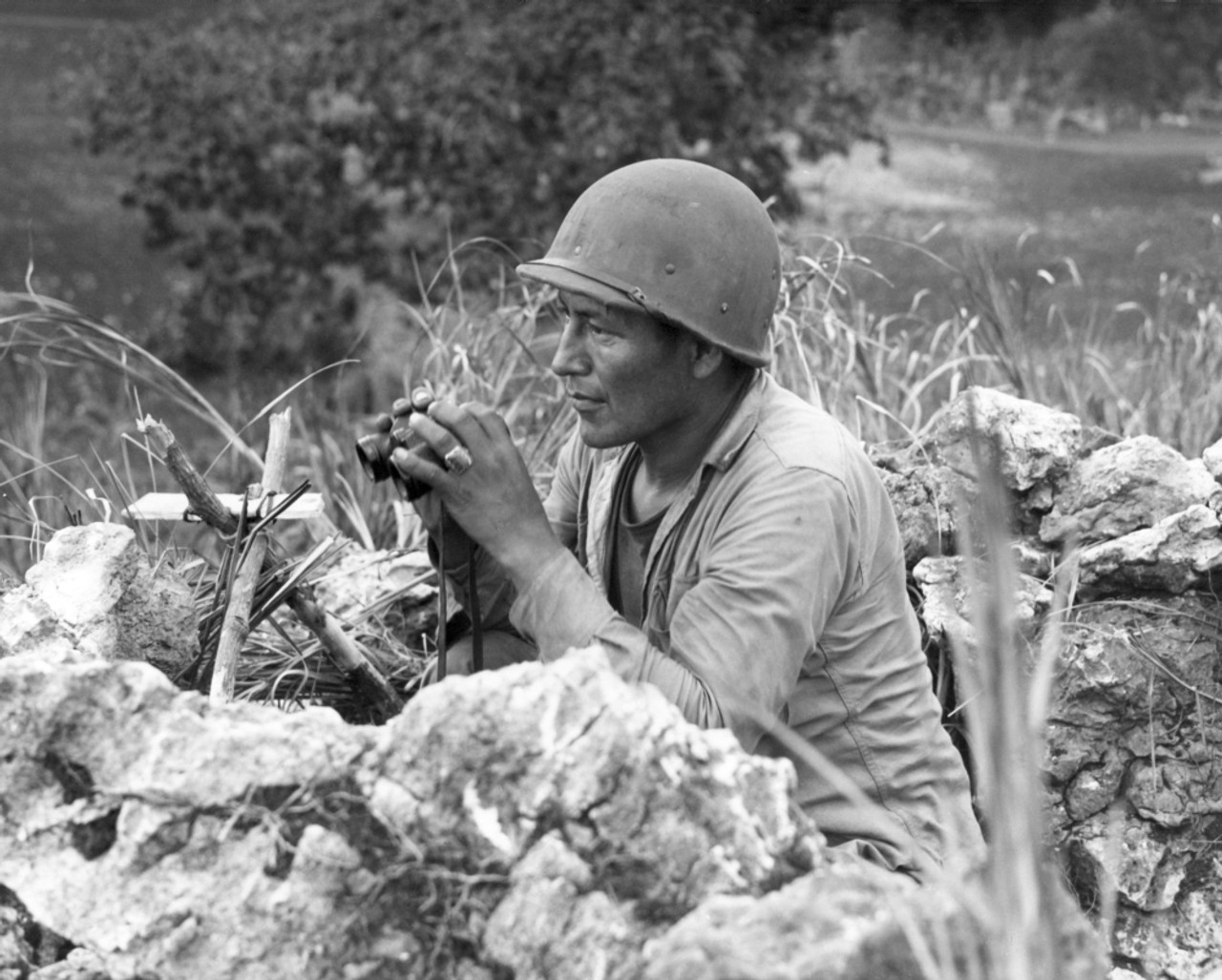
A Native American Marine “Code Talker” at an observation post overlooking Garapan during the Battle of Saipan, June 27, 1944.
(SNIMC) — The leadership of the 17th Saipan and Northern Islands Municipal Council recently endorsed the funding request by Gov. Arnold I. Palacios to install a permanent commemorative memorial court of honor for the Marianas Marine Scouts and the Navajo Code Talkers in appreciation for the ultimate sacrifice by these two groups in the Battle of Saipan Operation Forager on the 15th of June to the 9th of July 1944 by the code talkers and August 1944 to September 1945 by some 50 Chamorro and Carolinian Marine Scouts recruited by the U.S. Marines.
Over 30 years later following the Battle of Saipan on August 14, 1982, President Ronald Regan declared National Navajo Code Talkers Day, saying the code talkers played an instrumental role in the Pacific War from 1942 to 1945.
A little over 50 years later on January 31, 2000, Guam delegate to the United States House of Representatives Robert Underwood stood and eloquently delivered before the U.S. House of Representatives a rousing “At Last America Remembers Marianas Scouts” speech, naming by their full names the stewards of peace in the Battle of Saipan’s Operation Forager in Ignacio Reyes Ada, Antonio M. Aguon, Antonio Angailen, Pedro SN Attao, Santiago Miyasaki Babauta, Antonio Manahane Benavente, Juan V. Benavente, Daniel T. Borja, Gregorio Flores Borja, Gregorio Camacho Cabrera, Juan Camacho Cabrera, Albert S. Camacho, Lorenzo Tudela Camacho, Cristino S. Dela Cruz, Joaquin Duenas Dela Cruz, Bernardo C. Deleon Guerrero, Joaquin C. Deleon Guerrero, Jose S. Deleon Guerrero, Lorenzo Diaz Deleon Guerrero, Serafin Borja Kaipat, Juan Limes, Rafael C. Mafnas, Jose Blas Magofna, Miguel Blaz Magofna, Pedro Mettao, Nicolas Quidachai Muna, Francisco Nekai, Juan Quitugua Norita, Isidro Limes Ogarto, Francisco C. Palacios, Joaquin B. Pangelian, Juan San Nicolas Pangelian, Edward M. Peter, Jose Roberto Quitano, Benigno A. Rabauliman, Antonio T. Rogolofoi, Isidro R. Rogopes, Vicente T. Rosario, Ignacio Mangarero Sablan, Segundo Tudela Sablan, Herberto San Nicolas, Pedro F. Sakisat, Felipe Agulto Salas, Gofredo Aguon Sanchez, Juan A. Sanchez, Guillermo P. Saures, Felipe Mazinnis Seman, Juan Malus Tagabuel, Benedicto Satur Taisacan, Antonio Camacho Tenorio, Antonio P. Tenorio, Vicente Olaitiman Taman, Miguel Pangelinan Tenorio, Pedro Peter Teregeyo, and Manuel Seman Villagomez.
In a letter of support to the Assistant Interior Secretary for Insular and International Affairs Carmen G. Cantor, the Saipan and Northern Islands Memorial Council leadership underscored the role of the code talkers as pivotal in their enigmatic way of encoding messages which literally confused the Japanese command post on the location of the U.S. soldiers and the direction the Operation Forager was headed, and pivoted the manner in which World War II ended in the Battle of Saipan in the Pacific Islands.
After the major bombardment on Saipan by the combined forces of the U.S. Marines, Army and Navy, a few carefully vetted local civilians were conscripted into the U.S. Marine Battalion: their singular duty was to ensure the continuing safety of the U.S. soldiers and local civilians following Operation Forager. These civilian Marines were chosen by the U.S. Marines because of their insights and knowledge on Japanese military hideouts in tunnels and caves, including the locations of the Japanese gun emplacements, no less their familiarity of the terrains throughout Saipan and fluency in the Japanese language.
The local council leadership is joined by former Gov. Juan N. Babauta, the CNMI’s former representative to Washington and author-publisher of “Now for Then: The Marianas Marine Scouts,” saying “the Navajo Nation’s unique communication symbols and language codes, the Navajo code talkers steered U.S. naval fire with eagle-eye precision on Japanese holdouts, both on sea and on land, throughout Saipan.”
Babauta said the conscripted local civilians were tasked with post-assault safety of U.S. soldiers and local civilians following Operation Forager, and vetted and carefully selected because of their personal insights and personal knowledge of Japanese military hideouts in tunnels and caves, including locations of Japanese gun emplacements. Importantly, their intimate familiarity of the mountainous terrains, death valleys and waterways coupled with their fluency in the Japanese language pivoted their recruitment for service in the U.S. Marines.
“As a former Washington representative and former CNMI governor, I stand shoulder-to-shoulder with the Honorable Governor Arnold I. Palacios’ funding assistance for the permanent installation of a well-deserved court of honor for the Navajo Code Talkers and the Marianas Marine Scouts on Saipan at the American Memorial Park or other suitable locations on Saipan,” Babauta said.
Former Precinct 3 Rep. John “Liling” S. Reyes likewise stated: “I wholeheartedly support to the Honorable Governor Arnold I. Palacios in requesting funding to emplace a permanent court of honor in commemorative remembrance of the Marianas Marine Scouts and the Navajo Code Talkers in The Battle of Saipan’s Operation Forager on the 15th of June to the 9th of July 1944.”
Added Reyes, “The Navajo Nation retains a unique system of communication symbols and language codes for over decades prior to the European migration to America, and this unique linguistic richness retained by the Navajo code talkers largely steered U.S. naval fire with eagle-eye precision on Japanese holdouts, both on sea and on land, throughout Saipan.”
“I, too, stand shoulder-to-shoulder with the Honorable Governor Arnold I. Palacios’ funding assistance for the permanent installation of a well-deserved court of honor,” Reyes said.
Herman B. Cabrera of H.B. Cabrera and Associates, a local certified professional architect and community developer, also urged support for Governor Palacios’ funding request to Interior’s Cantor saying, “I stand ready, willing and able to contribute my talents and resources towards the design of Governor Palacios’ court of honor for the Navajo Code Talkers and the Marianas Marine Scouts.”
