

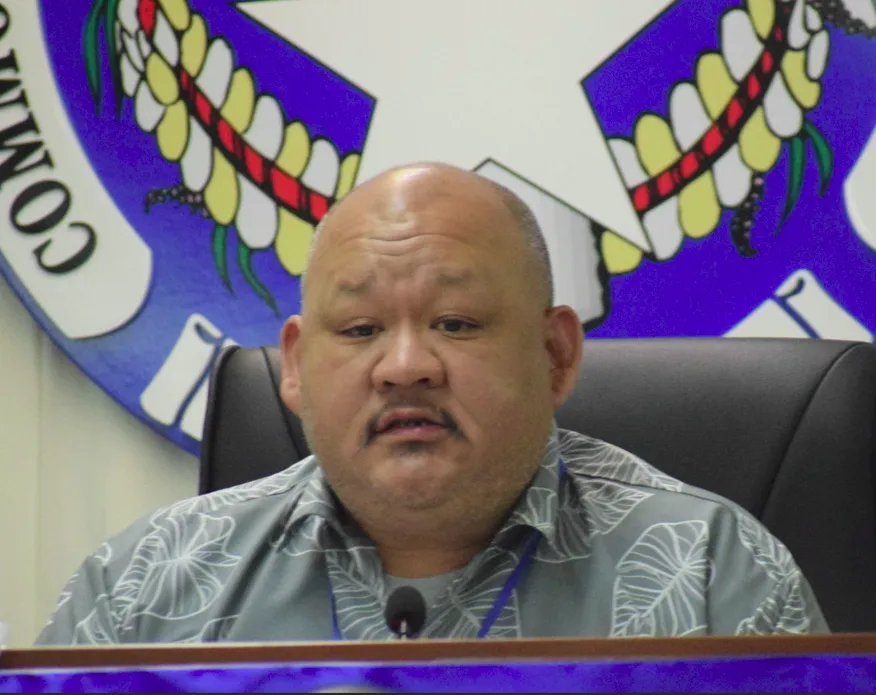




IN separate letters to the CNMI leadership on Friday, Oct. 20, the Saipan Chamber of Commerce and the Hotel Association of NMI listed several recommendations that they said will balance national security considerations with the need to improve the local economy.
Chamber President Joe C. Guerrero and Acting HANMI board chairman Dennis Seo signed the letters to Gov. Arnold I. Palacios, Lt. Gov. David M. Apatang, U.S. Congressman Gregorio Kilili Camacho Sablan, Speaker Edmund S. Villagomez and Senate President Edith Deleon Guerrero.
The business leaders expressed concerns about the “collapse of our only industry,” which is tourism, and the administration’s pivot from the Chinese tourism market.
The business leaders said “the challenge we face, while multi-faceted, is simple to surmise — the CNMI government does not have the financial resources it needs to support government services, public employment, and to provide for the needs of the public to the levels they expect and deserve.”
At the heart of the issue, Guerrero and Seo said, “is that the businesses in the CNMI are struggling to operate in this economy.”
They said the role of tourism in the CNMI economy cannot be overstated, adding that the local economy and the government cannot sustain themselves on revenue generated by residents alone.
They said despite the progress in reviving the South Korea tourism market, this “cannot shoulder the entire weight of the Commonwealth alone.”
The missing factor, they said, is a “diversified tourism marketplace.”
“It is certainly true that the U.S.-China relationship is undergoing a period of increased tensions. Yet despite these tensions, the United States government has engaged in multi-prolonged approach to rebuilding the economic ties that ultimately make our country and its economy stronger,” Guerrero and Seo said.
They added that there have been concerns related to the Chinese tourism market “that include the idea that geopolitical security and tourism from China are in a zero-sum relationship. However, excluding Chinese tourists as the primary strategy for greater resilience against geopolitical threats is at odds with current American foreign policy [that] will significantly curtail the private sector’s ability to recover and sustain itself, and discounting the role of policy options that can mitigate the main concerns related to the China tourism market.”
Recommendations
Quoting President Biden who said, “We are for derisking…not decoupling from China,” the Chamber president and HANMI chair made the following recommendations:
1) A framework already exists to ensure that direct investment from China is not in conflict with the nation’s security. Guerrero and Seo said they “wholeheartedly share the concerns that foreign actors are prevented from influencing our national security though commercial transactions in the CNMI.” To ensure that this does not occur, they recommend engaging in a dialogue with the Committee on Foreign Investment in the U.S. to ensure that there are open channels of communication on proposed investments in the CNMI, and if necessary, initiate review of any given investment to ensure our national security interests are protected.
2) The CNMI-Only Transitional Workers Visa program “can be tailored to better meet the needs of our community and evolve to proactively address negative outcomes of foreign labor.” One example would be to amend the eligible countries of origin of foreign labor to become better aligned with the eligible country listing provided by the H-2B visa classification. This eligible country listing, if applied to the CW-1 program, would not permit CW-1 permits to be issued to nationals of the People’s Republic of China, while allowing workers from the Philippines, South Korea, Japan and Taiwan among others, to support unmet workforce needs.
Applying the H-2B list of eligible countries to the CW-1 program would result in the reduction of long-term Chinese nationals working and living in the CNMI and would hinder attempts by bad actors to exploit Chinese labor within the Commonwealth.
3) A discretionary parole system “can be better managed and made more secure through incorporating China into the Guam-CNMI waiver program.” The Economic Vitality & Security Travel Authorization Program or EVS-TAP initiated by the U.S. Department of Homeland Security in 2021 has been revised to reduce the duration of stay of Chinese visitors from 45 days to 15 days. This would help increase the level of passenger screening and create firm safeguards against overstaying visitors or any potential rise in birth tourism.
4) Strengthening patrols of surrounding waters with CNMI manpower and federal cooperation has multiple benefits including containment of illegal sea transport, and other mechanisms can be put in place to ensure that those trying to illegally travel to Guam by sea do not have the means to do so.
5) There are many ways in which the private sector, the Chamber of Commerce and HANMI, are eager to assist the government toward economic recovery and growth. Economic growth and national security are not at odds, and a balance between the two is met in the states, cities and communities across the U.S. even among those with more diverse challenges than the CNMI.
6) A tax increase will not address the underlying issues at hand and there are neither practical nor tangible options for recovery outside of improving visitor arrivals.
“We should continue to appreciate the friendships and partnerships we have made with all our stakeholders and work together to ensure that CNMI remains a vibrant, dynamic and safe place to live,” Guerrero and Seo said.
“We understand the complexities of geopolitics and the myriad of considerations when crafting policy. However, the CNMI stands at a pivotal juncture, and the decisions made today will echo for generations. We are not merely seeking for economic growth; we are striving to preserve our way of life, our culture, and our shared American values. We humbly urge you to consider our recommendations, keeping in mind the broader tapestry of U.S, interests, regional dynamics, and the very real immediate needs of the CNMI’s residents,” they added.
