






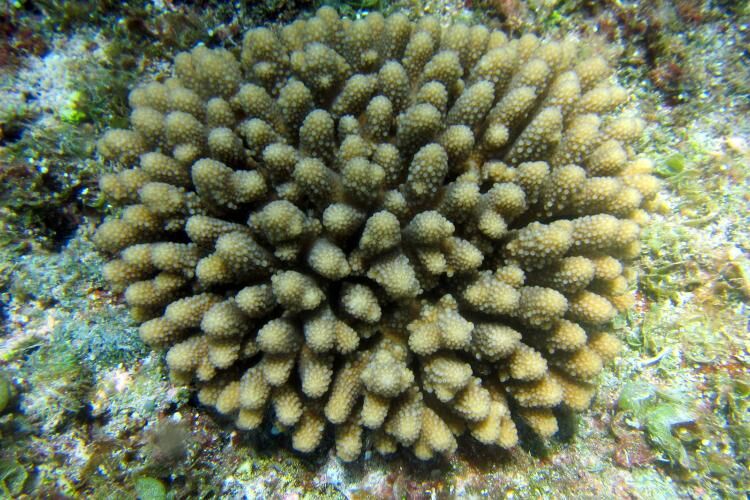

Acropora globiceps at Tinian. Under the Endangered Species Act, A. globiceps is listed as threatened in the CNMI, American Samoa, Guam, Hawaiʻi, and the Pacific Remote Islands Area.
A NOAA coral reef critical habitat designation in the CNMI would only affect federal actions on and near the waters of the Marianas, according to Lance Smith, a fishery biologist with the National Oceanic and Atmospheric Administration.
Smith met with Variety for a virtual interview on Jan. 12 to discuss a NOAA proposal to designate critical habitat for Acropora globiceps, a type of coral that is “sensitive” to ocean warming, ocean acidification, and coral bleaching, he said.
Smith said a critical habitat designation is established once a species becomes protected under the Endangered Species Act. The critical habitat is a location where the species can thrive.
For the CNMI, NOAA has identified areas in Uracas, Maug, Pagan, Alamagan, Saipan, Tinian, Aguiguan and Rota as habitat that is vital to the survival of Acropora globiceps.
If the proposal is accepted, federal agencies must consult with NOAA about their actions that would impact coral habitats, Smith said.
“The only thing that results from [a critical habitat designation] is that federal agencies need to look at the [critical habitat] maps, and then when they propose an action they determine if their actions are going to have an effect on critical habitat,” he told Variety. “If so, then they come and talk to [NOAA].”
“Critical habitat is designed to restrict federal agencies from impacting critical habitat,” he added.
Smith said a “federal action” is any action that’s “funded, permitted, or carried out by a federal agency.”
For example, if the CNMI received federal funds for a marine project and then partnered with the U.S. Army Corp of Engineers, projects undertaken would be viewed as “federal action,” Smith said.
“Critical habitat [designation] requires federal actions to minimize their impacts on coral critical habitat,” he added.
He said ordinary residents can still fish in critical habitats because the designation does not create a closed area, marine protected area, refuge, wilderness reserve, preservation or other conservation area. It also does not affect land ownership, he added.
A series of public hearings regarding the proposed critical habitat designation will be held this week and next week.
The first public hearing is scheduled for Jan. 18 at Crowne Plaza Resort on Saipan. The second will be held on Jan. 23 at Tinian Elementary School and the third will take place on Jan. 25 at the Northern Marianas College campus on Rota.
On Guam, the public hearing will be conducted on Jan. 16 at Lotte Hotel Guam.
For all meetings, doors open at 5:30 p.m. An information meeting is scheduled for 6 p.m. before the public hearing, which starts at 7 p.m.
Smith said the public comment process is crucial to the designation of critical habitat.
“NOAA Fisheries does make these rules, but it’s a public process and we very much encourage public participation. And really, community involvement is a vital part of this process,” Smith said.
He added that the current habitat designation proposal is an edited proposal that began its approval process in 2020. The federal public commentary period ends Feb. 28.
At the upcoming CNMI public outreach events, he said, the community can attend the 6 p.m. informational meetings to ask questions directly to NOAA, and to listen to presentations they have regarding the proposal.
