




In her affidavit submitted to the Attorney General’s Office, Pangelinan said the court should look into the Fund’s policy of not paying those who want to retire from delinquent agencies.
“Is this permissible? Should this be considered a scenario in which benefits are being diminished or impaired?” she asked.
“If this is happening, then the Retirement Fund board would seem to be defending the Fund rather than the retirees. If they were defending retirees, they would have certainly pursued payment of deficient employer contributions, but would also be honoring what appears to be a constitutional obligation to those retiring. To the best of my knowledge timely and full annuity payments to all qualified retirees is still within the financial capability of the Defined Benefit Plan. P.L. 15-61 requires these payments. If qualified retirees are not getting paid, then the Defined Benefit Plan is not complying with the law.”
She said although the Fund is not receiving employer contributions on a regular and timely basis, it is getting employee contributions.
“Currently, it seems that the Define Benefit Plan can pay its current retirees’ annuities in time and in full. But this would change if the market value of the investments continue to drop and employer and employee contributions are not made,” she added.
Depressing
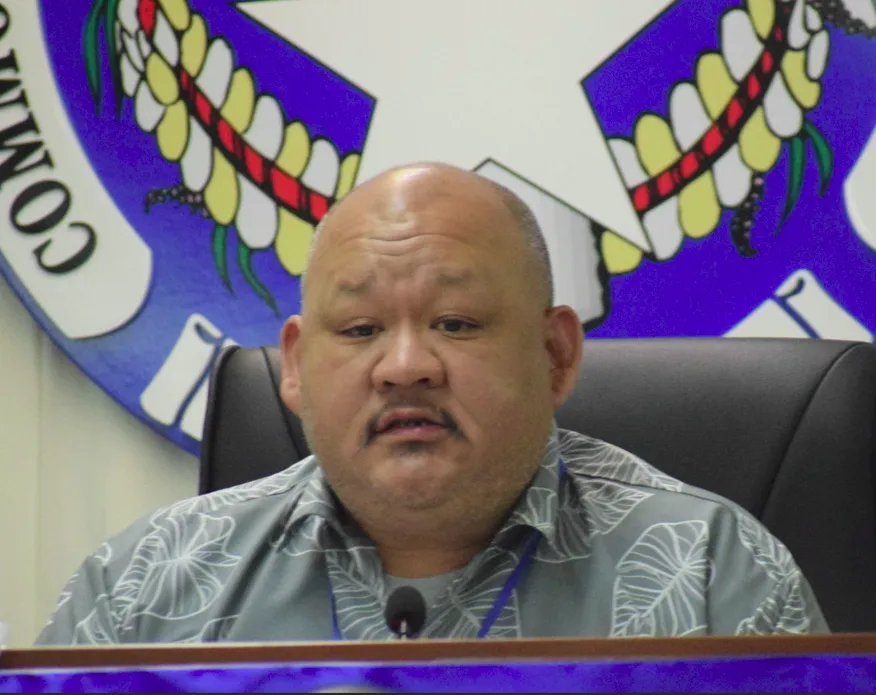
In an interview on Friday, the chairwoman of the Senate Fiscal Affairs Committee described the Retirement Fund issue as “really depressing.”
“I worked on my affidavit for four days and I get emotional about it — it makes me wake up at night. Why is it that we cannot just do something about it? Why are we so complacent and why are we suing each other?” she asked referring to lawsuit filed by the Fund against the central government.
The court has already ruled in favor of the Fund and will hold today the first of the two hearings to determine the amount of damages that the government must pay.
“We’re already in a fiscal disaster,” said Pangelinan, D-Saipan. “The government is bankrupt. If the court says pay now, it may mean shutting down the government. That’s like shooting your right foot to make your hands work.”
Ultimately, she added, “it’s the taxpayers who have to pay — and their children. They will have to pay for a debt they didn’t create. And what investor would like to do business in a place with a bankrupt government that might just tax them?”
She said her affidavit asks the court to take into consideration the government’s dire financial condition.
Major problem
In a separate interview, Rep. Tina Sablan, Ind.-Saipan, said she, other lawmakers, including Retirement Fund officials and candidates for office attended last week’s meeting of over 100 government retirees.
“The major problem is that the government has not been paying its contributions,” Sablan said. “But the solution to that and its implications — I don’t think anybody talked about it.”
One possible solution, she said, is to amend the Constitution and allow the government to renegotiate retirement benefits.
“It would mean a reduction of benefits but at least everyone would get their basic pensions — but nobody likes that.”
According to Sablan, some retirees are getting $80,000 to $100,000 a year.
Yet these benefits were never properly paid for by the government, she added.
Instead of floating a bond, which Sablan said is not feasible, “we have to look at other options — painful ones. And we need elected officials who have to make these decisions and an electorate who accept that this is necessary. The alternative is more pain.”
Sablan said she would like to “ask the retirees, those who are soon to retire and all taxpayers: how important it is to save the Retirement Fund and are you willing to see the government downsized? What are they willing to push for?”
She said the retirees talked about organizing and supporting candidates who would protect the Fund and make sure the government pay its obligations.
“But what that means is cutting the size of government and renegotiating benefits — there have to be sacrifices.”
Very difficult
She said it is not enough to accept promises from candidates who vow to “protect” the Retirement Fund.
“What does that mean? Will they actually pay the actuarial rate?”
Pangelinan has estimated that over 1,000 government employees will lose their jobs if the government pays the 37.39 percent actuarial rate.
“We will have to make very very difficult decisions and I don’t see any signs from the current leadership if they’re willing to do that — not with the new budget just submitted [by the governor],” Sablan said.
“We need to restructure this government and it’s going to be difficult, but there is assistance to do that, technical assistance from [the Interior Department’s Office of] Insular Affairs. I talked to some folks from the USDA Graduate School. They’re funded by Interior and they have gone to Chuuk and Kosrae to help them restructure their government, streamline all the public agencies. We need that independent, non-political expertise; we just got to do it.”
Sablan admitted, however, that “the people who are in positions to make those decisions believe that their constituents don’t want them to make those decisions, so I think the buck stops also with the voters.”
She added, “Are you willing to throw your support behind a candidate who will make tough decisions?”
What the government should not do, she said, is to raise taxes.
“Instead, we need to increase the tax base and create more opportunities in the private sector.”
The party’s over
Pangelinan said the government “cannot operate anymore while dealing with a day to day crisis.”
The root cause of the problem is the government’s generosity, she said.
“The party went on for so many years and everybody was just partying and nobody was seated in the corner wondering, what will happen once this party ends? We’re at that point now.”
She said in the states, the average annual pension is $24,000 a year while the Social Security’s average annual pension payment is $18,000.
“Here it’s $60,000, $80,000, $100,000, $150,000,” Pangelinan said.
“We also have highly paid agency heads and managers who can’t make executive decisions — who always go to the Legislature to ask us to make tough decisions for them. What are we going to do? You cannot have one agency eating steak, the other one eating rice while the other one is starving. Why are these [agency heads] getting $75,000 or $80,000 when they can’t do anything to address their budget shortfalls? They have to come here or send their employees.”
Pangelinan, who is not seeking re-election, said she doesn’t have “all the answers but we have so many minds in this government so why can’t we sit down and discuss this problem instead of government suing government? We should sit down and work as one government.”
Cost-saving
Asked for comment, Press Secretary Charles P. Reyes Jr. yesterday said the governor is still waiting for cost-saving legislation to come before his desk for approval.
“The Fund has endorsed a series of legislative reforms to add more financial restrictions on Fund payouts, but the Legislature has yet to pass such reforms and bring them to the governor’s desk. I suspect their reluctance could be attributed to this year’s election. They may not want to pass politically unpopular reforms to help save the Fund in an election year. This would include, among other things, restrictions on adoptions, benefits and fund withdrawals.”
Reyes said the governor “would also like to significantly reduce or do away with the hefty 25 percent penalty charged by the Fund for late payments. This is an excessive and arbitrary charge that is factored into the total amount the Fund claims that it is owed.”
He said among the items endorsed by the Fund is the legislative initiative to authorize a bond for the Fund.
“We are still waiting for legislative action on this issue.”
“As you know,” Reyes added, “the governor cannot pay the Fund without legislative budget authorization, but those funds must be identified. The responsibility for addressing the Fund’s problems rests not only with the administration but with the Legislature as well.
“The ultimate solution rests with economic growth. For example, if the CNMI economy were still strong and bringing in $210 million in government revenues, our government could now be operating on a $150 million budget while contributing $60 million to the Fund. But federalization makes significant economic growth very difficult.
“The Fund’s status would also improve once financial markets recover.”
