





H.B. 21-89, authored by Rep. Ivan A. Blanco, proposes to prohibit the use of disposable food container composed in whole or in part of polystyrene foam.
Introduced by Sen. Vinnie Sablan, S.B. 21-37 would ban the importation, production, distribution and use of single-use plastic bags in the Commonwealth.
On Thursday, testimonies were given by the authors of the bills, as well as by representatives from the Bureau of Environmental and Coastal Quality, the Saipan Chamber of Commerce, the Department of Public Works, Herman’s Modern Bakery, and the Micronesian Islands Nature Alliance.
BECQ Administrator Eliceo Cabrera, Division of Coastal Resources Management Director Janice Castro, and Division of Environmental Quality Director Jonathan Arriola voiced their support for both of these bills.
Arriola said polystyrene foam — otherwise known as Styrofoam — is non-biodegradable.
Castro, for her part, said non-biodegradable products take up “some space in our landfill, which is costly for our 21st Legislature.”
She said the bills aim to “inspire behavioral change,” not burden businesses in the CNMI.
When asked why BECQ was excluded from the enforcement portion of the bills’ language, the officials said they have no jurisdiction when it comes to ensuring that businesses are in compliance.
Rep. Ivan Blanco, in his remarks, said: “I wish to submit alternative products that are manufactured locally in our sister islands, and can be done here as well. We manufacture these products here, and perhaps sell locally and tap the Guam market, for starters.”
Blanco then presented plates manufactured from betel nut sheath and banana fiber, noting the zero costs from natural resources, and the fact that the products can be sourced locally. He added that he would be open to consider changing certain language in the bill.
Senator Sablan also provided testimony, highlighting the 11 years it has taken to consider a ban on single-use plastic bags.
He mentioned that the movement started with House Bill 16-166, and has even made its way to the Youth Congress — “the future leaders off the CNMI” — which recently endorsed the passage of a similar bill.
He said the bill is nothing new, as similar bans have been proposed and implemented in neighboring Pacific islands, as well as across the globe.
Maxine Laszlo, on behalf of the Saipan Chamber of Commerce, said the business group does not intend to stop the bills. She said they agree with the intent of both measures, but just have a few concerns.
Regarding H.B. 21-89, the chamber recommends working with Customs to enforce excise tax exemptions so as to help businesses make a smoother transition from non-biodegradable to biodegradable products.
By removing excise tax, it would make the costs of biodegradable products somewhat equivalent to the costs of non-biodegradable products, she said.
The chamber would also like to recommend more public outreach, so that consumers are aware of environmentally friendly products compared to those that are not environmentally friendly.
Regarding S.B. 21-37, Laszlo said businesses would appreciate an appeals process, in the instances that businesses are fined for using single-use plastic bags if this bill passes.
She noted that it would be a similar appeals process that a vehicle operator would go through after receiving a parking ticket.
DPW Administrative Services Director Peter Camacho and DPW Solid Waste Management Acting Director Blas Mafnas also provided testimony.
They said DPW supports the intent of both bills, but recommends that there be a mandatory segregation process for recyclables, perhaps something that resembles the one used in the Republic of Palau.
Mafnas said there is a bit of an issue with recyclables because DPW currently does not have the capacity to ensure that all recyclables they will receive will be recycled.
“Only 9% of recyclables are actually recycled. The rest ends up in the landfill,” he added.
Mafnas said even if the CNMI recycles 100% of recyclables, it might take about 10 years to fill up countless containers and ship those containers off to China, which is already coping with several issues following the coronavirus outbreak.
Mafnas said it would be more feasible to reduce than to recycle.
Anna Guerrero Hayes of Herman’s Bakery stated that the company also fully agrees with the intent of the bills. However, she said they and other businesses need more time to find more durable biodegradable alternatives.
Hayes noted that the timeline is “too short,” and added that the bakery would need about two and a half to three years in order to be more sustainable.
She also highlighted that the bakery has already begun switching over to biodegradable products.
Micronesian Islands Nature Alliance executive director Roberta Guerrero said the organization fully supports both bills. She noted that the bills are aligned with MINA’s mission statement.
“This is a step in the right direction,” she added.

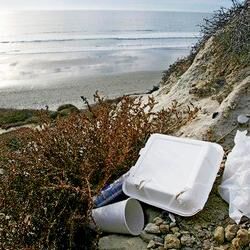
Styrofoam food containers litter the side of a bluff above Carlsbad State Beach near Palomar Airport Road. The state is proposing a ban on the containers. (Photo by Bill Wechter – staff photographer)
