





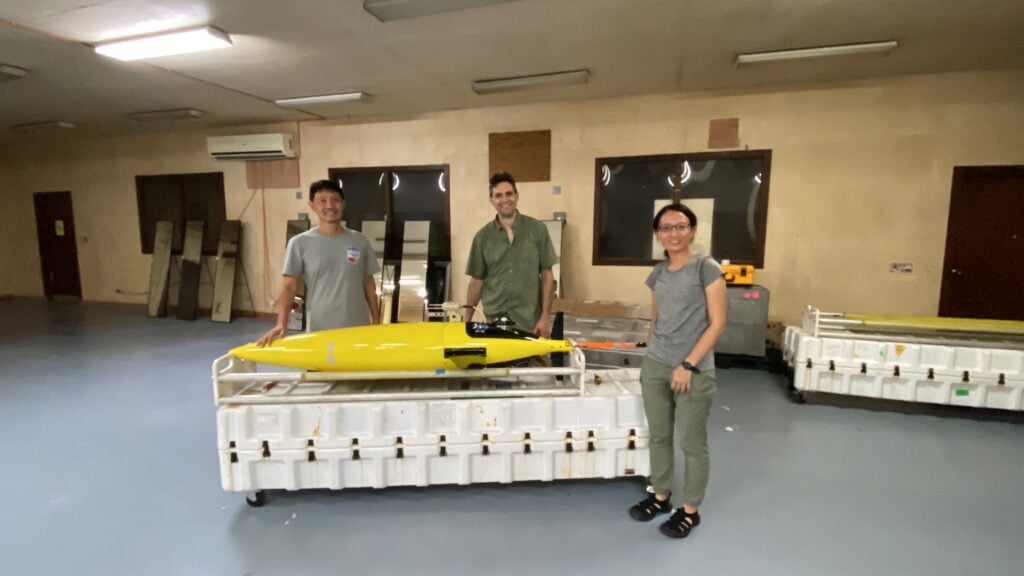
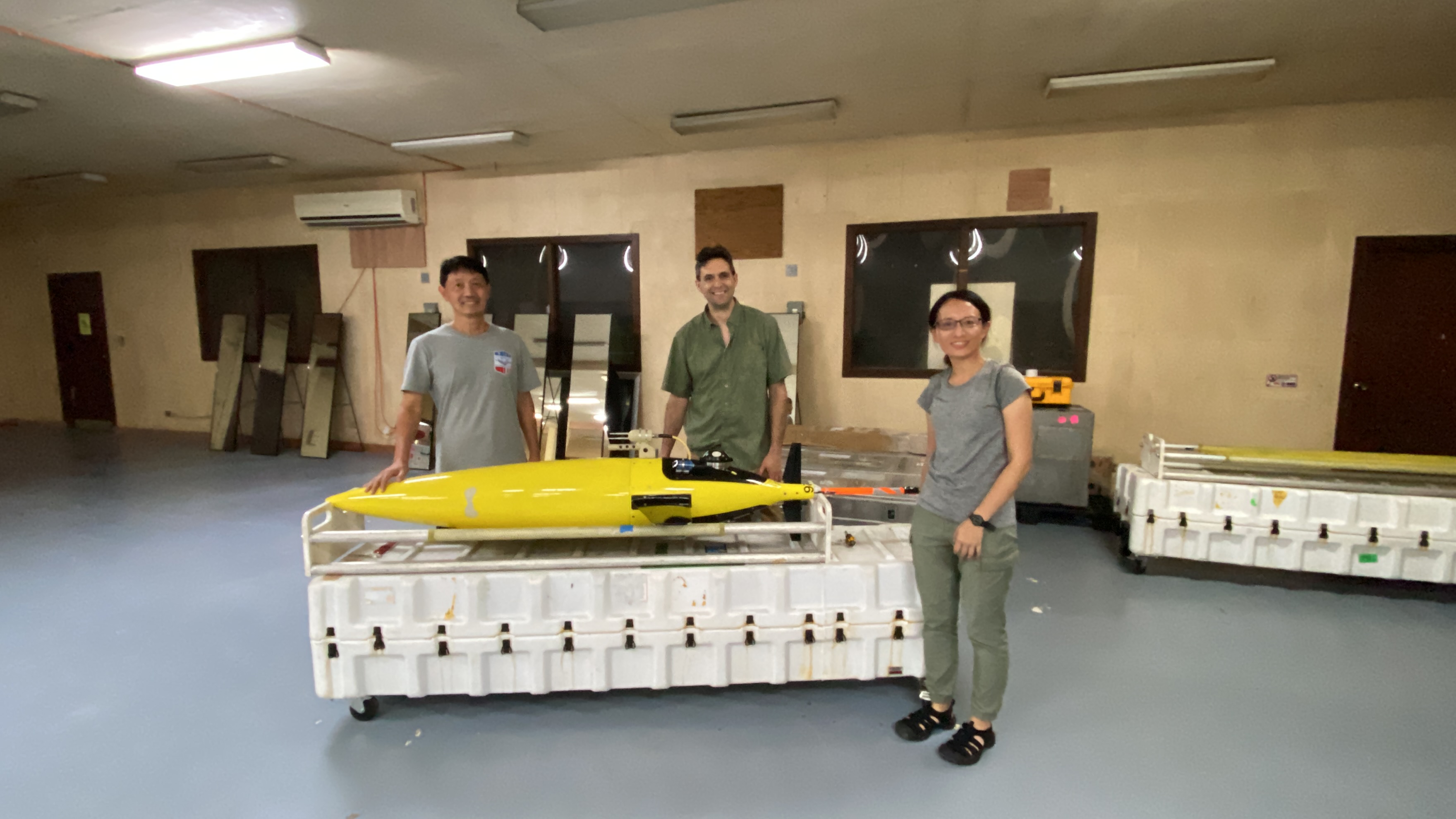
From left, Sen Jan, Luc Rainville, and Cathy Yang.
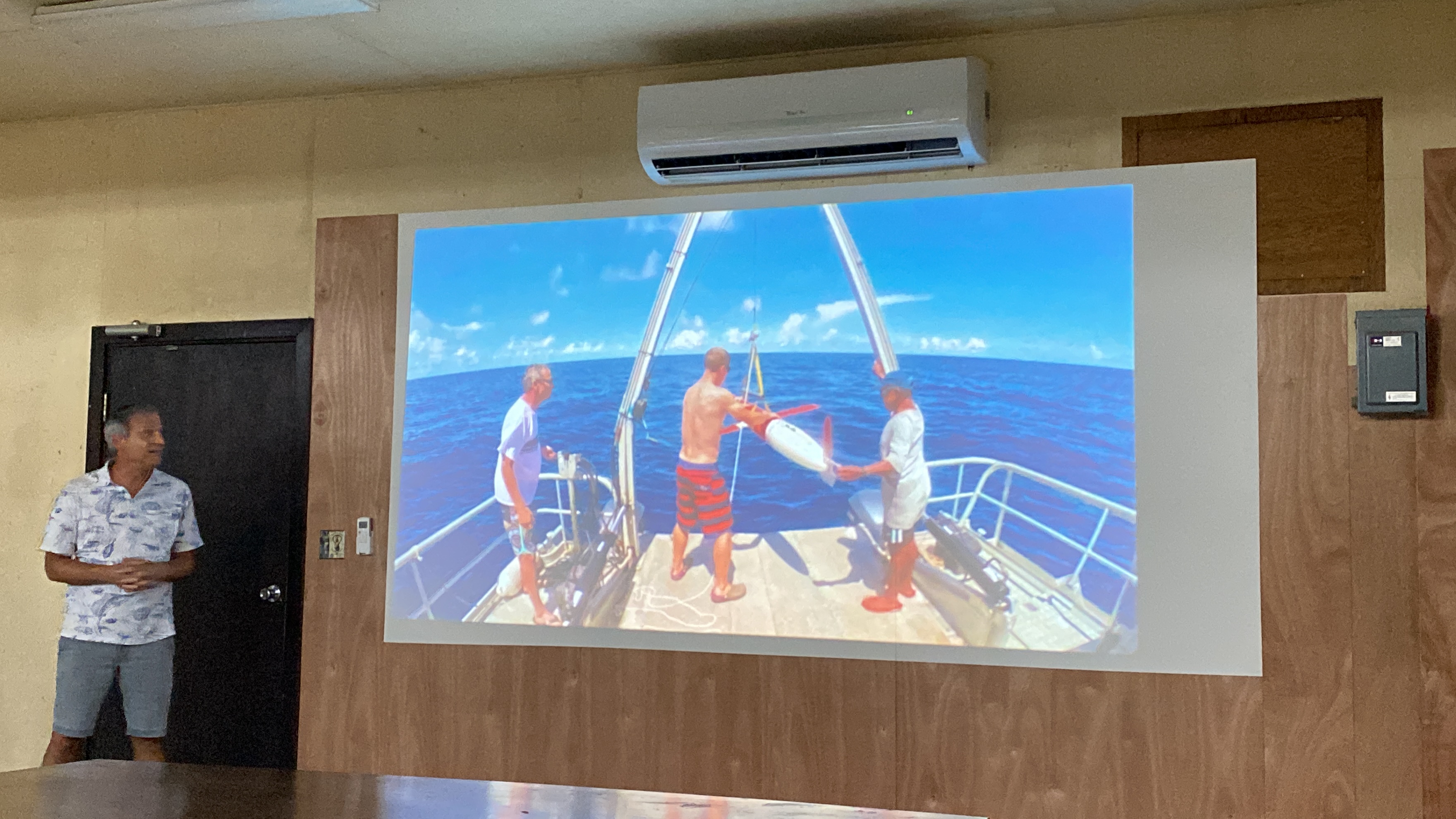
Professor Dan Rudnick, a professor at UC San Diego. Behind him is a photo displaying how they lower ocean gliders into the Western Pacific to conduct studies of undercurrents.
AT the 500 Sails Cultural Maritime Training Center on Sept. 13, Dan Rudnick, a professor of physical oceanography at the Scripps Institution of Oceanography at UC San Diego, gave a presentation on the activities he and other ocean researchers have been conducting using unmanned ocean gliders to collect data.
He said the undercurrents in the Western Pacific are areas where oceanographers could formulate new scientific studies.
Rudnick is part of a research team of scientists from the College of Earth, Ocean and Atmospheric Sciences at Oregon State University; the Applied Physics Laboratory at the University of Washington; National Taiwan University; and University of California San Diego.
Since August, he said they have deployed 11 unmanned ocean gliders in the remote waters northwest of Saipan.
All of the gliders were controlled remotely, some as far away as Oregon.
According to Sen Jan, one of the researchers from National Taiwan University, the gliders all function in similar ways. Each has an inflatable bladder that can be filled with oil, thereby changing the volume of the entire glider. This changes the amount of water the glider displaces, meaning it can either sink or float, depending on the bladder.
Jan said when the glider begins to sink, a mechanism inside the glider moves its internal battery forward, which causes the glider to sink at an angle. When the glider reaches around 1,000 meters, its autonomous system moves the oil into a pressurized container and shifts the battery, allowing the glider to float back to the surface.
Rudnick said once at the surface, the gliders, which all have antennas, communicate with researchers through satellites. The gliders receive information and communicate their status, indicating if they are damaged or functional. Afterward, they go back beneath the surface, and travel in a “saw-tooth” pattern, sinking and floating, while moving forward, all without the use of fuel or a motor.
According to another researcher attached to the project, Ph.D. student Chad Gibson from Oregon State University, they collected information regarding the ocean’s salinity, temperature, and turbulence. He said when the project is finished, that data will go into larger ocean models and climate models.
Rudnick underscored the significance of the studies.
“The currents on the western side of all the ocean basins are the most important currents,” Rudnick said. “Since the Pacific is the biggest ocean basin these currents are extremely important to climate.”
