





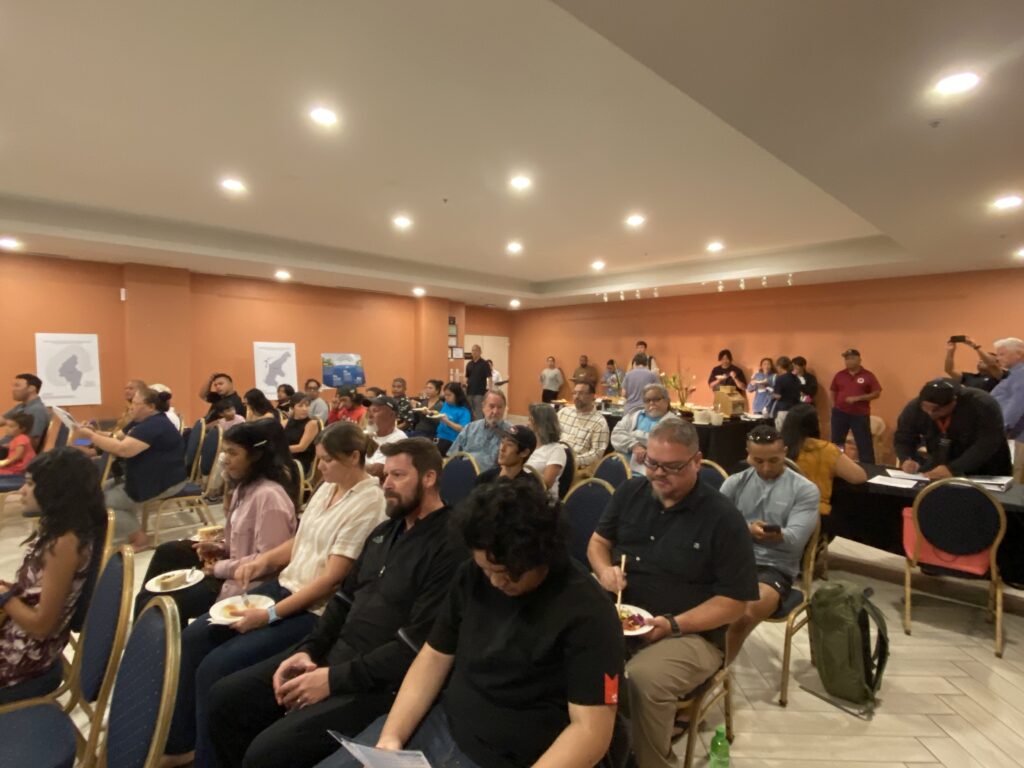
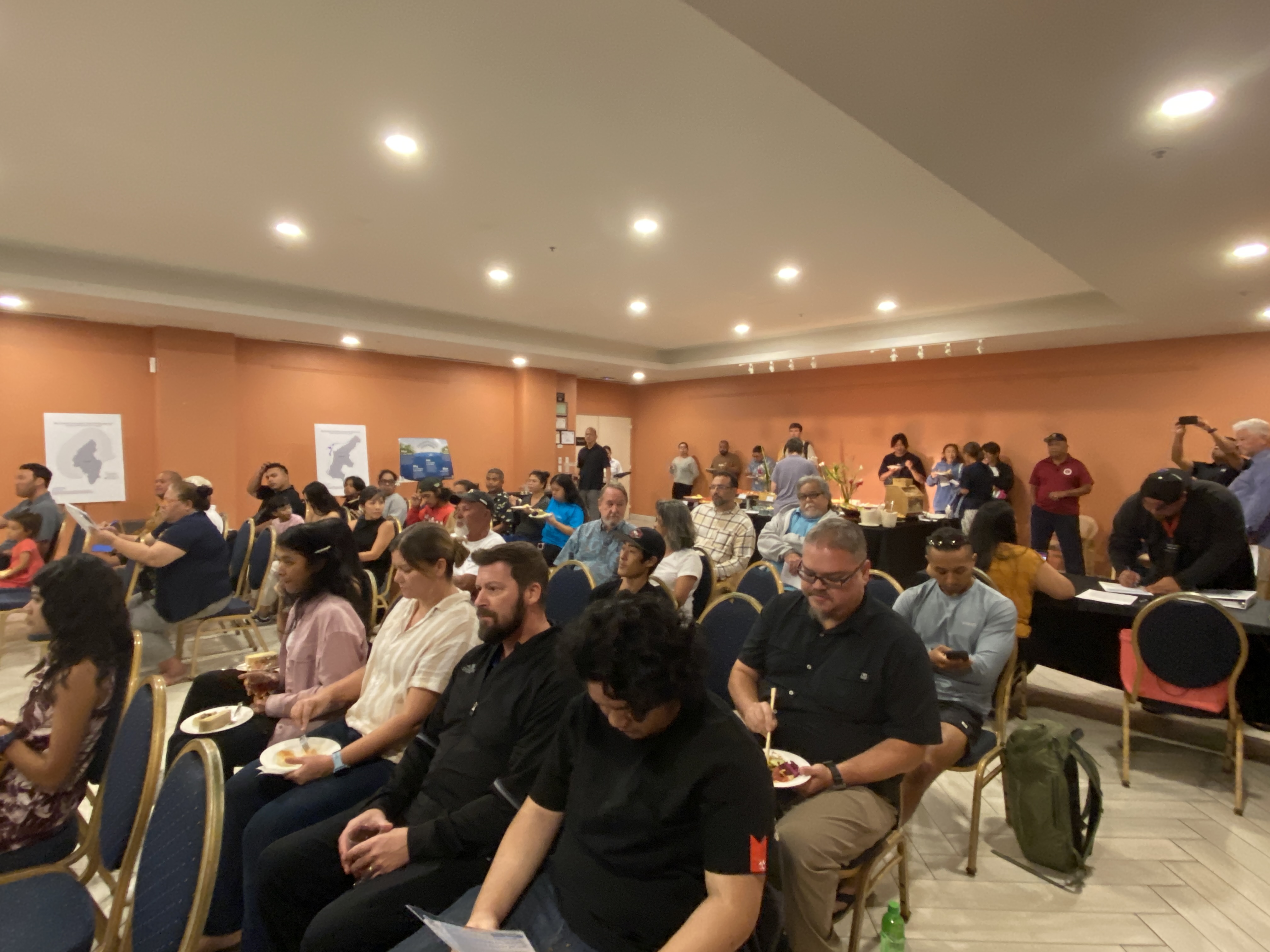
Dozens of people attended the public meeting hosted by NOAA on Thursday at Crown Plaza Resort regarding a proposal to designate many islands in the CNMI as critical habitat for Acropora globiceps, a species of acroporid coral.
KKMP radio personality Gary Sword described the NOAA event as a “parachute meeting.”

Precinct 1 Rep. Vincent Aldan does not want to see a coral reef critical habitat designation in the CNMI.
Assistant Attorney General James Kingman expresses support for the proposed coral reef critical habitat.
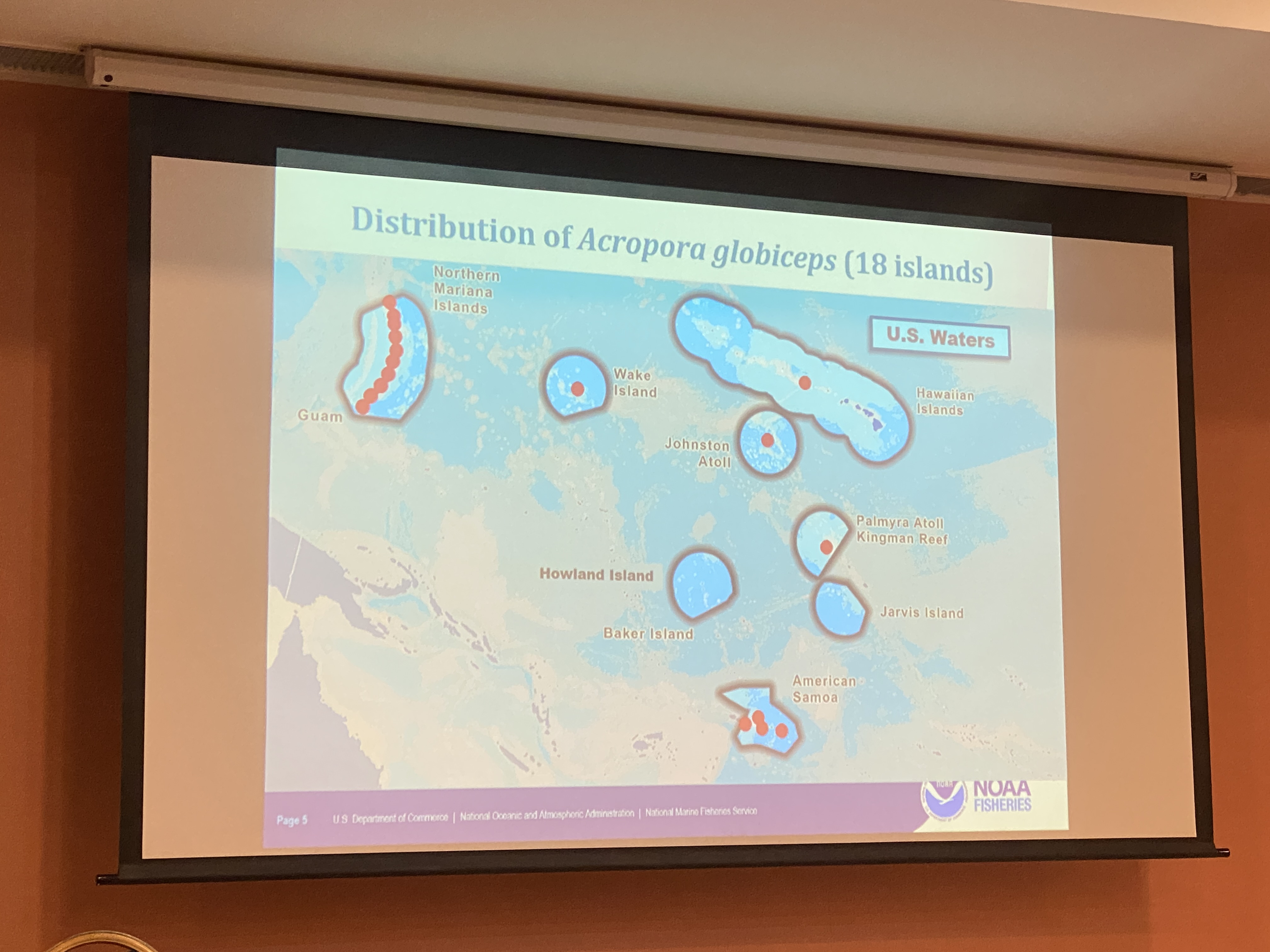
This map displays some of the areas where the Acropora globiceps can be found.
SEVERAL local residents shared their concerns with a proposal to establish a coral reef critical habitat in the Marianas.
On Thursday, Jan. 18, at Crowne Plaza Resort, the National Oceanic and Atmospheric Administration hosted a public meeting to solicit comments from the public.
The proposed critical habitat designation aims to protect the coral species Acropora globiceps. If finalized, the designation would affect Uracas, Maug, Pagan, Alamagan, Saipan, Tinian, Aguiguan and Rota.
NOAA has stated that a critical habitat does not create a closed area, a marine protected area, a refuge, a wilderness reserve, a preservation or other conservation area, and that residents would still be able to fish in the designated areas.
According to NOAA Fisheries’ Chelsey Young, the designation is a regulatory designation that affects the federal government.
“A critical habitat is designed for other federal agencies,” Young said. “It’s a requirement to ensure [federal agencies are] minimizing their impact on this habitat and this species. Federal agencies that are carrying out, authorizing, or funding any activities [have] a requirement to come consult with us to make sure we’re minimizing those impacts.”
She said federal actions include state/territorial actions that receive federal funds.
“We’ve heard a lot from you all in previous meetings that many of your projects, whether it’s coastal development or coastal construction or things of that nature do come with a lot of federal funding and need. That would trigger this federal nexus — or connection — to this critical habitat,” Young said.
She reiterated that when it came to personal use of the water, Marianas residents would not be affected by the critical habitat designation.
“You can fish, dive, swim, snorkel, boat. Any recreational activity — you can do that in critical habitat areas with no restrictions,” Young said.
Young’s colleague, Lance Smith, said the designation seeks to protect Marianas coral from federal actions that “have the potential to adversely modify these areas as a whole.”
“Hypothetically, an example would be like if the [Environmental Protection Agency] were to authorize a chemical or a pesticide to be used that’s toxic to these essential features. That’s not something that a private entity would do, that’s something that the federal government could do,” he said. “Or if a land use agency [like the U.S. Department of Agriculture] or somebody with the [U.S. Forest Service] could authorize some land use issue that could cause runoff that could hurt these essential features. So that’s our concern. It’s not the individual private entities.”
More federal intrusion
However, some attendees of the meeting took issue with a federal agency having an ability to regulate a Marianas resource.
Precinct 1 Rep. Vincent Aldan is not in favor of the critical habitat designation.
“For the past 400 years it seems like we could never speak for ourselves,” he said. “I don’t believe that anybody … should be coming here to our place and dictating to us what should be and what shouldn’t be.”
He also expressed concern that a critical habitat designation would be the start of more federal intrusion into the Marianas.
“This seems like one of those ‘Step one’ process where you’re going to tell us that … we’re going to have this place as a critical habitat and then two years from now you’re going to come around and tell us ‘yup it’s a critical habitat, it’s an endangered species’ and when is that going to stop?”
KKMP radio personality Gary Sword said the coral reef critical habitat designation goes against the CNMI’s right to self-governance.
“Maybe these people who asked for this designation haven’t even been here, and yet they want us to live with this [designation] while they go ahead and live their lives,” he said. “It’s wrong, very wrong.”
He also said the NOAA public meeting was a “parachute meeting.”
“You just parachute in for the meeting and then you take off again, but we still live here,” he told NOAA representatives. “And everything that you do, everything that you say affects us and our livelihood and our way of life.”
Supporter
One supporter of the coral reef critical habitat designation was Assistant Attorney General James Kingman, who was speaking in his personal capacity as a U.S. citizen.
He acknowledged the “long history of environmental destruction perpetrated by the federal government,” but added that “things are much different now.”
He said the NOAA critical habitat designation would help the Marianas.
“An increase in the amount of protection and status and supervision and expertise … can only be good,” Kingman said.
The next public meetings are set for Jan. 23 at Tinian Elementary School, and Jan. 25 at the Northern Marianas College campus on Rota. Doors open at 5:30 p.m. for both meetings.
In an interview on Friday, Young told Variety that the public comment period concludes in February.
After the public commentary period, NOAA will take the information it has received from the public and potentially revise the language of the critical habitat designation.
Young said the final rule will be published by December, and its implementation will take around 60 days, which means that if the critical habitat designation is finalized, the rule would be effective around February 2025.
“It’s important that we protect [corals] and their homes,” Young said. “We need habitats for them to be able to grow and reproduce, to create new coral so that they’re contributing to sustainable healthy coral reefs and oceans.”
