





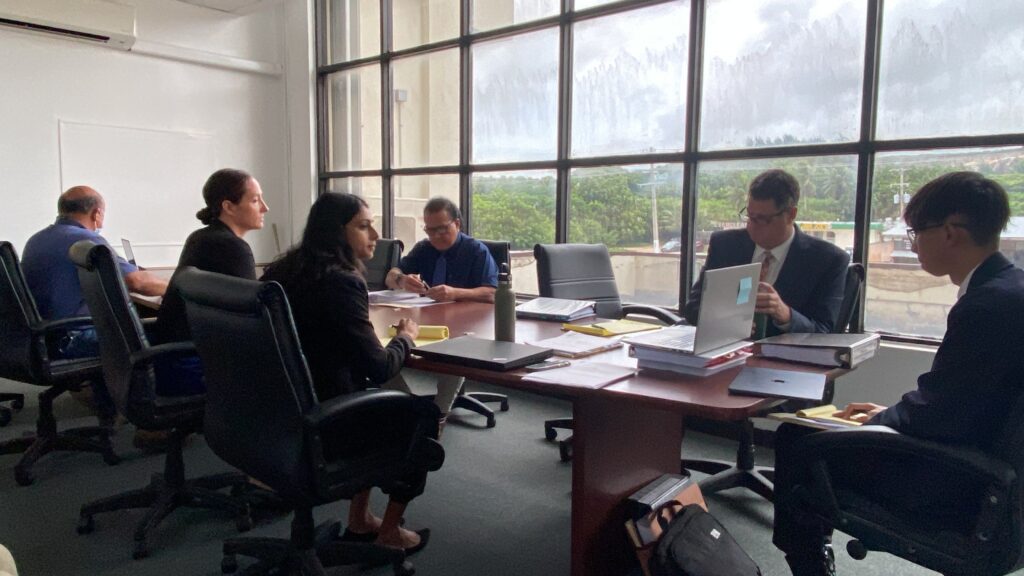
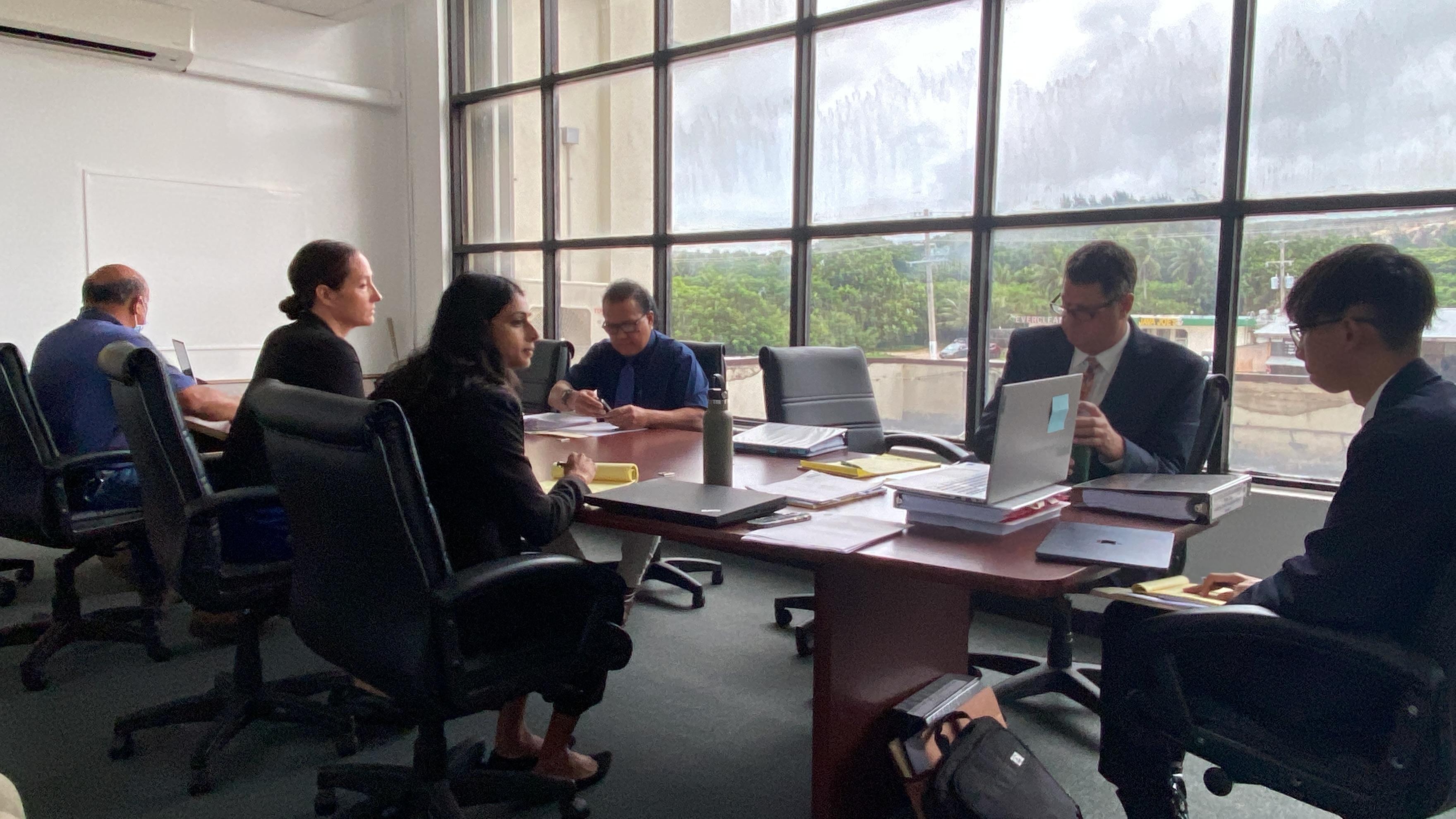
Front row: Assistant Attorneys General Ali Nelson and Vina Seelam, representing the Department of Public Lands. Back row, from left, DPL Hearing Officer Ramon Dela Cruz and attorney Colin Thompson, Rota Resort legal counsel during an evidentiary hearing on Sept. 8, in the DPL conference room.
THE evidentiary hearing on Rota Resort’s lease termination ended on Friday, Sept. 8, with the leaseholder, Hee Kyun Cho, providing testimony about his experience running the resort. The Department of Public Lands, for its part, argued that the lease termination is justifiable.
Assistant Attorney General Ali Nelson, who represented DPL in the hearing, said Rota Resort had its lease revoked because it failed to pay its lease, and abandoned its hotel and golf course facilities.
But Cho, through attorney Colin Thompson, said under Article 11 of his lease agreement with DPL, “force majeure” could excuse his obligations to the CNMI.
In this case, Cho said, the Covid-19 pandemic caused him financial hardship and resulted in his shuttering of the resort.
“Force majeure is a provision in a contract that frees both parties from obligation if an extraordinary event directly prevents one or both parties from performing,” according to Cornell Law School.
During the evidentiary hearing, Cho, through live videoconference, said during the pandemic, his resort had no foreign guests. He said one or two locals checked in at the hotel at various points in that time, but without tourists he was losing money.
Nelson noted that Rota Resort did not make a lease payment in three years, including after the Covid pandemic ended.
Moreover, even during a pandemic, rent payment and maintenance of the facility are “continuing obligations,” she said.
“While Article 11 might allow for a delay of performance of certain of its obligations due to a force majeure event, it doesn’t apply to a failure to operate or a failure to pay rent,” she added.
She said from July 2021 to July 2022, Rota Resort operated its hotel and restaurant, despite not paying its lease to DPL.
Under Article 11 of the lease agreement, Rota Resort was supposed to have given DPL written notification within 30 days of a force majeure event. Nelson said this wasn’t done.
“We don’t have any explanation why Article 11 applied to excuse any initial delays in performance,” Nelson said. “What happened in July 2022 that changed the facts that allowed it to close again? The abandonment provision is pretty clear that for a lessee to stop operating for a period of more than 90 days it has to request a written consent from DPL to do that.”
Nelson also cited a recent CNMI Supreme Court ruling on Commonwealth Casino Commission v Imperial Pacific International: force majeure “does not excuse a failure to perform outright.”
“In terms of rental payments those payments remain due,” Nelson said.
Under questioning from his attorney, Cho said he invested in the Rota Resort because he believes Rota is the Marianas’ most beautiful island. He also saw the potential in Rota Resort as a golf facility.
Cho said since 2008 he has invested close to $50 million in Rota Resort.
Around the time of the pandemic, he had about 70 employees, he said.
When he began experiencing the financial burden caused by a lack of tourists, he said he took out a Paycheck Protection Program loan, which enabled him to continue paying his employees.
“Covid-19 and the CNMI executive orders [that] suspended [flight service] for customers [impacted the business],” he said.
During the hearing, he did not dispute that he owes DPL over $630,000 in rent.
DPL Hearing Officer Ramon Dela Cruz will have a decision before the end of October.
