




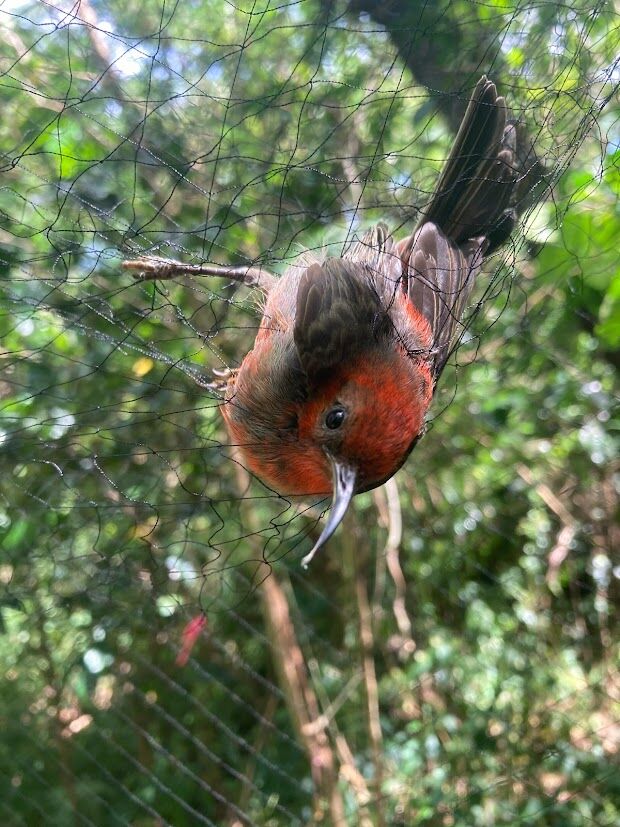

An egigi or Micronesian Myzomela rests in a mist net in the jungle of the CNMI. Tinian youth are encouraged to apply for a summer internship with the Tinian Division of Fish and Wildlife and Division of Coastal Resources Management.
RECENT high school graduates on Tinian who are interested in starting their career in STEM are encouraged to apply for a paid summer internship with the Tinian Division of Fish and Wildlife and Division of Coastal Resources Management, according to a release from the Tinian DFW.
The application deadline is April 4.
Full details are available on the website of the Division of Coastal Resources Management at https://dcrm.gov.mp/.
The dates are still being finalized, but the program will consist of 20 hours per week from June to August at a pay rate of $13.50 per hour.
Current high school seniors may also apply.
Required documents include a CNMI employment application; cover letter; résumé; transcripts (official or unofficial); two recommendation letters (instructors and/or employers only); and a copy of a valid photo ID (driver’s license, passport, etc.)
Completed application packets may be submitted via email to [email protected] or in person at the DCRM office.
According to Fletcher Moore, a biologist from the University of Washington who conducts research with Tinian DFW, the intern will assist with biological research related to native bird conservation, forest ecology, native forest restoration and native plant rearing in the DFW nursery.
Fletcher said the work may include assisting with mist netting for birds, banding birds, radio telemetry, vegetation surveys, forest mapping, tree planting, invasive species clearing, public surveys, and native tree propagation.
“The goal is to give the intern opportunities to try different things and over the course of the 10-week program, find which area of work suits them best and begin to focus on that,” Fletcher said. “At the end of the program the intern is expected to create a presentation on some of the work they were a part of.”
Interested applicants do not have to have a background in science, as they will be trained in research methods on site. But candidates should be comfortable spending time outdoors, have proficiency in word processing, Power Point and Excel, and be excited to learn more about the natural world of the Marianas.
“This position is best suited for young people who are interested in starting a career in natural resources who do not yet have much hands-on field experience,” Fletcher said.
He said the internship could be an “excellent launching point for a long career in conservation or science.”
“There are almost infinite fields of science connected to the natural world with our expanding technology,” he added. “Drones, genetics, health care, sociology, public health, agriculture and many others. The Marianas is an under-researched area relative to the rest of the United States — who knows how many discoveries and advances could come from these islands?”
