






ACTING Office of Planning and Development Director Elizabeth Balajadia, P.E. and Department of Public Works Secretary Ray N. Yumul, in separate interviews on Sunday, said the departure of construction workers due to the “touchback” rule will affect a lot of federally funded projects in the islands.
“I’m sure all these touchbacks are going to impact a lot of our projects,” including the revitalization of the Garapan tourism district, said Balajadia who is also the Office of the Governor’s capital improvement project administrator.
Balajadia said she has talked with U.S.A. Fanter, the contractor for the Paseo De Marianas improvement project in Garapan, who told her that they were already hiring new construction workers to replace those who have to leave the island because of the touchback rule.
“So I hope all the contractors…will do the same thing because we all know about this touchback,” she said.
The touchback provision requires employers to send CW-1 visa holders back to their home country every three years. The CW-1 employee is then required to remain outside the U.S. for a minimum of 30 days. The processing of a renewal application, however, can take up to seven months.
Balajadia noted that the Garapan revitalization project is an $11 million federally funded undertaking.
A U.S.A. Fanter employee told Variety on Friday that 15 of their construction workers are affected by the touchback rule, but they are not the ones assigned to Garapan.
GPPC Inc. is the contractor for Phases 3 and 4 of the Beach Road improvement project, which is also federally funded.
DPW Secretary Yumul said 93 of GPPC’s 134 employees have to leave the island in compliance with the touchback rule.
Phases 3 and 4 of the project begin at J’s Restaurant in San Jose and go all the way to the American Memorial Park intersection in Garapan.
“It’s a big impact,” Yumul said, referring to the “exit” of the construction workers.
He said DPW’s Federal Highway Division officers and staff will meet with the contractors of all DPW projects this week to “get an update” on the status of their construction workers, and determine the extent of the touchback rule’s impact on their ongoing projects.
Yumul said DPW’s biggest concern is the delay in the Beach Road improvement project because the old asphalt on the road has been removed already, “and we don’t want it to sit idle.”
Yumul said fortunately, the Route 36 road project in Talofofo is almost complete. The contractor, RNV Construction, has a significant number of construction workers affected by the touchback provision.
CNMI Labor Secretary Leila Staffler earlier said that based on her research and projections, September 2023 may see the largest number of departures because of the touchback provision.
“In particular, we see there will be a huge area of need in health and human services,” she said.
Staffler also noted that the CNMI currently has over a billion dollars in construction projects scheduled or ongoing, but does not have enough construction workers on island, even without the “touchback” provision in place.
Gov. Arnold I. Palacios has urged U.S. lawmakers to repeal or delay the implementation of the touchback provision, saying, “help us help ourselves.”
In March, U.S. Congressman Gregorio Kilili Camacho Sablan introduced H.R. 1420 “to modify the requirement to remain outside of the United States for Commonwealth Only Transitional Workers.” The bill remains pending in the U.S. House of Representatives.
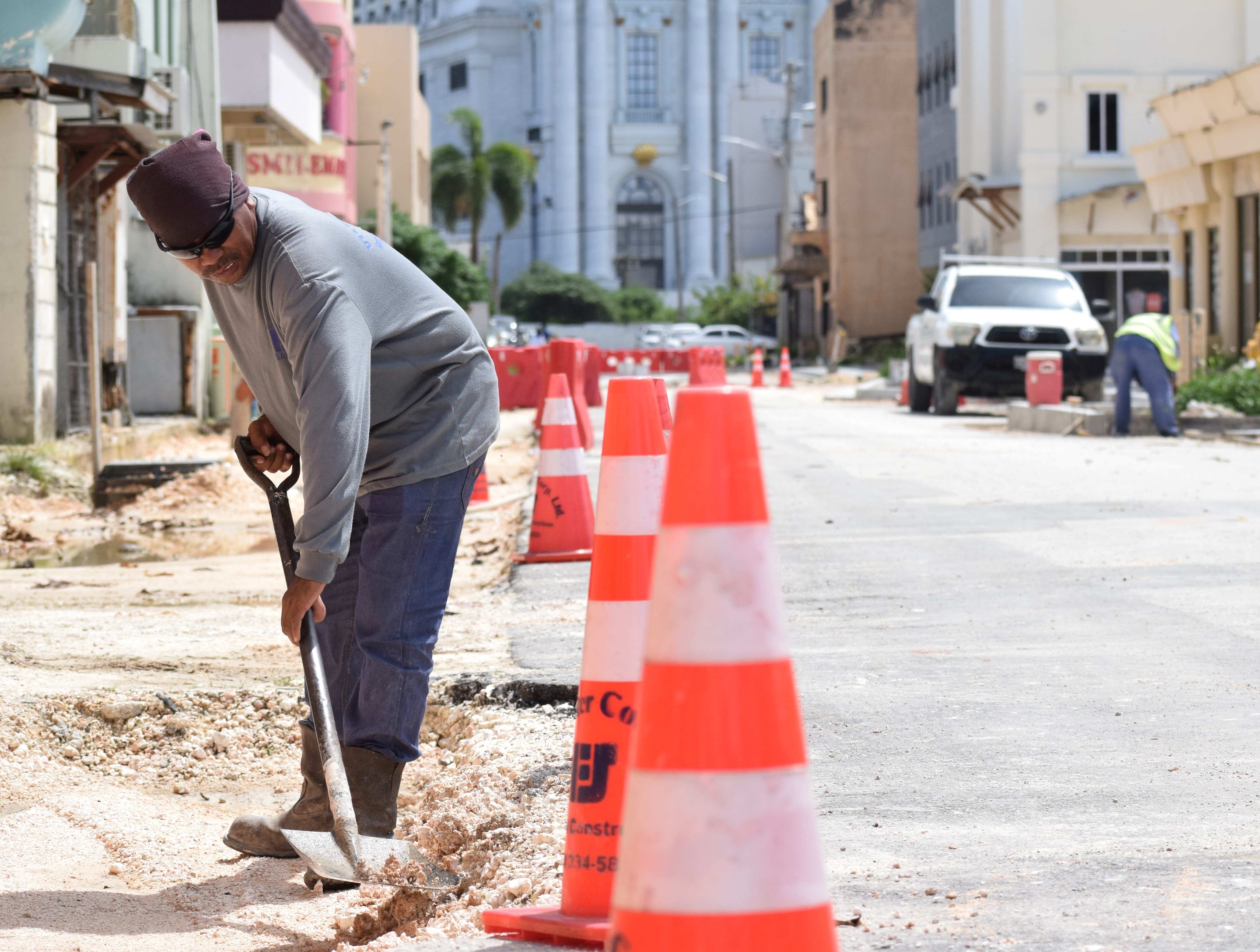
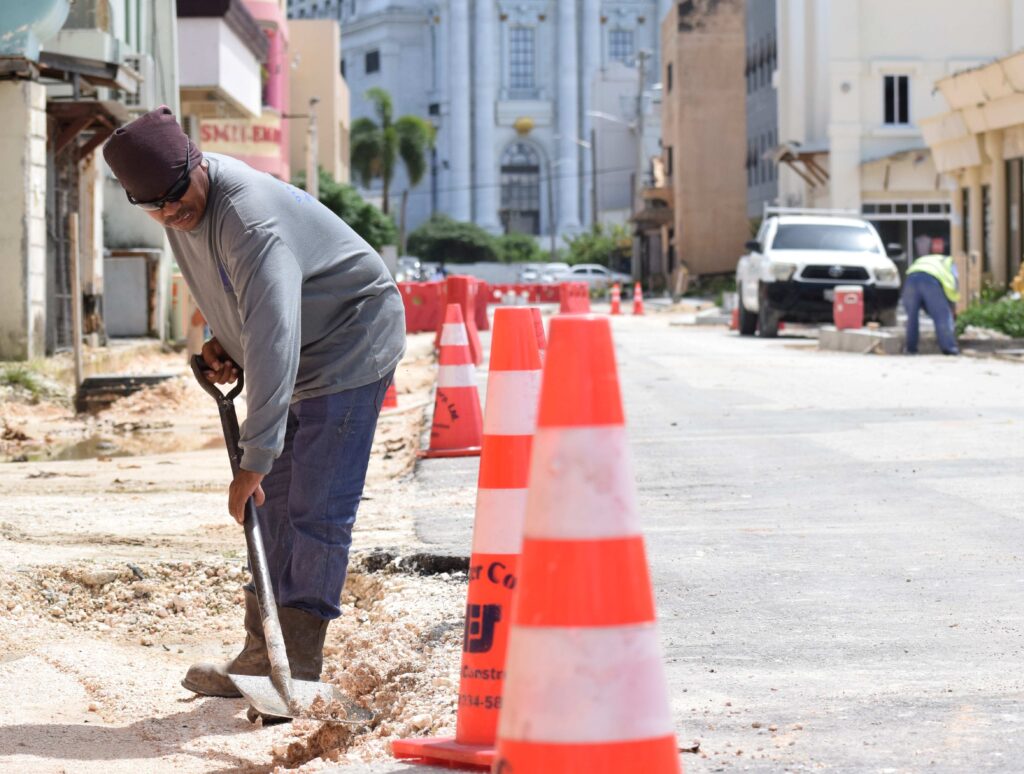
U.S.A. Fanter’s Ric De Villa works on a portion of a road that is part of the Paseo De Marianas improvement project in Garapan.
