




Buckle your seatbelts, because geotextiles are about to take you on a wild ride. “Isn’t this going to be boring?” you ask.
I’m sorry, buddy. Do soil mechanics bore you? Does learning about the various applications of geotextiles bore you? Is it tedious to distinguish between woven and unwoven materials?
I hear it now. It does sound monotonous.
But, listen, sometimes being boring is a good thing. Geotextiles are what we’re talking about. Geotextiles prevent waterways from becoming clogged, highways from sinking into the ground, and basements from becoming indoor pools. So strap in. It will be a safe and informative journey.
What exactly is a Geotextile?
Understanding the “what” is the best place to start. Because geotextiles are used to solve a wide range of erosion problems, they come in a variety of forms, shapes, weights, and sizes.
You’ve probably heard of geotextiles, whether you work in construction or not. A geotextile is a common residential example, such as weed barrier fabric beneath your garden or a black roll of underlayment beneath your pavers.
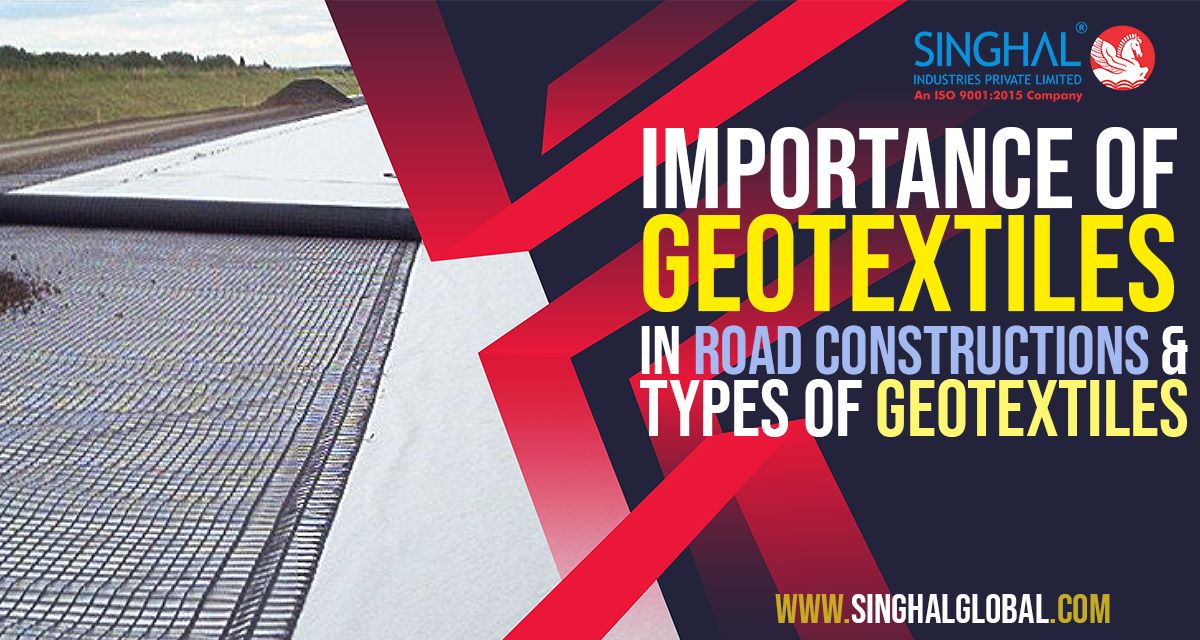
We’re talking about large construction projects in this case. Geotextiles, which are used in both temporary and permanent capacities, are the go-to solution for many soil-related issues. Filtration, separation, reinforcement, and stabilisation are four key erosion and soil-related applications for geotextiles.
Filtration
When most people think of geotextiles, they think of sediment filtering. It is a key feature of all geotextiles and the primary reason for their effectiveness. Silt fences are a popular filtration application. Silt fences are geotextile filtration fabrics that are fastened to fencing posts and used to position downgrade from a job site or any other location with disturbed soil.
When a rainstorm blows in and washes dirt and sediment downhill, the runoff water will filter through the silt fencing, protecting local storm drains and waterways.
French drain systems are an ongoing application for geotextile filtration. To prevent sediment from building up inside the trench and clogging the system, the geotextile fabric is wrapped around the drainpipe.
Separation
Separation is one of the most common geotextile applications, and it has revolutionised the construction industry. Modern roads, for example, are built in layers of different materials. The bottom layer of rocks and gravel will sink into the mud if the soil beneath the road becomes wet. Using geotextiles as an underlayment separates the road and keeps it from sinking.
Why not substitute a plastic liner? Because water can pass through geotextiles, they are used instead of just plastic liners or tarps. If water is unable to pass through the layers, it will accumulate in-between them, destroying the road from the inside.
Landfills, railroads, and many other applications use the same separation principles.
Reinforcement
When engineers are faced with the difficult task of preventing the failure of inherently unstable structures such as embankments and retaining walls, they once again rely on geotextiles for reinforcement.
Geotextiles can be installed in layers on man-made embankments to increase the soil’s shear strength. The resistance or friction of soil particles sliding over one another is measured by shear strength. Engineers want to minimise and prevent as much sliding on an embankment as possible.
Geotextiles are frequently wrapped around the outside of an embankment and reinforced with wire netting to keep the embankment’s vertical face from eroding. This system is commonly seen on rocky walls adjacent to roadways.
Stabilization
Geotextiles have the ability to transform a wet, unstable base into a consistent stable surface. A common method of stabilisation is to place geotextiles over wet compressible soil. As the soil compresses into a stable layer, the liquid in it can escape through the geotextile layer.
Methods like these would have been extremely difficult, if not impossible, prior to the use of geotextiles.
Geotextile Subtypes
People in the world are divided into two groups: those who understand geotextiles and those who do not. Geotextiles are classified into two types: woven and non-woven. Both options have advantages and disadvantages, as well as features that make them better for certain applications.
Geotextile woven
You probably guessed how woven geotextiles are made. Threads, typically made of monofilaments or silt film, are woven together. Weaved geotextiles, like most woven fabrics, are extremely strong and have a high load capacity. They are ideal for road construction and other high-loading applications. Because of the way woven geotextiles are made, they are very corrosion-resistant.
The disadvantage of woven fabrics is that they are less porous and therefore drain more slowly. As a result, woven is a poor choice for applications requiring rapid drainage. Slow drainage isn’t always undesirable. When covering embankments, you want as much water to pass through the geotextile fabric as possible rather than seeping through to the soil beneath.
Geotextile (non-woven fabric)
I have a strong opinion about nonwoven geotextiles. I believe the name is careless. It doesn’t make sense to describe something as “not something”. You wouldn’t name one child Justin and the other Not-Justin if you had two. Bonded geotextiles should be used instead of nonwoven geotextiles.
In any case, you’ve probably guessed that non-woven geotextiles are made by bonding fibres together rather than weaving threads. These fabrics are typically made of synthetic fibres and are extremely porous.
They do not have a high load capacity and are not known to be very durable due to how they are manufactured. Despite having an illogical name, they are excellent for applications requiring filtration and drainage. In the previously mentioned French drain example, a non-woven geotextile would be ideal.
Geotextiles: How Do They Work?
The development and application of geotextiles are based on a lot of science and engineering, and it all revolves around the term soil mechanics. Geotextiles are intended to aid in the control and improvement of key soil mechanics, namely soil compression, tension, and shear strength.
Compression of Soil
A geotextile layer aids in the compression of the top layer of soil while reducing unnecessary soil compaction beneath it. Certain projects require a flat layer of compressed soil, which can be difficult to achieve without the use of geotextiles. Consider the construction of a building or a road. Attempting to compress topsoil would only result in downward pressure. A geotextile layer assists in preventing this.
Tension in the soil
The amount of water retained by the soil is measured by its tension. You don’t want the soil to be too wet or too dry for any project. Dry soil is easily eroded, and wet soil is mud.
We previously discussed how woven geotextiles are less permeable than nonwoven geotextiles. That permeability comes into play when controlling soil tension. You will select a geotextile that can provide the required permeability level based on the needs of your project.
Shear Strength of the Soil
We briefly discussed it earlier. The friction resistance of soil particles sliding over each other is measured in this way. It may appear to be an odd thing to measure, but it is critical in situations where you do not want the soil to move.
Geotextiles, when used correctly, can dramatically increase soil shear strength. Consider how much stronger cement becomes when rebar is added; this is essentially what geotextiles and soil are doing.
Geotextile Purchase
Because geotextile is a product category, you won’t want to go up to the counter and request “one geotextile, please.” These are purpose-built products, and you will select the ones you require based on the specifications of your project.
Silt fences are a popular geotextile product application, but not all silt fences are the same. For a smaller project, you can get contractor-grade silt fences, but if you’re working on a road or utility project, your silt fencing must meet locally mandated specifications.
Singhal provides silt fences that meet New York Department of Transportation specifications as well as options that meet New Jersey Department of Transportation specifications, Delaware Department of Transportation specifications, and Pennsylvania Department of Transportation specifications. As previously stated, geotextiles are purpose-built, and it is critical that you have what you require.
That’s not all. For areas prone to erosion, you may need to instal a wire-reinforced silt fence. Similarly to silt fences, you may require an erosion control product that prevents sediment-filled water from flowing into a storm drain when surrounding the drain with silt fencing is not possible.
Dandy bags and other Dandy products can help with this. These are geotextile materials in the form of bags or pouches that are designed to fit around storm drain covers as a last line of defence against sediment.
Large rolls of geotextile fabric, of course, are commonly used for stabilisation. You can choose between woven and non-woven options depending on the load and permeability required for your project. In any case, Singhal has everything you require.
*Disclaimer*
The information on this page is provided solely for promotional and educational purposes. All equipment should only be used by trained professional tradesmen who have been taught how to use the equipment described on this page and are aware of the risks associated with their work. Singhal accepts no liability for any errors or omissions in the use or misuse of any purchased product. Singhal shall not be liable for any direct, special, indirect, consequential, or incidental damages, or any other damages, arising out of or in connection with the use of this information or the contents of this page, whether in an action of contract, negligence, or other torts. Singhal reserves the right to make changes to the contents of this page at any time, without notice.
Please contact us.
Geotextiles are a broad topic that can be difficult to grasp. If you have any questions about erosion control products and this article hasn’t answered them, please contact us. We are delighted to assist, and our team members have extensive experience with utility and infrastructure construction projects. So please contact us right away!