






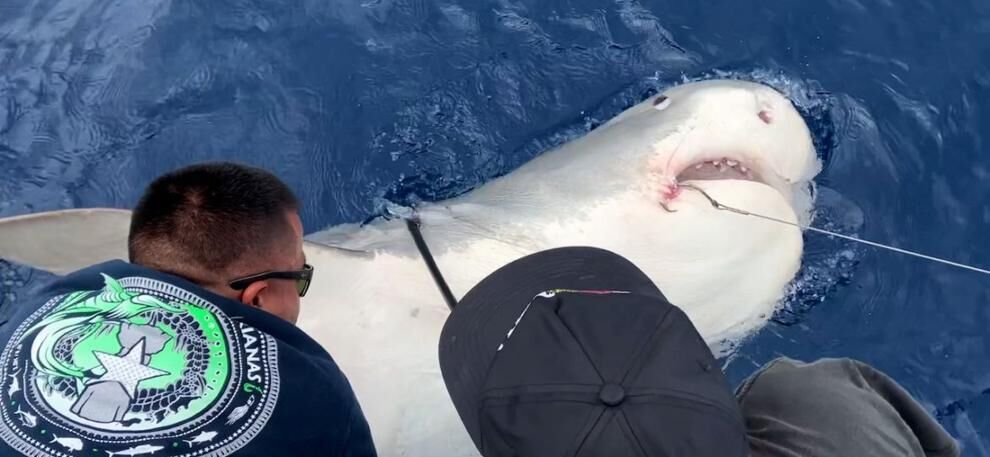
HAGÅTÑA (The Guam Daily Post) — With the growing problem of sharks snatching the catch off local fishermen’s lines, fishermen from Guam and Saipan recently had the chance to learn how to handle and tag sharks in Hawaii.
Tracking shark movements in the hopes of learning more about why they keep stealing from fishermen, a habit called depredation, was the goal of the visit to the Hawaii Institute of Marine Biology. The visit by the Marianas fishermen was the subject of an episode of “Voices of the Sea” this month, a production from the University of Hawaii Sea Grant College Program.
“There’s a certain sound that is emitted from outboard engines when you put it in neutral, and it’s this high-pitched scream. And all of my videos show that as soon as a boat gets put in the neutral, sharks come out from the deep from left and right. They just all just – boom – straight into that sound,” Jason Biggs, assistant chief of the Guam Department of Agriculture Division of Aquatic and Wildlife Resources, told “Voices of the Sea.”
“So I’m thinking, one, our fishing techniques are training the sharks … that high-pitch noise is very distinct and only comes during that time. Well, when do you put the boat into neutral? When you’re about ready to reel in the fish,” he said.
Shark encounters were reported by just over half the fishermen from the Marianas who participated in a survey for the Western Pacific Regional Fishery Management Council, according to a 2021 report. The issue of sharks snatching fish off the line is especially bad for trollers and bottom fishers who operate out in the open ocean. Fishers reported losing up to 60% of their catch to sharks.
According to Biggs, the outcome of the visit to Hawaii and future study of shark movements will hopefully be to reduce the number of interactions that fishermen have with sharks out on the water.
“We’ve had interactions with sharks as part of the ecosystem from the get-go. For as long as we can remember, we know that the sharks are training and learning from human behavior, and so we’re trying to figure out the cues and how to change human behavior to reduce those interactions again,” he said.
Guam’s DAWR office is looking to achieve a more harmonious coexistence with sharks, not cull them or eliminate their population.
The process of tagging sharks, which involves inserting a tracking device into their bodies, will require more training, Biggs said.
“I have got to say, everybody’s just like me when it comes to a 14-foot tiger shark. First thing you do is, whoa, I’m not ready for that. Can we have a smaller one, please?” he said.
More trainers will be coming to Guam for a training workshop to show folks how to get hands-on with sharks that are reeled in, according to a meeting of the Western Pacific Regional Fishery Management Council held late last month. Besides tiger sharks, smaller silky sharks and gray reef sharks will be the target of the program.
DAWR received a state wildlife grant to fund 60 receivers around the island to help track the sharks that are tagged.

Guam and Saipan fishermen learn about shark depredation as University of Hawaii scientists tag a shark in waters off Hawaii.
