






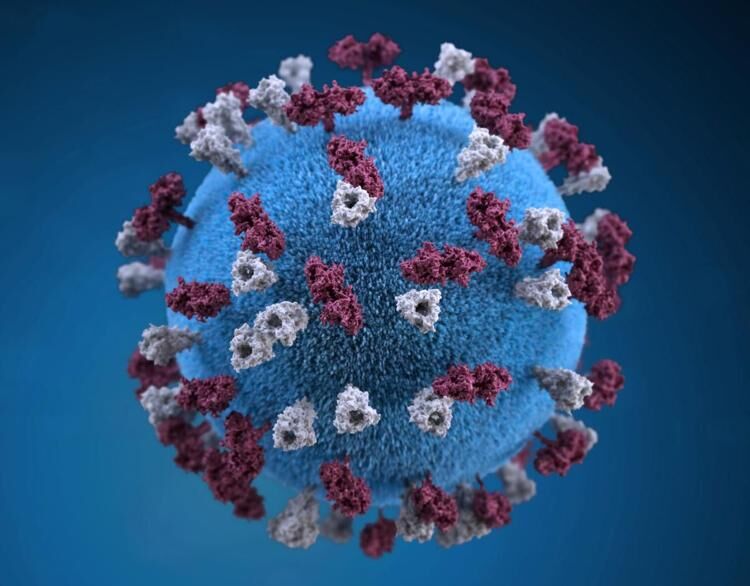

An illustration provides a 3D graphical representation of a spherical measles virus particle studded with glycoprotein tubercles in this handout image obtained April 9, 2019.
HAGÅTÑA (The Guam Daily Post) — Over the weekend, the Department of Public Health and Social Services held a child immunization outreach clinic, urging parents to take advantage of free vaccines for preventable diseases, especially since Guam health officials learned of positive cases of measles recently reported in Hawaii and American Samoa.
“Due to frequent travel of residents between Guam and the U.S. it is possible that the disease may be brought here. The DPHSS encourages individuals to review their shot record to ensure they are up to date on all routine vaccinations before traveling to any destination,” the department stated in a press release, which also advised local physicians to be on alert for possible cases.
A day before the outreach clinic was held at the Micronesia Mall, DPHSS announced that the Hawaii State Department of Health reported a second case of measles as of April 24, “an Oahu resident who was exposed to a previously confirmed case in an unvaccinated resident returning from international travel.” On April 27, Guam health officials learned of an unrelated development in American Samoa where 45 probable cases are under investigation.
“Prevention is always the key,” stated Dr. Robert Leon Guerrero, DPHSS chief medical officer. “Although measles is more common in babies and children, adults are also susceptible to an infection.”
The annual immunization clinic was held ahead of the summer travel season. Vaccination rates since 2020, with the emergence of COVID-19, have declined worldwide.
“Globally, immunization coverage rates have plummeted,” Annette Aguon, DPHSS acting chief public health officer, told The Guam Daily Post. “We have really lost the momentum. We slid back on our coverage rates, so we are just trying in our island, across (the) nation, throughout the region, and the world, to bring back these coverage rates to prevent the introduction of measles because that could spread quickly and it’s very dangerous and can lead to hospitalization and even death.”
The department cautioned parents to protect their children and themselves as measles is a preventable disease.
“Measles is a highly contagious viral disease. It is primarily spread by person-to-person contact via large respiratory droplets. Symptoms are characterized by a generalized rash lasting three days or longer, with fever, … and cough, or (runny nose), or (red eyes),” DPHSS stated in a release.
Aguon told the Post that the body needs time to respond to a vaccine, and getting up to date with immunizations now will offer protection for summer travel.
“The DPHSS recommends that persons traveling to any destination to areas where measles is spreading, ensure they are fully vaccinated for measles, given in combination with the mumps and rubella vaccines, at least two weeks before departing. If your trip is less than two weeks away and not vaccinated with MMR, one should still get a dose of MMR vaccine,” the release stated.
The MMR vaccine is recommended by the CDC for children, college students, adults and international travelers. However, there are instances where a person is unable to receive the vaccine, for example, because of an allergic reaction or existing medical condition.
“The doctor will determine is that something that should be considered a temporary medical contraindication or if it’s permanent. If it’s permanent you can’t force anyone. You just, for the rest of your life, not get that vaccine. That will be notated down. There’s a medical exemption given to schools, it should be noted in your medical record,” Aguon told the Post.
Follow-up appointments should be scheduled if vaccination is “contraindicated,” according to the department. If no contraindication is found, regulations are in place that require school-aged students to be immunized against certain diseases to participate in school activities like summer camps and summer school, with measles among them.
No cases of measles have been reported on island as of Monday, however, Public Health urged island doctors to review and update patient immunization records, be on alert for possible cases and report suspected cases promptly to the Immunization Program Bureau of Communicable Disease Control.
