





HAGÅTÑA (The Guam Daily Post) — The threat of lawsuits is a big possibility with public schools not opening for in-person instruction, according to Attorney General Douglas Moylan, who called together education officials to try to avoid the government of Guam being held liable or the federal government from stepping in.
“You guys know what happened with the (Ordot Dump). … The federal government came in … and said that the government of Guam … cannot run that landfill because it was a mess. And they literally took the whole function away from the Department of Public Works and … the government of Guam,” Moylan said. “U.S. (Department of Education) and the government of Guam are basically facing the exact same situation here.”
He said the public school system has already lost military students as a result of this failure.
The Department of Defense Education Activity “came in and took away the entire infrastructure and said, ‘You guys aren’t providing the education, therefore, the federal government is going to do it.’ They have that right under the Organic Act (and) the instrumentality of a territorial status,” Moylan said. “That’s a danger, by the way, and I am hearing that this is unprecedented in Guam’s history.”
Three alternatives
Members of the 37th Guam Legislature, Guam Education Board, Guam Department of Education, charter schools, private schools and even former educators came to the table Tuesday to brainstorm what can be done.
Three possible interim solutions were discussed: leasing spaces; school vouchers for public school students to attend private schools; and sending students to charter schools.
Early on in the discussion, the AG asked a representative from the island’s Catholic schools if leasing San Vicente Catholic School, which closed last year, would be an option. As it stands, the building is available, but it is up for sale.
Saint Paul Christian School noted this could possibly be an opportunity for public school students to experience a private school education, but the school would first need to see how many students it could accommodate.
Under this option, a public school student would be able to attend a private school through the use of a school voucher issued by the government to pay the tuition, according to Moylan.
“I would envision it’s like contracting the school to provide for the student, and they would be following their curriculum,” Moylan said.
An annual report published by GDOE covering the 2021-2022 school year showed a total of 26,619 students attended a public school during that time frame.
GEB Chairperson Mary Okada, who also is the president of Guam Community College, shared the possibility of GCC and the University of Guam working with George Washington High School to open its doors so students can start school in person on Aug. 9.
‘Big red flag’
But those in attendance didn’t support every idea, including possibly sending students to charter schools. As attorney Daniel Sommerfleck pointed out, GovGuam still could be held liable for failing to meet the law.
“The adequate education law to me is 101. … Why wouldn’t you have certified teachers? This is actually one of the issues I had with charter schools. They are public schools, but they don’t have to have certified teachers? That doesn’t make sense,” Sommerfleck said. “If they are public schools, why would you have one school that’s run by (GDOE) that has to have all certified teachers but another school that’s run by a charter school – also a public school – not being required to have certified teachers? This is sort of the downfall I see with the planning with that.”
While Moylan agreed, he said, “The problem is we are in triage now.”
Sommerfleck also stressed that one of the bigger issues is how GDOE would meet the requirements for children with special needs, which Moylan also said “would be the big red flag” for the feds to get involved.
“I think that we need to have heart-to-heart discussions … to understand (the) capacity that’s out there,” Moylan said. “Because we can’t provide everything. It’s clear. Even in this year, we can’t provide everything. There’s no certified teachers in some of these schools. The fact that they are accredited is a positive thing. … We are not where we need to be, but we are so far below where we need to be to start the school year.”
Moylan asked charter school and private school representatives if they could accommodate children with special needs. Both noted that they could, but with limited capacity. According to officials, it would be on a case-by-case basis.
Governor blames Barnett
While no plan moving forward was decided upon, the roundtable session was a good start, according to Sen. Chris Barnett, chair of the legislative committee on education.
“It was a productive discussion. It is humbling to see everyone come together to address this important issue,” he told The Guam Daily Post after the meeting.
Gov. Lou Leon Guerrero, who didn’t attend the roundtable, took to social media and stated: “Let’s be clear. Lt. Gov. (Josh Tenorio) and I support our students, but a ‘whole of government’ approach means we listen and heed warnings from both GDOE and Public Health professionals who stated this bill would close schools. Sen. Barnett ignored their warning.”
Barnett is the author of a bill, now P.L. 37-4, that moved up the date for GDOE and other educational institutions to comply with updated school sanitary regulations.
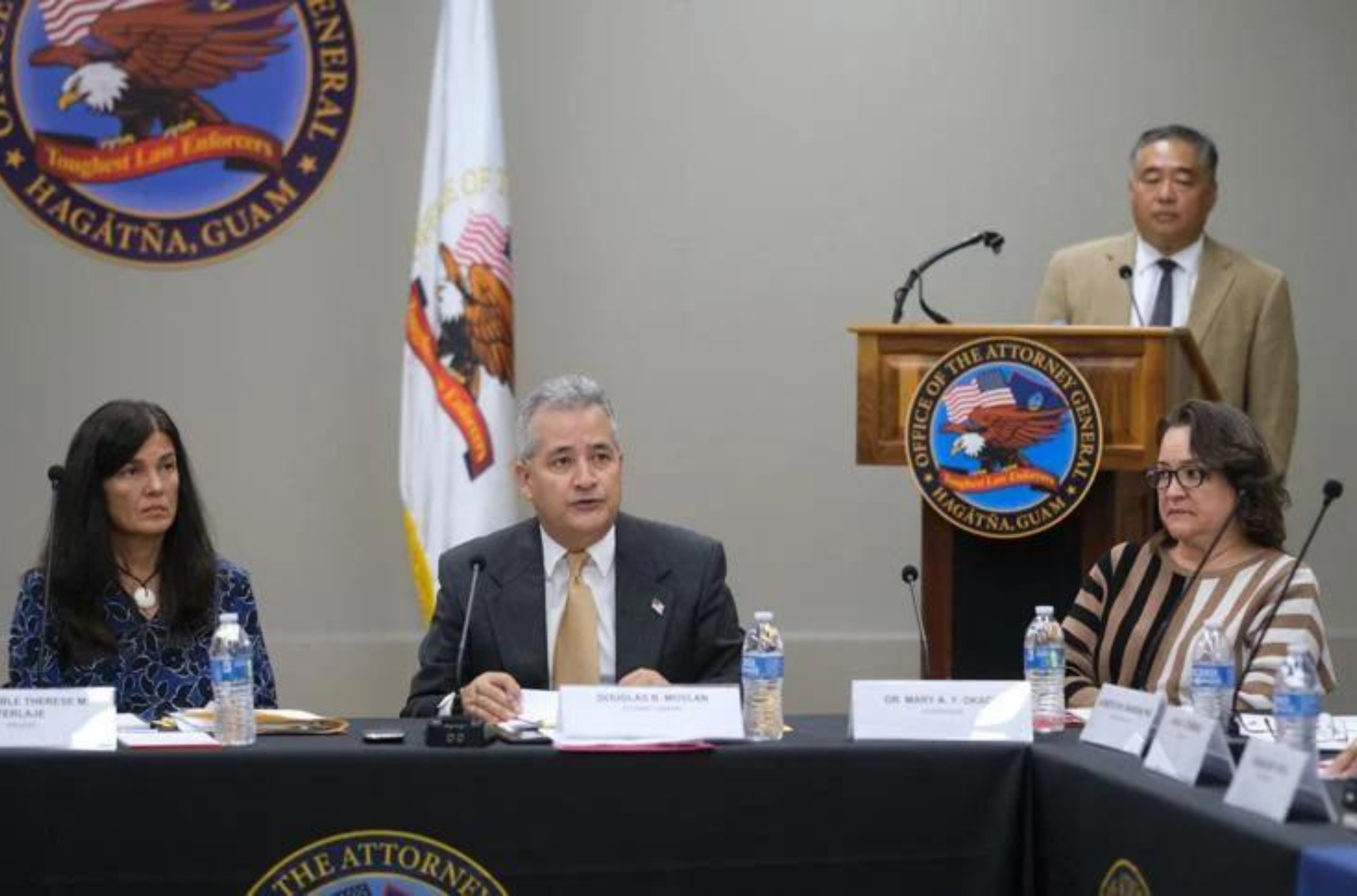
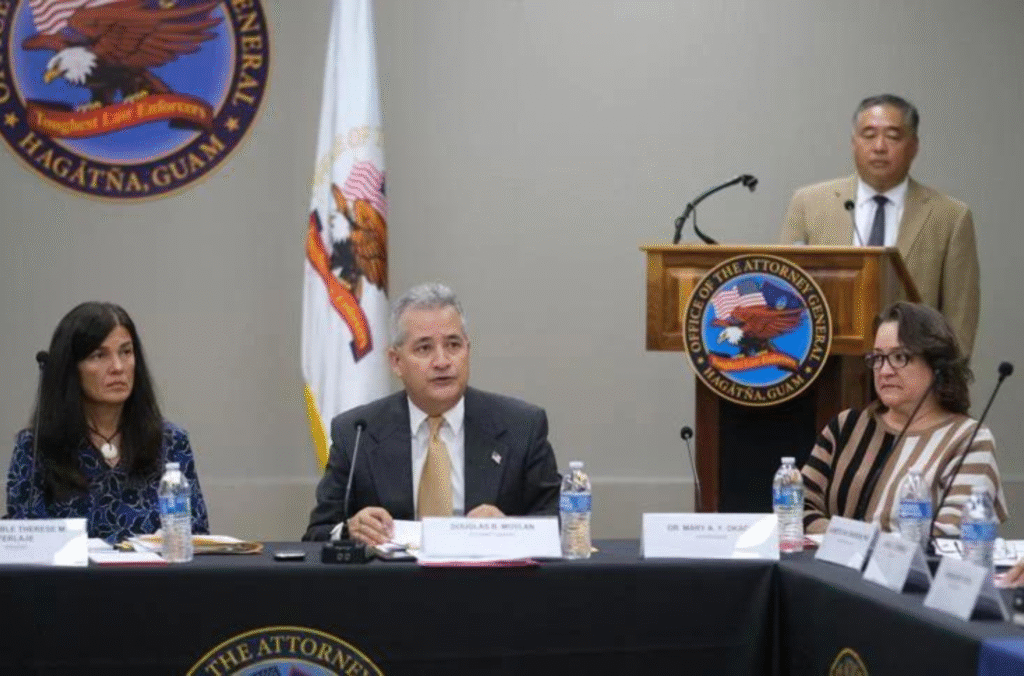
Attorney General Douglas Moylan, second from left, holds a roundtable discussion Tuesday, July 18, 2023, at the AG’s conference room at the ITC Building in Tamuning. From left are Speaker Therese Terlaje; AG Moylan; attorney Fred Nishihara; and Mary Okada, Guam Education Board chairperson and president of Guam Community College.
