






“THE Omicron surge is here,” said Dr. Lily Muldoon at the CNMI Covid-19 Protocol Forum on Friday at Kensington Hotel.
Although data suggests that the Omicron variant of Covid-19 is less severe than the Delta variant, it can still cause hospitalizations and deaths among those infected, the Commonwealth Healthcare Corporation medical director of public health added.
She emphasized that an out-of-control spread will overwhelm the CNMI’s healthcare system.
Although treatments, or an array of Covid-19 therapeutics, are available on-island to prevent severe disease, she noted that education and support for individuals to access these treatments in a timely manner are still needed.
Muldoon shard data pertaining to new Covid-19 cases and the seven-day rolling average of new cases from the beginning of the surge on Oct. 28, 2021 to Feb. 8, 2022.
For the past three months, the CNMI has seen spikes in new cases, with a record number of new cases reported earlier this month.
Data also places the CNMI among those with the highest caseloads in the nation, despite having a record number of fully vaccinated individuals in its eligible population.
However, this case load is expected to decline within the next few weeks.
Dr. Muldoon at the same time said the comparison of caseloads among U.S. jurisdictions is misleading because it does not really take into account the vast difference in the total eligible population of a small island territory, such as the CNMI, and that of a much more populated state.
While the rest of the nation is far past its first wave of the Omicron surge, the CNMI is just experiencing its first wave, with far fewer Covid-19 hospitalizations and deaths compared to other jurisdictions, she said.
“We have not peaked yet,” she said, adding that at this rate, Covid-19 is still a pandemic, not an endemic.
She explained that an endemic would be much like the flu, where a shot is needed annually to combat the mutating virus without having to shut down schools, businesses, and other establishments when positive cases are identified.
Presently, the CNMI is seeing positive cases for either the Omicron or the Delta variants, but the former has been predominant thus far.
Muldoon emphasized that the unvaccinated are at a far higher risk of contracting the virus and experiencing severe illness and hospitalization, in comparison to the vaccinated, including those who have received a booster dose of the Covid-19 vaccine.
She said if an individual is experiencing flu-like symptoms, it is likely Covid-19, and that individual should get tested as soon as possible.
Testing is available via home testing kits or community-based testing sites.
Covid-19 treatments, including Remdesivir, Evusheld, Molnupiravir, and Paxlovid, are available for those who test positive for Covid-19, may show an onset of symptoms within five days, and/or are at risk of progressing to severe disease, even if they have not been hospitalized.
Those who are considered high risk are individuals 65 years of age or older, are diabetic, have high blood disease, are obese, have heart disease, have chronic kidney disease, are immunocompromised, or are pregnant.
Individuals who meet any of these criteria are encouraged to seek treatment for Covid-19 at the Medical Care and Treatment Site, or MCATS, across from the CHCC emergency room, or at the Koblerville Covid-19 Community Center, or KC3, at the Koblerville Youth Center.
KC3 serves as a resource center for information and receives referrals for government isolation and/or treatment at the alternate care site at Kanoa Resort.
For more information, contact the CNMI Covid-19 Infoline at (670) 488-0211 or [email protected]
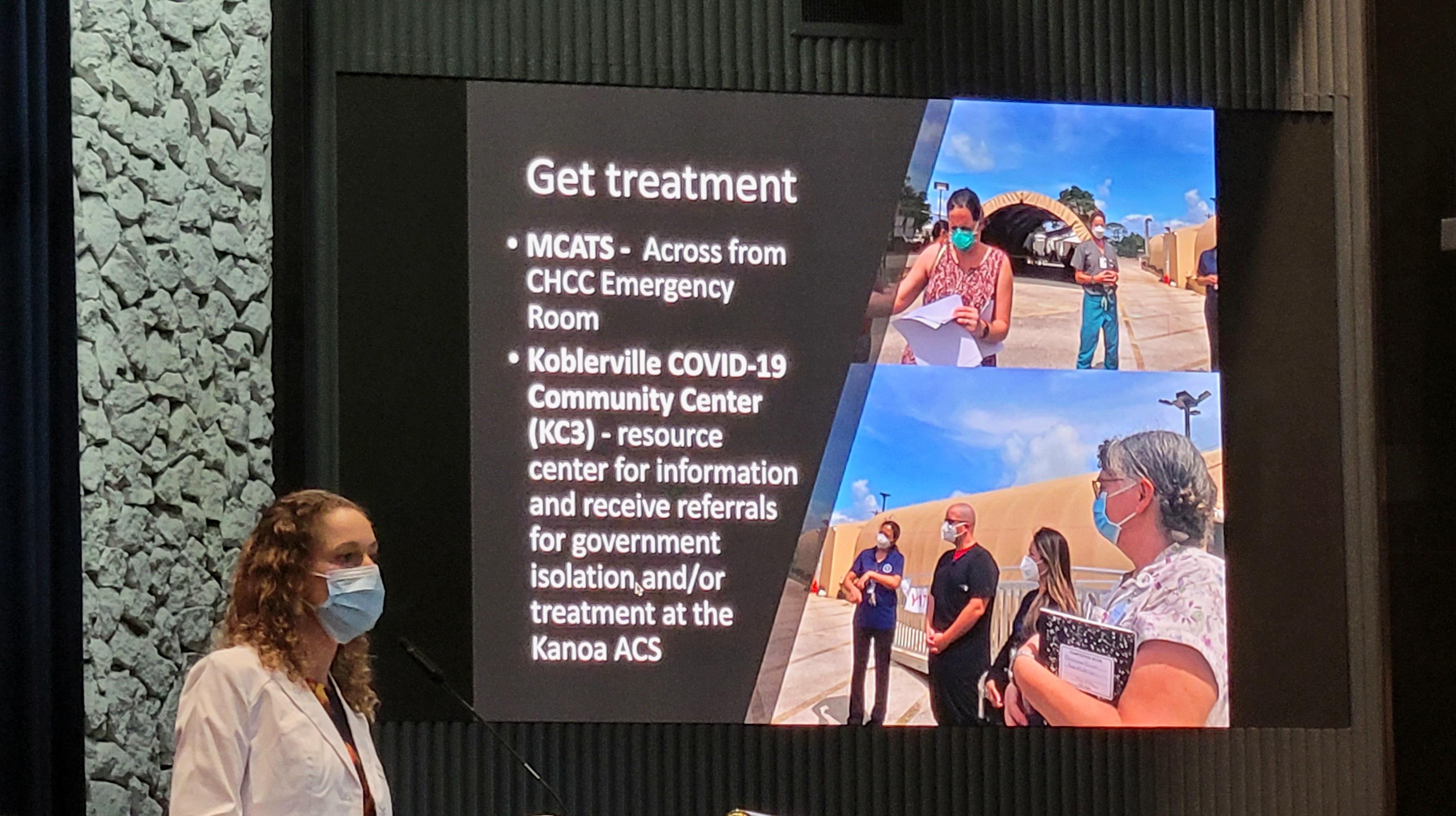
Dr. Lily Muldoon, Commonwealth Healthcare Corp. medical director of public health, speaks during the CNMI Covid-19 Protocol Forum on Friday at Kensington Hotel.
